
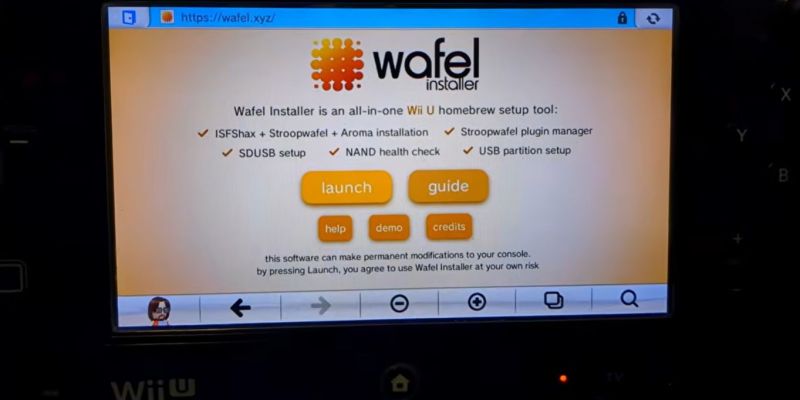
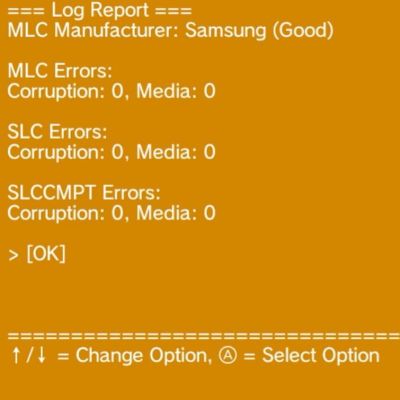
 Game consoles tend to have a weak spot or two that will take certain units out sooner than they would due to normal parts aging. In the case of the Wii U it’s the eMMC storage IC with the console’s firmware and any user data that likes to keel over, with the SK Hynix variant reportedly developing faulty cells much sooner than the Samsung and Toshiba chips. If you want to check the health of these eMMC ICs in your Wii U, you can do so easily now with the Wafel Installer project by [zer00p].
This doesn’t take much more than navigating to the wafel.xyz URL on the Wii U to launch the installer on any (unmodified) Wii U, or alternatively starting it from an SD card if you’re running a homebrew-enabled console. This can also install the Stroopwafel CFW, ISFSax and the Aroma homebrew environment, but the NAND testing option in the installer’s menu is what you want to select if you’re not into homebrew or have already cracked open the console for said sweet homebrew action.
All of this is covered in this video by [FunkyScott47], whose Wii U’s Samsung-branded eMMC is fortunately still all fine, but it shows off the variety of tests available. Unless the eMMC is already quite cooked this should take only a minute or two, so it’s pretty good for ease of mind.
With the heavily waffle, syrup and stroopwafel-coded naming scheme for these tools we can not be held responsible for a sudden case of the munchies, of course.











Fascinating and precisely why I dont buy Nintendo hardware. A Switch 2 will be a nice paperweight in 10 yeats
10 yeats? So if you don’t throw it 10 times, it’ll be fine? /s
Clearly this was Nintendo’s fault. If only they had gone with a reputable mainstream eMMC manufacturer like SK Hynix, instead of cheaping out and buying from a random company in South Korea called “SK Hynix”. /s
admittedly it is annoying that the switch 2 went back to directly soldered eMMC, when the original switch had an easily swappable storage daughterboard.
and you do have a point – there are options out there that are much easier to repair and that use easily-replaceable nvme drives for storage, like the steam deck and its imitators.
They already had gone back to onboard eMMC by the OLED revision of the original Switch, but yes, it makes repairs more annoying.
Wouldn’t that run foul of European regulation? They already pressured Nintendo to make future Switch 2 have removable battery for easier replacement. If MMC chip is prone to failing, it should have been made into easy to swap module.
It’s not like it was ever actually user-serviceable anyway, due to the security.
It was only made that way because they couldn’t fit the emmc on the mainboard.
I’ve never heard accusations that Nintendo hardware is less durable than the competition. I’ve had the same n64 for almost 30 years. Meanwhile I went through 3 xbox 360s in a 10 year period.
The bigger travesty are early Tesla Model S cars that become 2-ton bricks when their in-dash computer wears out the emmc with overly-aggressive writes to /var/log/
DS and 3DS carts sitting unused in storage are already decaying, the memory ICs they used for those is a kind of Flash that needs to be powered regularly to refresh its contents, unlike the mask ROMs used in older generations. Good thing those systems have been well preserved.
And there was the joycon drift issue too… They just don’t make the hardware like they used to, I guess.
You think this is a Nintendo-specific issue?
At least there’s a fix for it..
It *might* be an interesting topic but AI-generated video thumbnail made my mind vomit in disgust so I skipped it.
Just yesterday I was playing with the idea of an FPGA-enabled urinal and it looks almost exactly the same: https://imgbank.cz/image/9y5b
OK you people complaining about this in such overdramatic fashion are vastly more annoying than the ai image itself.
No, YOU are the problem (you specifically).