
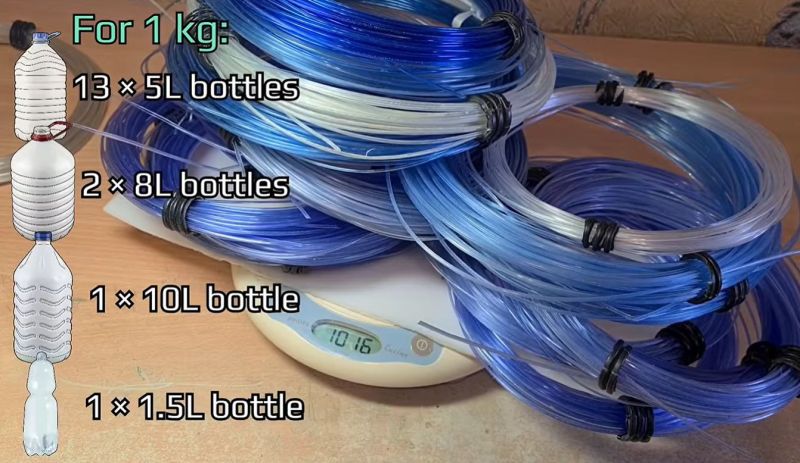
In countries where PET bottles do not get slapped with an additional fee that induces you to return it for recycling and said fee back, the resulting piles of discarded bottles have led many enterprising individuals to consider using them to make their own PETG filament. One big question of course is just how much work it is to create even a single 1 kg spool of PETG, which is a question that [PETCraft] was only too happy to answer in a recent video.
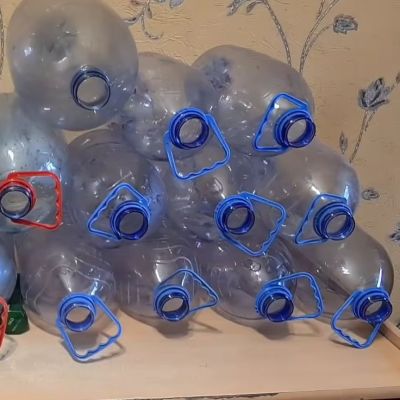
With the channel owner clearly living in a country without a bottle deposit, it’s very easy to see PET bottles strewn about as trash, including multi-liter water bottles. As a very recycling-focused channel, this provides an excellent opportunity to show how they go about recycling these into filament.
The detailed process is covered in previous videos in the channel, but essentially they are first heat-smoothed to make them much easier to cut into thin strips. This is done with a very DIY cutter – also constructed from mostly salvaged and other common parts – before the strips are passed through the heated extruder nozzle of the DIY filament extruder before being wound onto spools.
Ultimately it took thirteen 5 liter bottles, a 10 L, two 8 L and a single 1.5 L bottle to hit the 1 kg target, which is quite an impressive amount of work. The next challenge will be to actually print with it, which will – naturally – be done with a DIY 3D printer made from salvaged parts and an Arduino board.
The good news about recycling bottles like this into filament is that basically all PET bottles will actually be PETG anyway, as the glycol adds the flexibility that’s essential in water bottles so that they do not shatter or rip easily. The real question you have to ask yourself is whether cleaning, cutting and spooling dozens of bottles is worth saving perhaps 10-20 bucks on a commercial spool of 1 kg PETG filament.












How many PET bottle are required to make 1kg of PETG filament? Zero. This is not the same material.
Even if close… The PETG filament has a stable composition, while your PET bottles have just enough cyclohexanedimethanol to make them strong enough to support the one use they are intended to survive. There are so many different bottle’s thickness, transparency, color, … that mixing it in a single spool linearly is the best way for print issues with different behaving part on when oozed.
Indeed you’d want to add an extra step of pelleting the filaments made of random PET things to then extrude a well mixed filament if you really really need that consistency. But ultimately I rather doubt it will be a real problem, you but the good reel for those projects that absolutely must look perfect and use your recycled accepting the minor ooze, layer adhesion, bubbles etc it may develop as it doesn’t matter.
One 1.5L bottle makes 1KG filament?
Sure if your Western time doesn’t worth anything.
Surely this is a more profitable product to sell than to recycle the bottle into plastic pellets?