
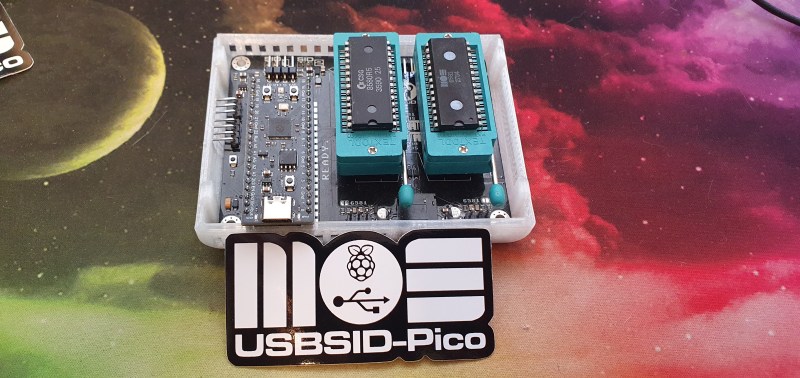
We’ll give you three guesses what the most important bits of silicon in [LouD]’s USBSID-Pico are, and two don’t count. Yes, there’s a Raspberry Pi Pico, and a pair of the unforgettable SID chips from MOS– the sound chip of the C64, the die that launched a thousand chiptunes. Well, unless you build it with a hardware SID replacement, but the goal of this device is to get SIDs hooked up to modern hardware.
To that end, USBSID-Pico can be controlled via USB– obviously– in the form of CDC/WebUSB/WebSerial but also MIDI, and even ASID, which is a specific protocol for streaming SID register data over MIDI. You might be wondering the point, since surely you can get cycle-accurate SID emulation on an RP2040, right? Well, not everyone agrees that cycle-accurate emulation is accurate enough; like the people who swear by the subtle distortions tube amplifiers introduce into the sound, some say the chip’s own inaccuracies give the sound out of the physical device a unique vibe emulators don’t match. That’s a fight for others to litigate; we just appreciate the work that went into getting these old sound chips talking to modern hardware, and getting the project certified as Open Source Hardware.
This combination of old sound and new microcontroller makes the USBSID-Pico a good entry for our ongoing retrocomputing contest, particularly the retro-modern category. Just be aware of PAL and NTSC differences with these old chips, or your beeps and boops might be out of tune. They haven’t made them in decades, but there are more than a few modern replacements for the MOS 6581.












Nonlinearities in the chips, and digital aliasing, are reasons why the authentic chip is preferred to emulation. An IC synth will have sound qualities that emulation lacks or has poorly implemented. I write my own 2A03 emulators and the real thing truely is night and day
Couldn’t you emulate capacitors and incudances in software? Matlab can do it. If recompiled to use CUDA you could probably run it on a GPU.
This is the large mathy barrier I now face. I was hoping there would he simple transfer functions I could utilize but alas it is more complex to model a capacitor than to make a naive square wave oscillator.
They were bad at reproduceability though, and therefore there was no authentic SID sound. They all sounded different, not only comparing different revisions, but chips within the same batch.
Does anybody know about a good website/video that demonstrates these differences in the way they actually sound (or are supposed to sound). Not the difference between the 6581 or the newer 8580, but the differences between various 6581s. I ask this because I have no idea regarding the “scale” of those differences and how noticeable this could be in certain compositions.
The shitty little speakers it was shoved into and the sound in your imagination in 1984 vs 2026.
Most chiptune music is enjoyed via headphones. Believe it or not SIDs are not so useful in the video game scene as much as they are coveted by independent musical artists. And then you have your uber influencers like Richard Devine who own like every synth ever.
I wonder if someone tried to build a hybrid SID implementation. do all the digital stuff digitally, and implement the analog filters and modulators and whatnot, in discrete analog hardware… The information seems to be mostly available: https://github.com/libsidplayfp/SID_schematics
I wonder if there’s a similar project but for Yamaha FM chips that could be driven by webUSB too (and make it easier to listen to glorious VGM files from the comfort of a web browser)
Actually, if you use a sidkick-pico you can use 1 sid and fmopl, also support by my firmware over midi or sid tunes.
Till true 1:1 emulation is achieved, or someone restarts manufacture of the actual SIDs, I find it difficult to be happy about modern SID-based hardware – it’s preying on a dwindling supply of failing chips to the point people are cannibalising whole C64 computers just for the SID.
Thanks for the post Tyler, appreciate it!
I’ll bite: SID chip feeding a vacuum-tube amp, anybody? :-)
Well I am working on a modular Pro version ;-)