
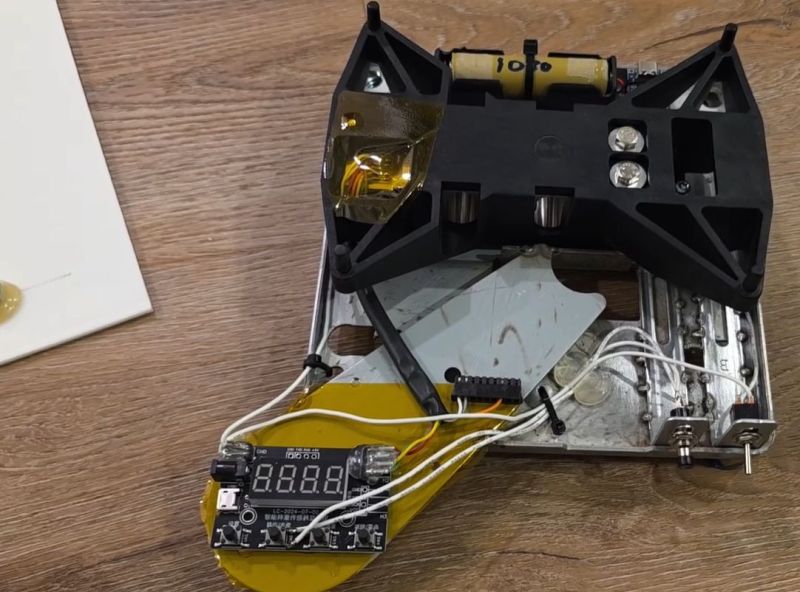
Kitchen scales are plentiful and cheap, but their accuracy and measuring speed often leave a lot to be desired. In particular the filtering out of noise can make small changes a nightmare because adding a little bit of weight slowly can result in the result never updating. This frustrated [Mark Furneaux] enough that he dug up the load cell and metal base of a scrapped laboratory scale and added a strain gauge amplifier to build a better kitchen scale around it.
The only purpose-bought part was an HX710-based strain gauge amplifier module for $7 with LED display, with the metal base getting some metal bits welded onto it to hold said module as well as a push button and toggle switch. Existing wiring from the load cell was wired into the HX710 module, with power provided from a single 18650 Li-ion cell. This was paired with the standard TP4056-based module and its protection IC.
Ultimately the entire assembly looks very much bodged together, with plentiful zip ties, hot glue and messy welding, but it’s hard to deny that it seems to work well. A plastic cutting board makes for a good surface for the items being weighed, and measured drift across the range was about 200 mg, while the amplifier module updates the output in real-time so that you can see even the smallest changes and noise.
Even if you’re not lucky enough to have such a nice load cell and base kicking around, strain gauges are everywhere, and you can absolutely hack an existing (kitchen) scale to be better with some custom hard- and software.











Yes, some scales (namely the Oxo, which is highly recommended by Wirecutter et al despite being very clearly defective) don’t update if you slowly add materials. Some of the chinese scales also like to fake measurements around typical calibration weights. Ie if you’re trying to get 500g, and add 498g of material, it’ll jump to 500g to look like it has a perfect calibration. It’s pretty stupid. Others will ‘auto zero’ at very low weights.
There are plenty that don’t have these issues. This one is accurate to 0.1g, comes with a wall wart, has a pretty decent weight limit for the precision/accuracy, and does not auto-shut-off. I think it also does counting and such. Its only real issue is that it’s a bit small: https://www.amazon.com/dp/B002SVNEWA
The Jennings scales are also very good, but some of them have some annoying features like beeping on every keypress. I had one that lasted me something like 6-7 years.
If you’re DIY’ing a scale don’t forget to include temperature compensation and periodically check the calibration.
I have a home-built scale under the coffee machine so I can weigh the water and coffee in-place. It’s got a 5 kg strain gauge and 1 g display resolution.
For filtering I use a 5-tap median filter which is a good compromise between display stability and update latency.
Another filter that works is accumulating sum_of_delta += (measured_value – displayed_value) and updating displayed_value += sum_of_delta / count_of_delta when the sum exceeds some threshold. This causes fast reaction to large changes but ensures that even small shifts in the average value eventually get through.
There are proper kitchen scales that will measure with 0.1 gr resolution and will update the screen value even if you add just a tiny amount.
I even found a kitchen scale where you can change the update rate and the averaging of values. So much easier to use than a cheapo chinese scale.
0.1 grain (gr) = 6.47989 milligram (mg)
I have several junk kitchen scales and the plan was always to do the opposite: make something useful out of them. One thing I had in mind was to build a system to weigh the content of a propane tank to determine how much fuel was left. But it’s a 500 gallon tank and those kitchen scales don’t really seem up to it.
I bought a cheapo kitchen scale for the express purpose of brain-transplanting it with esphome and an HX711.
The intent is to monitor the weight of the CO2 tank feeding my Drinkmate soda machine. (I’m using a bulk-tank adapter)
It sounds like the problem with a lot of these kitchen scales is not the actual strain gauges or load cells but the electronics, so brain transplanting fixes the issue.
When the display doesn’t update after adding a small amount, tap the container or the weighing platform sharply enough to jump the reading. Usually that results in the reading settling down to the correct weight — or at least to something closer to the correct weight.
Wow. I had no idea these scales were doing that sort of data fudging. Thank you for the tip on fixing it!
The main beef I have with kitchen scales is the idiotic auto-off after 30 seconds or less. If I meet the person that came up with that low sleep timer value I might become violent. Too many times I have started to measure something, look over at the recipe for the quantity needed or opened a new packet of the ingredient to find the scale already turned off.
I accept that it is for saving battery power, but then don’t add a clock on the scales that displays the time 24/7.
It is really frustrating that the scale manufacturers never declare the duration of the auto-off timer.
This is one of the household items that brakes for me. Either don’t update on small changes, gives fake readings or just dismantle by themselves. I will definitely look into that project.