
Homebrew Sonar

echolocation

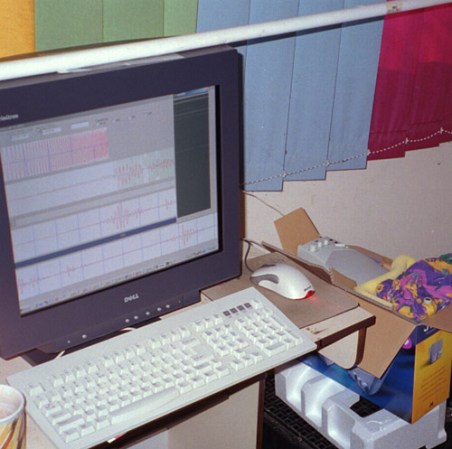
Eddie has an interesting writeup about his experience playing around with echo location. He uses a cheap computer speaker and microphone for all of the measurements. The program he wrote generates a sweeping chirp from 5-20kHz in the space of 4.5 milliseconds. Eddie knows what a perfect echo would look like so he can compare the measured values to the theoretical to determine the distance. For his final test he moved the box while it took 150 measurements. This data generated a parabola showing where the object was in the room. Have a look at his site for more details and his code if you are interested.

Continue reading “Homebrew Sonar”

Using Radiosondes As Cheap GPS Trackers

radiosonde

A Radiosonde is an inexpensive sensor package that’s intended to be used with a weather balloon for atmospheric measurements. The device transmits data in the 403 MHz band after being launched and they usually aren’t recovered after use. You can pick them up for very little money on eBay so [Nick] thought they might work well as a low cost GPS tracker. Unfortunately the Radiosonde doesn’t transmit standard NMEA GPS data, but GPS doppler measurements. It’s hard to determine what those are actually useful for. Nick did find one other paper documenting an unsuccessful attempt which he has posted to his site. So now Nick is looking for some help either making the data more useful or coming up with a functional device that’s just as inexpensive. Anyone got any leads?

Continue reading “Using Radiosondes As Cheap GPS Trackers”

Fun FON Hacking

With FON now selling their “social routers” for $5 a piece it seems like a good time to mention Hack-A-Day reader [Steve Anderson]’s previous FON hacking experience. By purchasing one of FON’s subsidized routers you agree to participate in their network for at least one year. Steve had a look at the patched OpenWRT firmware FON uses and found the heartbeat system they use to monitor compliance. He then swapped out the firmware and spoofed the heartbeat with a cron job. This hack is an ethical trade off: remove FON’s firmware and violate their terms of service or keep FON’s firmware which probably violates your ISP’s TOS. In related WRT54G news: you can now flash Linux onto v5 and v6 routers without hardware modification. So if you’re at all worried, just buy one for the regular price off the shelf.

[thanks bird603568 and fucter]

Continue reading “Fun FON Hacking”

Binary Clock

binary clock

Hans Summers has an amazing collection of projects. His most popular project is the binary clock. It runs off of mains, uses a bunch of TTL logic chips and a binary counter. He has posted links to the many projects that have been derived from his original post. Warning: project uses LEDs. If the binary clock isn’t your thing he has lots of other clocks, radio, frequency counters, computer and other projects.

[thanks Alan Parekh]

Continue reading “Binary Clock”

Beerquad Wifi Antenna

beerquad

[Coreyfro] recently sent me a thank you note for the biquad wifi antenna article I did for Engadget last fall. He directed me to his monster Beerquad antenna he built based on it. While searching for materials to build his antenna he discovered that flattened Guinness cans are the perfect size for regular antennas and that 25oz Labatt cans make for great double wide versions. He says the reception is great . I’m sure he’ll raise some OpSec eyebrows once he gets the laptop mount done. Most biquad wifi projects on the web are based on Trevor Marshall’s antenna.

Continue reading “Beerquad Wifi Antenna”

LED Marquee

led marque

[Ben Kokes] put together this guide for building an LED marquee. The design uses two 555 timers plus a bunch of shift registers. The first 555 handles the rate at which the LEDs turn on/off. The second controls how fast the sequence advances. The shift registers cascade through each row of LEDs. Here’s a CoralCDN of the video. The project is pretty simple, but hey, you’ve got to start somewhere. It does fit well with our “LEDs whee!” attitude.

Continue reading “LED Marquee”

Line Following Roomba

line following roomba

[Ben Miller] came up with a really simple way to turn a Roomba into a line following robot. The Roomba already has four “cliff sensors” built into it. Ben just added a potentiometer to the two outside sensors and then tuned the pots so that the Roomba could detect black tape on the ground. It isn’t your standard line follower, but if you draw a path using two strips of tape the Roomba will gladly stay inside. Here’s a CoralCDN link to the video.

Continue reading “Line Following Roomba”









