This Week In Security: PunkBuster, NAT, NAS And MP3s

Ah, the ever-present PDF, and our love-hate relationship with the format. We’ve lost count of how many vulnerabilities have been fixed in PDF software, but it’s been a bunch over the years. This week, we’re reminded that Adobe isn’t the only player in PDF-land, as Foxit released a round of updates, and there were a couple serious problems fixed. Among the vulnerabilities, a handful could lead to RCE, so if you use or support Foxit users, be sure to go get them updated.

PunkBuster

Remember PunkBuster? It’s one of the original anti-cheat solutions, from way back in 2000. The now-classic Return to Castle Wolfenstein was the first game to support PunkBuster to prevent cheating. It’s not the latest or greatest, but PunkBuster is still running on a bunch of game servers even today. [Daniel Prizmant] and [Mauricio Sandt] decided to do a deep dive project on PunkBuster, and happened to find an arbitrary file-write vulnerability, that could easily compromise a PB enabled server.

One of the functions of PunkBuster is a remote screenshot capture. If a server admin thinks a player is behaving strangely, a screenshot request is sent. I assume this targets so-called wallhack cheats — making textures transparent, so the player can see through walls. The problem is that the server logic that handles the incoming image has a loophole. If the filename ends in .png as expected, some traversal attack checks are done, and the png file is saved to the server. However, if the incoming file isn’t a png, no transversal detection is done, and the file is naively written to disk. This weakness, combined with the stateless nature of screenshot requests, means that any connected client can write any file to any location on the server at any time. To their credit, even Balance, the creators of PunkBuster, quickly acknowledged the issue, and have released an update to fix it.

Continue reading “This Week In Security: PunkBuster, NAT, NAS And MP3s”

This Week In Security: UTorrent Vulnerable, Crowd-Sourcing Your Fail2Ban, And Cryptographers At Casinos

The uTorrent client was recently updated to fix a null pointer dereference (CVE-2020-8437), discovered by [whtaguy]. Triggering the dereference simply crashes the client — so far an actual RCE hasn’t been found. Given the nature of the null pointer dereference, it’s possible this bug is limited to denial of service. That’s extremely good, because the flaw is extremely easy to target.

BitTorrent is a clever protocol. It’s still used to distribute large files, like Linux ISOs. The concept is simple: Split a large file into small chunks. Send the chunks to a client one at a time. As each chunk is received, the client sends a copy of that chunk to the next client. As a result of this peer-to-peer (p2p) arrangement, the bandwidth available to the server is greatly multiplied. As with all other p2p arrangements, the sticking point is how to make those connections between peers, particularly when most of the world’s desktops are behind NAT routers. In practice, for two peers to share data, at least one of them has to have a port opened or forwarded to the client. This is often accomplished through Universal Plug-n-Play (UPnP) or the NAT Port Mapping Protocol (NAT-PMP). The idea of both protocols are the same; a client on an internal device can request a temporary port forward without manual intervention. Whether it’s a good idea to allow automatic port forwards is another issue for another day. Continue reading “This Week In Security: UTorrent Vulnerable, Crowd-Sourcing Your Fail2Ban, And Cryptographers At Casinos”

This Week In Security: AD Has Fallen, Two Factor Flaws, And Hacking Politicians

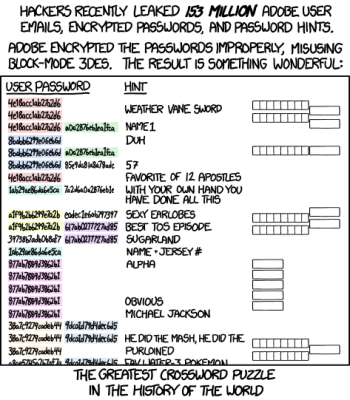
The big news this week is the huge flaw in Microsoft’s Active Directory, CVE-2020-1472 (whitepaper). Netlogon is a part of the Windows domain scheme, and is used to authenticate users without actually sending passwords over the network. Modern versions of Windows use AES-CFB8 as the cryptographic engine that powers Netlogon authentication. This peculiar mode of AES takes an initialization vector (IV) along with the key and plaintext. The weakness here is that the Microsoft implementation sets the IV to all zeros.

XKCD.com CC BY-NC 2.5

It’s worth taking a moment to cover why IVs exist, and why they are important. The basic AES encryption process has two inputs: a 128 bit (16 byte) plaintext, and a 128, 192, or 256 bit key. The same plaintext and key will result in the same ciphertext output every time. Encrypting more that 128 bits of data with this naive approach will quickly reveal a problem — It’s possible to find patterns in the output. Even worse, a clever examination of the patterns could build a decoding book. Those 16 byte patterns that occur most often would be guessed first. It would be like a giant crossword puzzle, trying to fill in the gaps.

This problem predates AES by many years, and thankfully a good solution has been around for a long time, too. Cipher Block Chaining (CBC) takes the ciphertext output of each block and mixes it (XOR) with the plaintext input of the next block before encrypting. This technique ensures the output blocks don’t correlate even when the plaintext is the same. The downside is that if one block is lost, the entire rest of the data cannot be decrypted Update: [dondarioyucatade] pointed out in the comments that it’s just the next block that is lost, not the entire stream. You may ask, what is mixed with the plaintext for the first block? There is no previous block to pull from, so what data is used to initialize the process? Yes, the name gives it away. This is an initialization vector: data used to build the initial state of a crypto scheme. Generally speaking, an IV is not secret, but it should be randomized. In the case of CBC, a non-random IV value like all zeros doesn’t entirely break the encryption scheme, but could lead to weaknesses. Continue reading “This Week In Security: AD Has Fallen, Two Factor Flaws, And Hacking Politicians”

Security This Week: Racoons In My TLS, Bypassing Frontends, And Obscurity

Raccoon is the next flashy security flaw with a name, cute logo, and a website (and a PDF). Raccoon is a flaw in TLS version prior to 1.3, and seems to be a clever bit of work, albeit one with limited real-world application. The central problem is that these older versions of TLS, when using Diffie Hellman (DH), drop leading all-zero bytes in the resulting pre-master key. As that key is part of the input for calculating the master session key, a shortened pre-master key results in a slightly faster calculation of the master key. If an attacker can make fine-grained timing measurements, he can determine when the pre-master key is trimmed.

Let’s review Diffie Hellman, briefly. The client and server agree on two numeric values, a base g and modulus p, and each party generates a secret key, a and b. Each party calculates a public key by raising the shared base to their own private key, mod the shared modulus: A = g^a mod p. These public keys are exchanged, and each party raises the received key to their own secret key: A^b. Exponents have a non-obvious quirk, the power rule. A value raised to a power raised to a power is the same as the value raised to the power of the exponents multiplied together. g^a^b is equal to g^(a*b). By going through this mathematical dance, the server and client have arrived at a shared value that only they know, while preserving the secrecy of their private keys. Continue reading “Security This Week: Racoons In My TLS, Bypassing Frontends, And Obscurity”

This Week In Security: Zero Days, Notarized Malware, Jedi Mind Tricks, And More

Honeypots are an entertaining way to learn about new attacks. A simulated vulnerable system is exposed to the internet, inviting anyone to try to break into it. Rather than actually compromising a deployed device, and attacker just gives away information about how they would attack the real thing. A honeypot run by 360Netlab found something interesting back in April: an RCE attack against QNAP NAS devices. The vulnerability is found in the logout endpoint, which takes external values without properly sanitizing them. These values are used as part of an snprintf statement, and then executed with a system() call. Because there isn’t any sanitization, special characters like semicolons can be injected into the final command to be run, resulting in a trivial RCE.

QNAP has released new firmware that fixes the issue by replacing the system() call with execv(). This change means that the shell isn’t part of the execution process, and the command injection loses its bite. Version 4.3.3 was the first firmware release to contain this fix, so if you run a QNAP device, be sure to go check the firmware version. While this vulnerability was being used in the wild, there doesn’t seem to have been a widespread campaign exploiting it.

Continue reading “This Week In Security: Zero Days, Notarized Malware, Jedi Mind Tricks, And More”

This Week In Security: XCode Infections, Freepik, And Crypto Fails

There is a scenario that keep security gurus up at night: Malware that can detect software compilation and insert itself into the resulting binary. A new Mac malware, XCSSET (PDF), does just that, running whenever Xcode is used to build an application. Not only is there the danger of compiled apps being malicious, the malware also collects data from the developer’s machine. It seems that the malware spreads through infected Xcode projects.

WordPress Plugins

WordPress has a complicated security track record. The core project has had very few serious vulnerabilities over the years. On the other hand, WordPress sites are routinely compromised. How? Generally through vulnerable plugins. Case in point? Advanced Access Manager. It’s a third party WordPress plugin with an estimate 100,000 installations. The problem is that this plugin requires user levels, a deprecated and removed WordPress feature. The missing feature had some unexpected results, like allowing any user to request administrator privileges.

The issue has been fixed in 6.6.2 of the plugin, so if you happen to run the Advanced Access Manager plugin, make sure to get it updated. Beyond that, maybe it’s time to do an audit on your WordPress site. Uninstall unused plugins, and make sure the rest are up to date, along with the WordPress installation itself. Continue reading “This Week In Security: XCode Infections, Freepik, And Crypto Fails”

This Week In Security: Bluetooth Hacking, NEC Phones, And Malicious Tor Nodes

One of the fun things about vulnerability research is that there are so many places for bugs to hide. Modern devices have multiple processors, bits of radio hardware, and millions of lines of code. When [Veronica Kovah] of Dark Mentor LLC decided to start vulnerability research on the Bluetooth Low Energy protocol, she opted to target the link layer itself, rather than the code stack running as part of the main OS. What’s interesting is that the link layer has to process data before any authentication is performed, so if a vulnerability is found here, it’s guaranteed to be pre-authentication. Also of interest, many different devices are likely to share the same BLE chipset, meaning these vulnerabilities will show up on many different devices. [Veronica] shares some great info on how to get started, as well as the details on the vulnerabilities she found, in the PDF whitepaper. (Just a quick note, this link isn’t to the raw PDF, but pulls up a GitHub PDF viewer.) There is also a video presentation of the findings, if that’s more your speed.

The first vuln we’ll look at is CVE-2019-15948, which affects a handful of Texas Instruments BT/BLE chips. The problem is in how BLE advertisement packets are handled. An advertisement packet should always contain a data length of at least six bytes, which is reserved for the sending device address. Part of the packet parsing process is to subtract six from the packet length and do a memcpy using that value as the length. A malicious packet can have a length of less than six, and the result is that the copy length integer underflows, becoming a large value, and overwriting the current stack. To actually turn this into an exploit, a pair of data packets are sent repeatedly, to put malicious code in the place where program execution will jump to.

The second vulnerability of note, CVE-2020-15531 targets a Silicon Labs BLE chip, and uses malformed extended advertisement packets to trigger a buffer overflow. Specifically, the sent message is longer than the specification says it should be. Rather than drop this malformed message, the chip’s firmware processes it, which triggers a buffer overflow. Going a step further, this chip has non-volatile firmware, and it’s possible to modify that firmware permanently. [Veronica] points out that even embedded chips like these should have some sort of secure boot implementation, to prevent these sort of persistent attacks.
Continue reading “This Week In Security: Bluetooth Hacking, NEC Phones, And Malicious Tor Nodes”