Recharging AC With Propane

[youtube=http://www.youtube.com/watch?v=v2vN_mxW4Bc]

As the summer heats up an air conditioning system is a necessity in many climates. [Grayson’s] system suffered some damage over the winter that caused it to vent its refrigerant, avoiding an explosive situation. Before he can chill out inside he’ll need to recharge it and he’s chosen to use propane in his cooling system. According to our friend Google this is not his original idea, but has been done many times before. [Grayson] makes the point that although propane is flammable it’s not necessarily any more dangerous in a fire than Chlorodiflouromethane, or R22, which is the nasty little gas that fled his system for its new home in the upper atmosphere.

The video above includes a brief explanation of recharging the system and the tools needed. We’d need to mill this over for quite a while before working up the gumption to give it a try. For now we’ll stick to [Grayson’s] more pedestrian hacks like making some servo motors sing or easing our yard work woes.
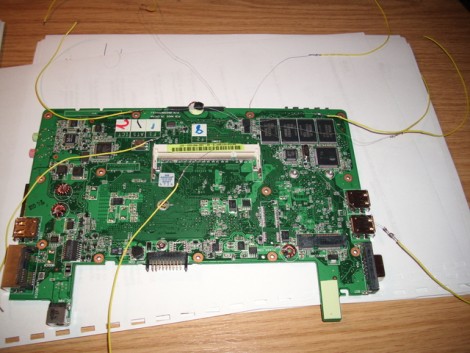
Unbricking With The Help Of Arduino

A

This bricked Eee PC came to [Janzo] for about $50. Everything was fine with it, except for the failed bios update that rendered it useless to the last owner. [Janzo] set to work with an Arduino on a quest to repair the bios. He looked up the datasheet for the EEPROM that stores the bios and did some delicate soldering to gain access to the power and data pins on the device. A bit of trial and error and he was able to read the registers. Some comparisons between the output file and the official Eee PC bios file in a HEX editor confirmed that the first 80 bytes were fine but after that something went wrong. After coding a quick Python script [Janzo] reflashed the chip and had the computer up and running again.

We’ve seen Eee PC bios recovery before. This is a very simple method because it makes use of the simplicity we find in the Arduino. Nice job.

Update: Flash_Destroyer Final Destroys EEPROM

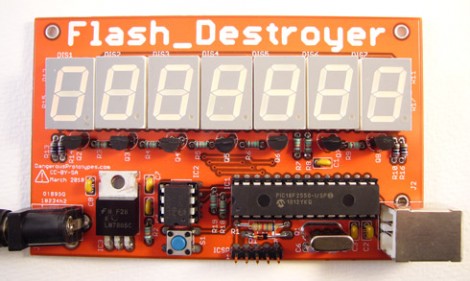
The Flash_Destroyer finally succeeded in rewriting that EEPROM until its demise. When we originally looked at the device it had already recorded 2.5 million successful rewrites. The first appearance of corrupt data occurred at 11,494,069 but that doesn’t tell the whole story. The chip kept working for another 200,000 rewrites before finally showing repeated data corruption.

We do find the writeup pretty interesting. There’s one thing that we can’t stop coming back to though. In the discussion of our original article [Tiago] pointed out that long-term data retention isn’t being tested here. If the abuse of that EEPROM had ended after say five million rewrites, would it have been able to hold the data long-term without corruption? Let us know what you think in the comments.

[Thanks Drone377]

Distance Measurement Input Device

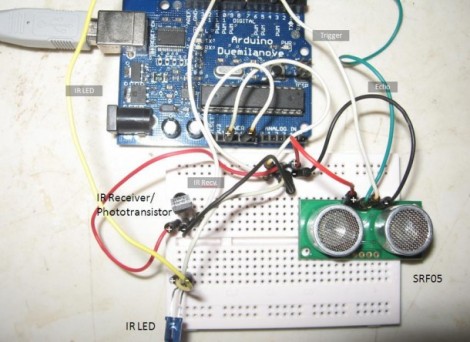
[Larry] put a different spin on a television remote control. He used an Arduino and an IR receiver to learn the codes from the factory remote. Now that he can use an IR LED to playback these signals he worked on an alternative to pressing buttons as the input. The ultrasonic range finder seen above allows him to wave his hand in front of the device to change channels and alter the volume levels. Check it out after the break.

There are many other ways that gestures could be used with this system, including a laser based input method. We’d like to see [Larry’s] system incorporated into a coffee table of some kind, as long as there was an opening for the range finder to work.

Continue reading “Distance Measurement Input Device”

Radio-Walkman-megaphone Hybrid

[Erich] rethought the use of a megaphone and ended up with this Mega-Tape-O-Phone. His first move was to ditch the megaphone’s amplifying circuitry in order to add his own based on an LM386 chip. From there a radio receiver joined the party followed by the guts of a tape player. He relocated the head of the tape deck to the end of a flexible cable and coated the outside of the megaphone bell with magnetic tape. Now he’s surfing the airwaves and scratching away happily.

The use of the tape head has been seen here before, but it was never in a mobile package like this is. Join us after the break for some video of this in action.

Continue reading “Radio-Walkman-megaphone Hybrid”

Toddler Android

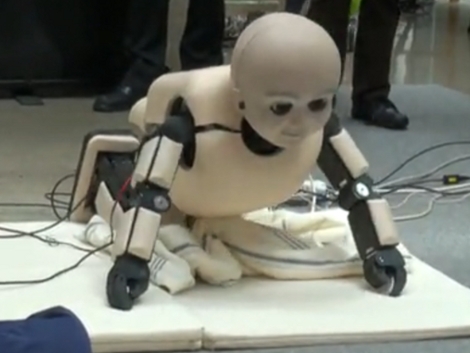
We came across a couple of videos of this toddler android. It sits up, rolls over, and responds to humans around it using visual, audio, and sensor inputs. After the break you will see that the movements are quite like that of a young child. The giveaway is the weight of the robot which is evident when its handlers trying to help it get untangled from that blanket. It seems to respond to individuals around with a smile and a twinkle of its… errr… camera eye. We wonder if it would find delight in knocking down some dominoes.

Continue reading “Toddler Android”

Gaming System For Less Than Three Bucks

[youtube=http://www.youtube.com/watch?v=r-Mdt6uzmOg]

[Rossum’s] latest project just hit and as usual, he doesn’t disappoint. Using an ARM cortex M0 he built a gaming system for less than $3 in parts. The M0 is a bit underpowered for this but at $1 it can’t be beat in price. He worked some video generation voodoo to get the signal he wanted but also mentions that upgrading to a bit more expensive chip like the Cortex M3 would solve this problem. The other part of the gaming system is an analog stick (again for about $1) that is the only input for the system.

Can’t say that you remember hearing about [Rossum] before? Go back and check out his Wikipedia reader, AVR media player, and AVR iPod touch killer.