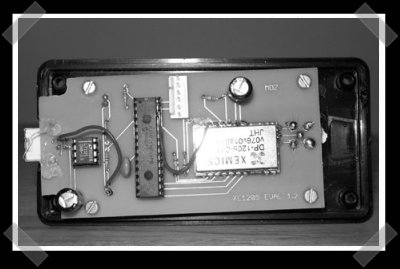
Since I mentioned Sparkfun electronics in the parts finding how-to, I started poking around their forums and stumbled across this interesting USB RF modem. It uses an off the shelf Semtec DP1205 RF module that’s controlled by a PIC 18F2550. The really interesting thing is that it uses spread spectrum frequency hopping – which means that by FCC rules, it can transmit up to 1 watt at 900Mhz.
Friday Night Pyro Extra

Well, not quite so much a pyro, but this setup rocks for cooking some good steaks.
[Tony] sent in this mp3 doorbell hack. I’m thinking… Star Wars theme song.
[Joey] let me know about this odd hack that adds guitar foot pedals to every button on a gameboy. (It makes sense if you remember that they’re popular for 8-bit sound production)
[Chris] sent in his wooden robot arm. It’s a simple servo based design, but it might be a good place to start if you’re leaning in that direction.
This already got plenty of attention, but [Billy] took his iPod apart and encased it in a block of resin. It’s still works, via a dock cable.
[D.G.] sent in this cheap ring-light tutorial. It’s based on a cheap LED light that’s got a set of ring mounted LEDs from the factory.
[Eliot] noted this interesting take on finding slingboxes using geographical IP addresses to set up your target search.
Finally, if you enjoyed [Eliot]’s visit to [Mr. Jalopy]’s garage, you might want to check out the video version on BoingBoingTV.
How-To: Where To Find Parts For Your Projects
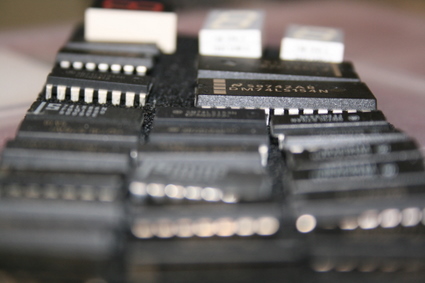
Hunting down the right parts usually takes more time than soldering everything together. I can’t count the number of projects that I tried to build and couldn’t find some key component that’s no longer made. You can help put together a list of suppliers at the end, but the idea is to have a quick reference to get your projects rolling (saving your money for important things, like espresso). Even if you’re familiar with the usual electronics parts shops, chime in to help me create a list of the best suppliers to fuel those hardware hacking projects.
Continue reading “How-To: Where To Find Parts For Your Projects”
Automatic Projector Calibration

[Johny Lee] sent in his(pdf) awesome projector calibration project. By adding embedding some optical fiber that feed into a set of USB connected light sensors, his groups software can determine the exact pixel position of each sensor. Once the positions are determined, the projected image can be dynamically adjusted to fix the screen. The technique can be used to stitch together multiple projectors, and even calibrate an image to project onto a three dimensional model. I know some home theater nuts that would love to have this system for calibrating their CRT projectors.
This is such an excellent project, that I want to give credit where it’s due – it was developed by [Johnny C. Lee], [Paul H. Dietz], [Dan Maynes-Aminzade], [Ramesh Raskar] and [Scott E. Hudson].
Be sure to check out the video demo after the break!
Toilet Terror Level Indicator

Normally, this wouldn’t quite make my radar, but [sprite_tm] built it, and it’s funny as hell. He created a Terror Level indicator for… his toilet. Rather than create an exotic smell detector, he simply uses a photo diode to measure the amount of time that the light has been on in the ol’ water closet. As time progresses, so does the Terror Level indicator. To make an audible indicator, he used the PWM generator in the ATTiny231to create a sort of ping sound when the level escalates. (I can definitely think of someone I need one of these things for.)
Simple VGA Test Box

Sometimes it may seem like I suffer from goldfish memory. [Chris] sent this in a while back and I’d almost forgotten about it. He built a simple VGA test box using a PIC 18F452. I’d probably be more interested in using it to add simple VGA output to another project than use a test box, but it can definitely be handy if you need a small portable video test signal.
Blowable Computer Interface
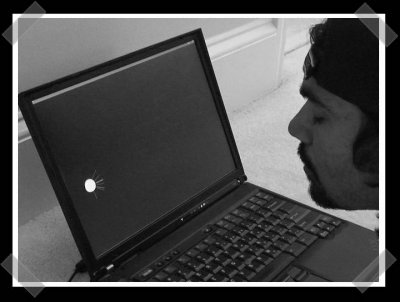
Remember Christopher Reeve’s blow controlled wheel chair? [Shwetak] sent in his blowable computer interface. It doesn’t require anything but an on-board microphone and a decent set of lungs. It works by taking audio fingerprints to determine the location on the screen that you’re exhaling on. The demo video (avi) shows off some surprisingly accurate location detection. You can get a few more details from his research paper. (If you need a decent avi video player, check out VLC player.)