New Year’s Eve Ball Drop In Your Kitchen

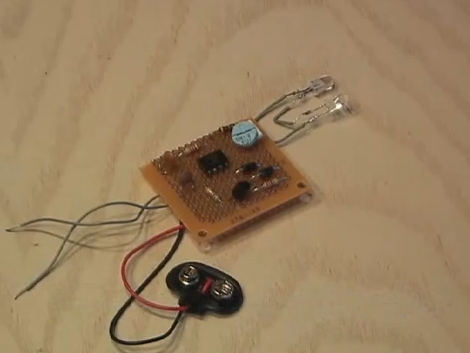
[Tech B.] hacked together a Ball Drop for New Year’s Eve using stuff he had lying around. The ball itself is an old Christmas ornament that he cut in half and filled with 14 LEDs and a 9V battery. He finished up that portion of the project by gluing the halves back together and adding a hole for the guide rod. The base is made of some cardboard boxes and hides an Arduino, a servo motor, an LCD screen, and the base for the vertical rod. When the last ten seconds of the year are counted down, a servo lowers the ball by unspooling some yarn that loops over the top of the rod. As the yarn is slowly dished out gravity pulls the ball toward its goal. We’ve embedded [Tech B.’s] demonstration video after the break.

Continue reading “New Year’s Eve Ball Drop In Your Kitchen”

Quiz-o-Tron 3000

Who would have known that being given the task of planning a holiday party at a wine bar would turn into a hacking project? Well, here’s how that happened. A committee was in charge of the festivities and had decided on doing a mock game show. It wouldn’t really feel like a game show unless you had a contestant lockout system where the first one to hit the button gets a light and a sound while the runners-up get nothing. This is where [RoysterBot] comes in. He built the Quiz-o-Tron from 4 “easy buttons” from staples and an Arduino. After having finished it, he found the system to be somewhat lacking in the excitement area. When a button was pressed it only lit an indicator on the main Quiz-o-Tron box. He decided to add a small circuit inside each of the Easy Buttons using a 555 timer and some LEDs to give them some better feedback. Apparently he was going to patch into the speaker as well, but didn’t have time to get that added.

[via Adafruit]

Developing An Electronic Board Game

[Zach] enjoys playing the game Catch Phrase, but the complexity of the words makes this game a no-go for the little ones. We remember that the game used to be mechanical, using paper disks with the words on them. Those would be easy to recreate with your own dictionary set, but since it has transitioned to an electronic unit that option is out the window. So [Zach] decided to build his own version of the game that lets you use custom word sets after drawing inspiration from another Catch Phrase hack.

He’s calling it AVRphrase since it uses an AVR ATmega328. You’ll also find five buttons, a piezo buzzer, and a character LCD included in the design. He saw the project all the way through to the end, having a PCB manufactured, and installing it in a project box. A demonstration of the finished game can be seen after the break. [Zach] ended up with 9 working units at a cost of about $30 each.

Continue reading “Developing An Electronic Board Game”

Flaming Guitar Hero

[Chris Marion] knew he wanted to play with fire, or more accurately with fireball spewing valves, but he need a good project in which he could use them. Inspiration finally struck and he built this controller that matches fireballs to the fret buttons on a Guitar Hero controller. There’s quite a lot that goes into this but we think that he hit a home run. The basic components are a manifold with electronically actuated valves, another manifold for the pilot lights, and a modified Guitar Hero controller.

To interface the controller he used an Arduino along with [Bill Porter’s] PS2 library to read signals from the buttons. But the real labor intensive part of the build came with the manifold. There’s a hardware store’s worth of fittings and flexible copper pipe that go into that assembly. In the end this all came together in just one week.

[Thanks Bill]

Jumbo Size New Years Countdown

New Years celebrations tend to get bigger and bigger every year for most people, and [Brian] takes no exception. In order to top his lighted tree of a few years ago, he has concocted a 40’x40′ set of Seven-Segment displays made out of Christmas lights, hung from nearby trees. These displays would start counting down the minutes an hour before the ball drop, and be synchronized with music. Also in the spirit of a New Years party, the music he has chosen is in the form of a Power hour. The control board [Brian] is using also comes with two extra outputs, which he plans to use for the most exciting possible additions: Fireworks and Flamethrowers.

Be sure to check back after New Years to see a video of the device in action. Be sure to Hack, Drink, and Party Responsibly out there.

Well-balanced Flight Simulator

Here’s a flight simulator which uses concepts simple enough for anyone to build. As you pilot your virtual craft, the cockpit you’re sitting in moves as well. But unlike some of the more extreme simulator builds we’ve seen, this uses basic materials and simple concepts to provide that motion. Its center of gravity is balanced on a base frame. The joystick slides as you move the nose of the craft up and down, shifting the center of gravity causing the cockpit to tilt as well. The pilot sees the simulated flight through a wearable display. There is a stationary reference in front of him which allows the system to measure head movements, panning and tilting the virtual display to match. Check out the overview video after the break, or click through to the page linked above and watch all 22 episodes of the video build log.

Continue reading “Well-balanced Flight Simulator”

Build A Pong Gaming Console

A lot of thought went into [Patrick Mccabe’s] Pong gaming console build. He used components we’re familiar with; an Arduino as a controller, 8×8 LED modules as the display, and potentiometers (with fancy knobs) in project boxes as the controllers. But every step along the way he took care to build this cleanly and robustly. Even the MAX7219CNG drivers for the six LED modules reside on PCBs from a fab house. The finished project is something you’d be proud to pull out and play when you have friends over. Even if they’re not part of the geek elite we think they’d enjoy a game or two. Great job [Patrick]. We hope to see an internalized microcontroller and scoring in your next update!

Want to do this but the cost of the matrix drivers scared you away? Follow our tutorial to build your own display using an AVR for the multiplexing.