Gutting An Air Freshener For The Parts

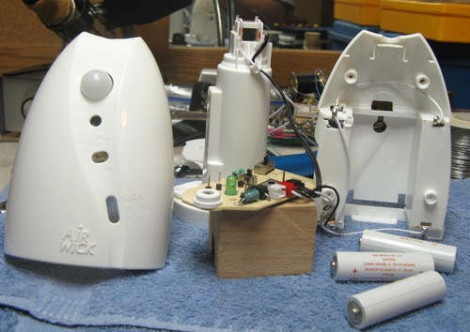
[Doug Paradis] took a good look inside the Air Wick Freshmatic Compact i-Motion and then stole all the parts for other projects. We’ve looked at adding a manual spray button or making air fresheners Internet enabled before. Those models didn’t have parts that were all that interesting, but this one has a passive infrared motion sensor. You’ll also gain three switches, a PNP transistor, and an LED.

Price seems to be all over the map for this model, but [Doug] says you can find it for $8 or less. After showing how to make a tool to bypass the triangular security screws, he explains how to access the PIR sensor. But if you want to be all you can be with the hardware, he details the modifications needed to patch into the analog and digital circuitry on the rest of the board too.

Low-power Wireless Home Automation Sensors

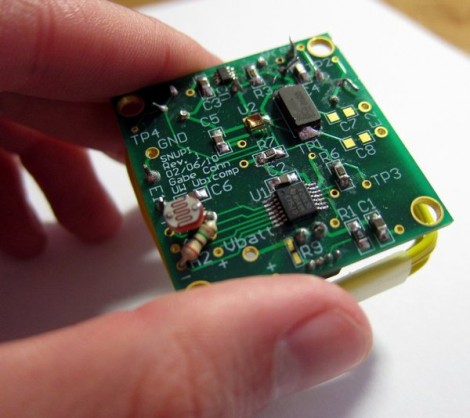
The line between serious research and well-executed hacks has been getting pretty blurry lately. The device above could have been designed in your basement but it actually comes from researchers at the University of Washington. They are working on low-power home automation sensors for monitoring things like humidity, temperature, air quality, and light. The key point in their research has been the use of a home’s electrical system for wireless communication. Operating at 27 MHz has proven quite efficient to the point that one of these modules placed within 10-15 feet of an electrical run can communicate with the rest of the home, powered only by a watch battery projected to last ten years.

That’s kind of exciting, it’s a heck of a lot easier to produce and distribute a set of small boards like this than to run communication wiring throughout the house. Now we just need to pair this with the Air Force’s parasitic power work and there’ll be no need for a battery at all.

[Thanks Sidhant]

Automated Entry For A Garden Gate

[Dan McGrath] tipped us off about a solution for a problem that most people don’t have. He built a web-based entry system for his garden gate. This isn’t quite as original as that chain and sprocket dorm room system, but it does use a keypad for entry. [Dan’s] already got a web server and home automation box that is always running. He coded a webpage that presents a virtual keypad for code entry. If the right code is input the system unlocks the electronic strike on the other side of this gate. Since the interface is a web page you can load if from any web browser (an iPhone is used for demonstration purposes after the break). But if you don’t have internet access you’re in trouble; there’s no physical keypad. But we guess you could always just jump the fence.  Continue reading “Automated Entry For A Garden Gate”

Keypad Door Lock, Better Than Last Years Keyfob?

It’s that time of the year again. The leaves are changing colors, it’s getting colder outside, and all the littler hackers are off to college. Which means we get to see an influx of dorm room locks and openers.

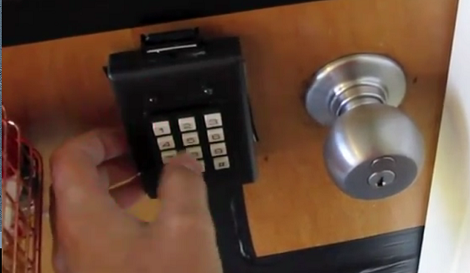
[Adam] is back at it again with a new keypad dorm room lock. Last year he had an exceptional setup using a car keyfob, so we’re a little curious as to why he would revert to such a low level system as a keypad that isn’t even color coded.

Perhaps its in his “new” way of presenting the hack. Rather than a blog or write up, he documents the entire most of the process in a little less than 20 YouTube videos. Watch him testing out the system after the jump.

Continue reading “Keypad Door Lock, Better Than Last Years Keyfob?”

Web Controlled Watering Can

Here’s a watering can and water vortex that are controlled with a webkit browser interface. The interface displays a drawing of the watering can on your browser. If you grab one of the handles on the circle around the image and move it, the can will rotate as well.

Okay, so this isn’t going to change the world and actually presents a fairly useless watering setup. But [Ben] seems to be a master of fabrication and that’s what we appreciate in this build. The watering can is solidly mounted and moves fluidly with seemingly little effort from the motor. He uses a spring to keep the rope loop taut, sourcing a castor wheel and automotive power-window motor to provide the motion. The hinged base on which the can sits has a potentiometer in it, used to measure the current position of the watering can. Remember these techniques as they’ll come in handy in your future builds.

There’s also a little bonus at the end of the video after the break. We wondered what [Ben] might use that power drill controller hack for. Looks like it makes an appearance in his water vortex work.

Continue reading “Web Controlled Watering Can”

Meat Smoker Texts You When It Is Done

yummmmm

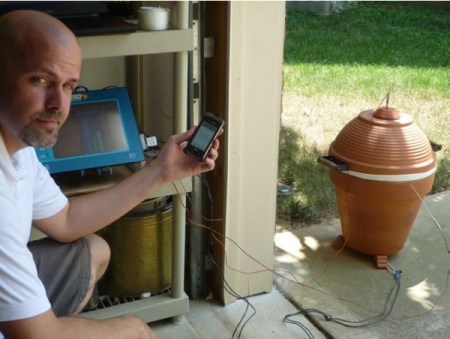
[Peter Rauch] has built this meat smoker that has a touch screen control interface. His system is capable of controlling the cooking by monitoring the internal temperature of the smoker as well as the temperature of the meat itself. His touch screen interface allows him to enter his desired parameters and it basically just takes over from that point and texts him when it is done.  You’ll have to download the pdf to get to the juicy details of his build, but it is an interesting read.

It looks like he’s using a 4-loop Gefran GFX4 temp controller in conjunction with a Modbus remote terminul interface and a TS8010 HMI touchscreen for the bulk of the electronics. It even has protection limits he can set to keep his family from bumping it up to 1200 degrees.

[via Makezine]

Replacing The Driver Board In An Old-school Door Chime

[Dan Kouba’s] parents replaced their doorbell button with one that lights up and found that the chime wouldn’t stop sounding after the button was pushed. These lighted buttons use an incandescent bulb in parallel with the button (a piece of hardware we’ve hacked in the past). It draws a small amount of current which isn’t enough to trigger the chime, but it is just enough that the chime unit reacts as if the button press never stopped. His parents asked what he could do about this and after some investigation he build a replacement board for the chime unit based around an ATtiny26L. The board monitors the voltage drop across a resistor in the doorbell circuit. When the comparator on the AVR detects a rise in the voltage drop across the resistor it rings the chimes, actuating the solenoids with a set of PNP transistors. [Dan] sent us all of the details which you can check out after the break.

Continue reading “Replacing The Driver Board In An Old-school Door Chime”