Stepper Directed HDTV Antenna

Credit: http://www.instructables.com/id/Computer-controlled-OTA-TV-antenna/

Broadcast TV has come a long way from adjusting the rabbit ears on top of the set just to get a fuzzy black and white picture. While nowadays there are often HD signals broadcast in most areas, it can often still be critical to redirect an antenna to get the best possible signal. By harvesting a stepper motor from an old 5 1/2″ floppy drive, and using a PC’s parallel port to control it, this adjustment can be handled automatically. Broadcast tower locations are easily found online, and once you have calibrated your stepper to face North, you are on your way to free HDTV reception.

What we would like to see is this antenna attached to a HTPC, and some kind of script to automatically direct the antenna for the best possible signal for the current channel. If anyone out there makes this happen, be sure to let us know.

Making The IM-ME Dongle More Useful

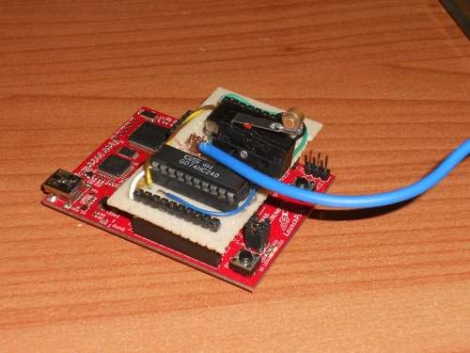
So you’ve hacked your IM-ME six ways from Sunday but don’t know what to do with the USB dongle? [Joby Taffey] set out to make this leftover a useful part of the hacking arsenal. He pulled off the USB connector and the USB controller chip. From there he glued on the pin headers as pictured above in order to turn this into a breadboard-friendly single in-line package. But wait, that’s not all… for the low-low price of common components he also built a power and programming cable. Once it’s all said and done you can load PinkOS, an operating system he developed for the device which lets you operate the onboard radio via serial protocol.

Need a better overview of the hardware on the board? [Joby] laid the groundwork for this hack back in October.

Wireless Sniffing And Jamming Of Chronos And Iclicker

The ubiquitous presence of wireless devices combined with easy access to powerful RF development platforms makes the everyday world around us a wireless hacker’s playground. Yesterday [Travis Goodspeed] posted an article showing how goodfet.cc can be used to sniff wireless traffic and also to jam a given frequency. We’ve previously covered the work of [Travis] in pulling raw data from the IM-ME spectrum analyzer, which also uses goodfet.cc.

The Texas Instruments Chronos watch dev platform contains a C1110 chip, which among other things can provide accelerometer data from the watch to an interested sniffer. The i>clicker classroom response device (which houses a XE1203F chip) is also wide open to this, yielding juicy info about your classmates’ voting behaviour. There is still some work to be done to improve goodfet.cc, and [Travis] pays in beer–not in advance, mind you.

With products like the Chronos representing a move towards personal-area wireless networks, this sort of security hole might eventually have implications to individual privacy of, for example, biometric data–although how that might be exploited is another topic. Related to this idea is that of sniffable RFID card data. How does the increasing adoption of short-range wireless technologies affects us, both for good and bad? We invite you to share your ideas in the comments.

Radios Without Power Sources

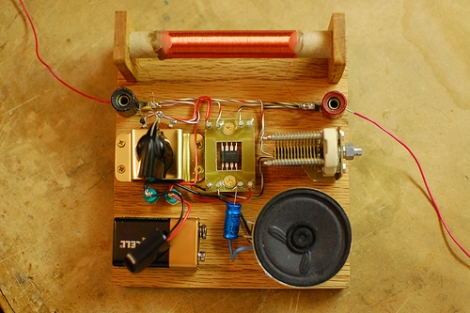
[Goodhart] is sharing his process for building a couple different AM radios. It’s surprising how few components he’s using; the first build is just a germanium diode, some wire, and a piezo earpiece. But it strikes us that both of the radios he gives build instructions for have no power source. We’re also amused by the process of selecting the station. His example uses 770 AM, and requires you to take the wire and place it up in a tree with the two ends about 1216 feet apart. We think there’s something a bit off with the math, but with that much conductor to start with there might be enough induced current for you to actually hear something come out the piezo. We don’t think we’ll be trying this anytime soon, but we’d like to hear comments from those of you who do (or already have).

555 Based AM Radio Transmitter

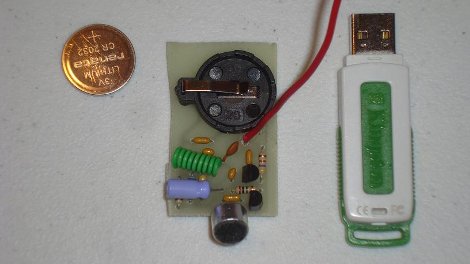
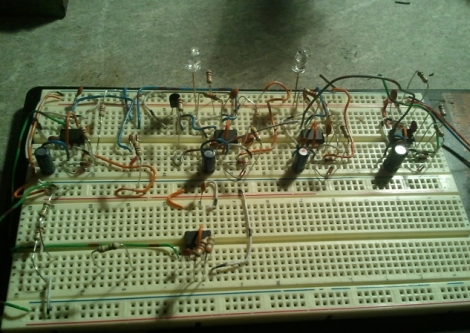
Bust out that 555 timer and use it to build your own AM radio transmitter. The circuit that [Rtty21] is using only needs the timer chip, an NPN transistor, three caps, three resistors, and a potentiometer. It generates an amplitude modulation signal around the 600 kHz range which you will be able to pick up with any normal AM radio. From the comments on the article it seems you’ll get around 30-40 feet of range out of the device. We don’t see this as a competitor for the FM spy microphone, but maybe you can use it as a diy baby monitor.

Designing An RF Transceiver

[William Dillon] is finishing up his degree. His final project as a student was to design an RF transceiver. He decided to work with the Microchip MRF49XA, which runs around $3 but will cost you $20 if you want it in a ready-to-use module. He didn’t find a lot of info on the Internet about communicating with these chips so he’s shared his design, code, and board files. If you’re ever wanted to delve into RF design this is a good primer. [William] talks about building around the example circuit from the datasheet but also includes a discussion of the calculations he made in working with the 434 MHz band, and an AVR-based library for using his module.

Copper-clad Enclosures

Building a great looking box for your projects can be a challenge. [Ken] boils down his process of building enclosures out of copper clad (PDF) circuit board material into an illustrated guide in case you want to try this for yourself. Why would you want to use PC board? The fiberglass substrate makes for a strong and lightweight material. Also, [Ken] is a ham radio operator and the copper coating acts as an electrical shield for delicate components inside.

As you can see above he uses solder to tack the pieces together. There’s some important considerations that go along with this method. First, he cuts the pieces just a bit oversized and then sands them flat and square before assembly. Next, he uses some 20 gauge wire as a shim between a ninety-degree joint and a right angle jig. This shim compensates for the shrinking that occurs as the solder cools, making sure the joint gets pulled to a right angle. He even solders nuts in place so that screws can be used to attach the case cover to the chassis.

Yesterday we saw toner transfer used to make labels on an ABS case. If you make your enclosure out of copper clad, using toner transfer for panel labels will be a snap!