Dice Gauntlet Joins Cosplay With D&D Gaming

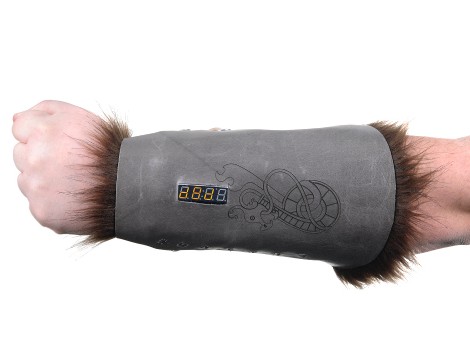
If you needed a reason to dress up for your next Dungeons & Dragons adventure this is surely it. Not only will this attractive wrist adornment go right along with your medieval theme, but the gauntlet doubles as a multi-sided digital die.

Sparkfun whipped up this tutorial which details the build. Yep, they’re hawking their own goods but we must say this is one of the few projects using sewable electronics which we thoroughly enjoy. It calls for several Lilypad modules, including an Arduino board, accelerometer, and slide switches. The switches let you select the number of sides for the die you are about to roll. The accelerometer starts the fun when you shake your wrist back and forth (that’s what she said). The project is powered by a rechargeable battery, which we always like to see, and uses a four-digit seven segment display located where the face of a wristwatch is normally found.

Of course, you could get the shaking action and use no batteries at all if you wish.

Sound Reactive Kanye Glasses!

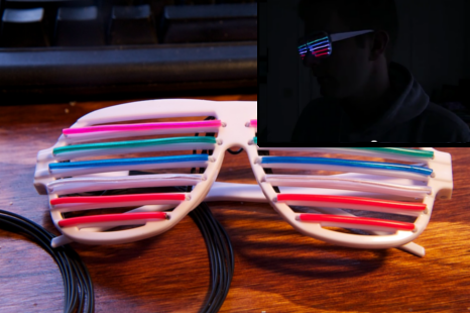
[Ch00f] has decided to ring in the new year with some el wire Kanye glasses. Technically the term for the glasses is either “shutter shades” or “slatted sunglasses”, invented around the 80s by [Alain Mikli] and originally given the nickname “Venetian Sunglasses”. Kanye West evidently got his own retro redesign by the original creator and the rest is history. That is enough Wikipedia for now. [Ch00f] has augmented the original design with six multicolor tracks of EL wire mounted to the shutters of the glasses. The EL wire is fed back through several discrete wires around the wearers ear and to two control boxes. As the video shows, the glasses function as a crude V/U meter based on the audio received by the driver circuit.

Instead of the typical microcontroller [Ch00f] (who has some kind of deep seated issues agaist the Arduino) decided to go full blown analog with the entire design. The audio signal is fed through various Op Amp circuits first amplifying the weak microphone signal then filtering with a low pass filter to focus on the bass frequencies. The filtered bass is then sent to an envelope detector to turn the audio wave into a DC voltage signal. Keeping with the Op Amp design [Ch00f] then uses a resistor ladder and six comparator circuits (with TRIACs on their outputs) to tune the trigger voltage levels of the EL bars. The TRIACs get to deal with the 100 or so volts for the EL strips so that [Ch00f] doesn’t have to party with six EL power supplies in his pocket. For those of you counting at home, that is a total of 13 Op Amps.

The results are fantastic, check the video below to see the glasses in action. Reportedly the circuit does freak out and lock all of the TRIACs in an on state, but a covert flip of the power switch fixes the issue for now. [Ch00f] admits that the project was rather rushed due to the impending new year’s eve party, but now that that is all over with we just need to get [Ch00f] to roll out a stereo version. If you need more [ch00f] we have covered a few of his projects before such as his Icebreaker POV toy hack and a ghetto accelerometer using a reflection sensor.

Thanks for the tips [Daniel] and [Sanchoooo], also via [reddit]. Happy new year!

Continue reading “Sound Reactive Kanye Glasses!”

Muff-Fones Sound Dirty; Well, Not Literally

Baby, it’s cold outside. But that doesn’t stop [Grissini] from listening to some tunes when not indoors. He added headphones to a pair of ear warmers. We guess you could call them ear muffs, which is where the name comes from. But these are the newer type that wrap around the back of your head.

[Grissini] picked up a set of headphones that similarly wrap around the back of your head. After pulling the speakers out of their plastic enclosures he needed a way to soften the sharp edges when they’ll be pressed against your ears. Sugru once again shows its versatility by providing a soft, self-bonding, and moldable surface. The last step is dead simple, as the ear warmers already have a fabric pocket by each ear perfect for accepting the speakers.

Now we need this to go one step further, by making them wireless. We figure hacking in a bluetooth headset board would make it work with your cellphone. Or you could roll your own minimal MP3 board and house it in the part that wraps around your neck.

Steampunk Wings: Bigger, Heavier, And Steampunkier

This pair of backpack-mounted wings was conceived after seeing the Angel/Archangel character in the movie X-Men: The Last Stand. They measure 14’6″ inches across, but they fold up so that the wearer can actually get around in them. The mechanism is built from MDF, using several layers of gears cut from the material as well as pieces that act as the skeleton for the appendages. This makes them look and work well, but adds a lot of weight as the project comes in at about 25 pounds.

The steampunk wings we saw a few days back were partly inspired by this set. But this pair is more true to the Steampunk concept, relying on pneumatics instead of electricity for motion. A pair of pneumatic rams originally made to cushion the closing of screen doors let the wearer automatically extend the unit. As you can see in the video after the break, this happens quickly and gracefully. They do have to be folded back up by hand, and we’d bet you need a second person to assist with this, but we could be wrong.

Continue reading “Steampunk Wings: Bigger, Heavier, And Steampunkier”

Personal Flight From The Steam Age

From a small-sized backpack these wings slowly grow to full size in a Steampunk costume that hearkens back to DaVinci flight designs.

The mechanism that unfolds the wings was fashioned from parts of a baby gate and an old back massager. The massager features a pair of orbs that are meant to move slowly up and down your back. This is what accounts for the slow unfurling of the wings. After a bit of prototyping with Popsicle sticks [Dannok] and his daughter figured out the best arrangement for the pivoting skeleton. From there, the slats from the baby-gate were used to build the frame, then covered with fabric to finish the wing element for this Halloween costume.

A 12 volt gel battery powers the device, which is activated with a brass pull-chain meant for a light fixture. Once full extended, as seen above, the wingspan is eight feet. Don’t miss the pair of videos we’ve embedded after the break which show the workings of the device.

Continue reading “Personal Flight From The Steam Age”

Second Run At Taser Gloves Uses Bug Zapper Parts

[Jair2k4] ditched the Altoids tins and found a new voltage source for this latest rendition of his taser gloves. Regular readers will remember his first iteration which used wrist-mounted enclosures containing the flash circuitry from disposable cameras to shock the wits out of someone with the laying on of hands. This one is a complete rework but it follows the same concepts.

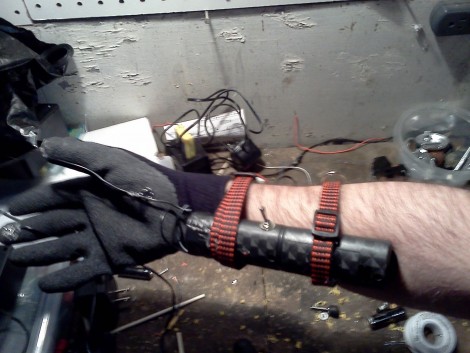
The new shock circuitry is from a bug zapper in the shape of a fly swatter. We’ve seen these handheld devices before and dismissed them as a gimmick, but [Jair2k4] got his hands on a couple of them and found out they can put out a spark of up to 2300 volts. He set to work by getting rid of the tennis-racket-style grid at the top of the handle. He soldered on some contacts which reach to the tip of his middle-finger and thumb on some rubberized work gloves. The original handle was kept as it’s a nice battery holder and works well strapped to his forearm.

Does it work? You bet – even singing his arm hair and leaving welts on his skin. See for yourself after the break. And yes, this goes on the list of hacks you should recreate!

Continue reading “Second Run At Taser Gloves Uses Bug Zapper Parts”

Taser Gloves Are A Bad Idea

In a project that you’re sure to read about in police blotter someday, [Jair2k4] built a pair of Taser gloves that will shock your victim with they laying-on of hands.

Not surprisingly, this project was spawned from a conversation at work about what tech would best suit a vigilante crime fighter. [Jair2k4] suggested taser gloves, which drew a laugh, but also stuck in his mind. His prototype takes advantage of the flash circuitry from a disposable camera to step up battery voltage all the way up to 300 volts.

The gloves he’s using are rubberized fishing gloves which help ensure that he doesn’t shock himself. Wire travels from the capacitor to conductors sewn into the fingers and thumb of the gloves He’s got video embedded on his post that shows the bright spark and loud zap of a discharge when the conductors get close to one another. Altoids tins lined with electrical tape house the hardware, with a momentary push button used to charge the devices.

Hopefully criminals will not mind waiting for you to charge your weapons before they attack. But then again, [Jack Buffington’s] own version of a taser glove had the same issue. That one used conductors on the knuckle side of the glove, and involved long wires tethering the glove to a belt pack. Locating that back as a bracelet is a nice improvement on the idea.