Testing Giant Fire Darts From The Mary Rose

Fire arrow versus the recreated fire dart. (Credit: Tod's Workshop, YouTube)
Fire arrow versus the recreated fire dart. (Credit: Tod’s Workshop, YouTube)

The Mary Rose was a carrack in the English Tudor Navy of King Henry VIII  that fought in multiple battles during the 16th century before it was sunk in 1545. After its wreck was located in 1971 and raised in 1982 the ship and all the items contained within the partially preserved hull became the focus of intense study. Among these items are the weaponry found, including the cannons, but also massive darts that seemed to have been designed for an incendiary payload. Recently [Tod’s Workshop] collaborated with others to test these presumed incendiary darts.

Although fire arrows have been around for a while, seeing what appears to be super-sized versions of these is somewhat unusual, but could make sense in taking out enemy ships of the time. The main questions are how you would even fire them, and how effective they would be. Were the darts thrown by hand from e.g. the crow’s nest, or fired from a cannon?

The reproduction darts used are based on the recovered remnants of the original darts, with an incendiary mixture inside a pitch-covered cloth covering. This mixture would be ignited by wooden fuses after a set amount of time, at which point the resulting fire would be basically impossible to put out. Obviously, this also means that if you were to throw one of these darts, it can absolutely not fall onto your own ship.

First tested was throwing the dart by hand, which seems like it would clear the ship. Of course, the three recovered darts were found near a rather special cannon that appeared to be both a miscast and angled upwards. Whether that cannon was used for launching apparently somewhat experimental darts is hard to say, but it can be tested. Sadly, lacking a full-sized black powder cannon a scale model dart was fired using compressed air.

From that scale test it’s clear that at full charge the dart would disintegrate due to the rapid acceleration, but a ‘soft’, or reduced, charge could work against nearby targets. Once the dart lodges itself into the enemy ship’s structure, it would definitely cause severe damage as further tests in the video demonstrate. Having a salvo of these fire darts fired at you from a nearby ship would definitely make for a pretty bad day.

Continue reading “Testing Giant Fire Darts From The Mary Rose

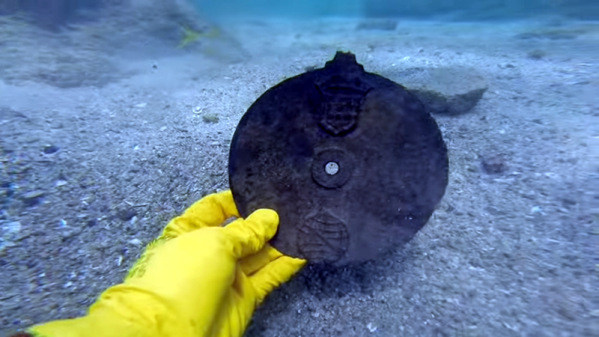
Maritime Analog Computer From 1503 Is The Oldest Remaining

We might not think of analog computers as having existed in the 1500s, but in fact the astrolabe first appeared around 220 BC. However, as you might expect only a few very old ones still exist. Early astrolabes were often wooden and were difficult to use aboard ships, however brass astrolabes with special features were more accurate on the deck of a ship underway. A recent archeological find from one of Vasco da Gama’s ships that sunk in the Arabian Sea has brought the number of known archeologically-significant instruments to 104, and also is one of the few nautical versions to employ a solid disk. As of now, it is the oldest known maritime astrolabe found so far — the ship sunk in 1503. You might wonder how the 104th astrolabe became number 108, but the catalog includes a few pieces or fragments of astrolabes. If you count those, there are 108 items in the catalog.

If you think archeology is about men in fedoras carrying whips, or stuffy old men wandering around tombs, you should have a look at the article about this find. In addition to divers recovering the piece from the shipwreck (see the video, below), the science involved in restoring it and analyzing it includes chemistry, lasers, X-rays, and energy-dispersive spectroscopy.

Continue reading “Maritime Analog Computer From 1503 Is The Oldest Remaining”

Ask Hackaday: What’s Your Favorite Internet Relic?

[Sadiq Mohamed] posted this great list of light bulb jokes in our post about drones changing light bulbs. This favored relic used to exist on a Compuserve SIG, but fortunately a dedicated user had saved the list.

There have been virtual worlds long before our computers could render anything but potatoes with anime faces. Bulletin boards, mailing lists, and forums dominated and then fell, for the most part, to social media. In a way even the personal home page has gone to the wayside. (remember geocities?)

The internet has gone through many phases of development. We’ve experimented with lots of concepts and when they fail or go out of style, there are ghost towns of information left untouched.

However, we remember. I still think fondly of my old shell server. Some of it is even history worthy enough to be in the books. What’s your favorite piece of internet gone by or just plain internet obscura? An old joke? A book five layers deep in a file structure somewhere. Or maybe just the 1959 definition of the word, “hack,” in the Tech Model Railroad Club’s first edition dictionary.

Archaeology, Virtually.

Drone technology is seeing useful application in a new field seemingly every day — so it was only a matter of time before it saw use in archaeology. And so, a team of researches in Australia are combining drone and VR modeling technology to help investigate the Plain of Jars, in Laos.

After the drone images the site, those photos are patched together by object recognition software and are reviewed in the immersive CAVE2 3D facility at Melbourne, Australia’s Monash University. Multiple surveys catalog and archive the dig at various stages and enable the archaeologists to continue investigating the site after leaving — especially useful for digs in dangerous regions. In this case, the landscape around the Plain of Jars is dotted with unexploded cluster bomblets.

Continue reading “Archaeology, Virtually.”