
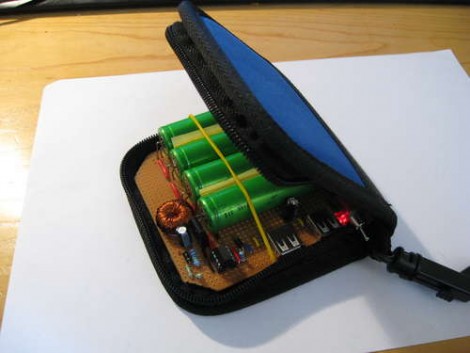
A More Powerful Boost Charger

[Meseta] built a powerful boost charger to top off his portable devices. He was inspired by the Minty Boost but wanted to overcome the rather limited capacity provided by the two-celled product. He ended up building his own DC to DC boost circuit rather than using an all-in-one IC. As you can see, the result uses four 18650 lithium-ion cells, normally found in laptop batteries, and can power two USB devices at the same time.

Learn From The Ice Tube Clock

icetube

Looks like they’re at it again over at Adafruit. This time they’ve produced a clock that looks more like it should be attached to a munition rather than cruising bedside. But, geek-cred aside, there’s a lot to be learned from their design. Like we’ve grown to expect, they’ve put together some good documentation on their choice of components.

Start off by taking a peek at their 5v power regulator. There is an extra diode on the output side that prevents reverse current from the 3v backup battery. The AVR ATmega168 that controls the clock is used to detect loss of power and quickly shift to the battery backup. They’ve also used theĀ  microcontroller as a boost converter for the high voltage VFD, a nice trick we’ve seen before.

[Thanks pt]

AVR Boost Converter

avrboost

Over at SpriteMods, [sprite_tm] realized that a microcontroller could be used as a boost converter to power itself. A boost converter steps up voltage from a battery by switching the output of a coil. First, it is tied to ground so a magnetic field can build up in the coil. It is then released as a higher voltage than the input. Normally dedicated chips do this at an incredibly high frequency, but the PWM signal from an AVR works well enough. This can be used in low-power situations where space is an issue.

[via EMSL]









