
Pong Gets The Boot

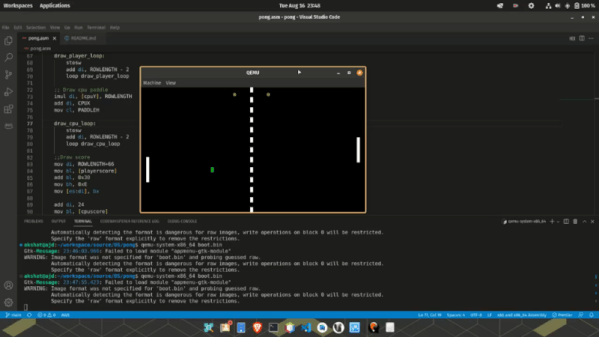
You might be surprised to find out that [Akshat Joshi’s] Pong game that fits in a 512-byte boot sector isn’t the first of its kind. But that doesn’t mean it isn’t an accomplishment to shoehorn useful code in that little bitty space.

As you might expect, a game like this uses assembly language. It also can’t use any libraries or operating system functions because there aren’t any at that particular time of the computer startup sequence. Once you remember that the bootloader has to end with two magic bytes (0x55 0xAA), you know you have to get it all done in 510 bytes or less.

This version of Pong uses 80×25 text mode and writes straight into video memory. You can find the code in a single file on GitHub. In the old days, getting something like this working was painful because you had little choice but reboot your computer to test it and hope it went well. Now you can run it in a virtual machine like QEMU and even use that to debug problems in ways that would have made a developer from the 1990s offer up their life savings.

We’ve seen this before, but we still appreciate the challenge. We wonder if you could write Pong in BootBasic?
Tiny Forth Could Be The Smallest

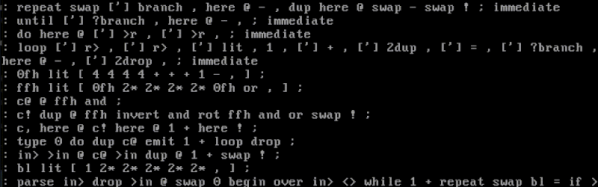
When you think of a programming language, you probably think of a hefty compiler or interpreter. Maybe its on a bunch of floppies, a CD, or even an EEPROM. But what about a language that fits in a single disk sector? A language like that would — in theory — be used to help bootstrap a computer system and that was the idea behind Sector Forth and, later, Sector Lisp. However, there’s a new game in town: milliForth, which claims to be the smallest ever at 422 380 bytes.

Why would you want such a thing? Well, first of all, why not? Even as a form of code golf, packing a functioning language into a tiny space seems interesting. However, you could also presumably use something like this to boot a small system or on a system with limited storage.

Continue reading “Tiny Forth Could Be The Smallest”

Boot Sector Pong As A Crash Course In Assembly

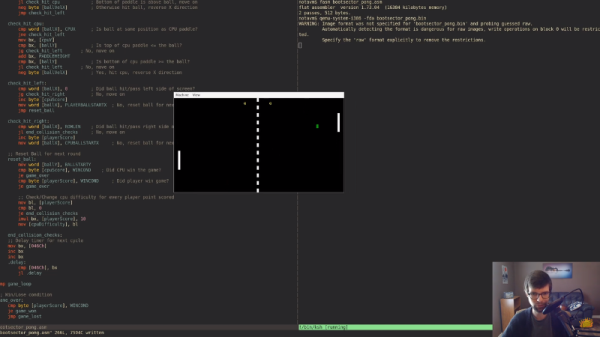
Have you ever wanted to develop a playable game small enough to fit into a disk’s 512 byte boot sector? How about watching somebody develop a program in assembly for nearly two hours? If you answered yes to either of those questions, or ideally both of them, you’re going to love this project from [Queso Fuego].

Whether you just want to check out the public domain source code or watch along as he literally starts from a blank file and codes every line for your viewing pleasure, chances are good that you’ll pick up a trick or two from this project. For example, he explains how all of the “graphics” in the game are done in 80 x 25 text mode simply by setting the background color of character cells without printing any text to them.

We really like the presentation in the video after the break, which was recorded over the course of multiple days, judging by the changing light levels in the background. As he types out each line of code, he explains what its function is and gives any background information necessary to explain how it will fit into the larger program. If you’ve ever wondered if you had what it takes to program in ASM, watching this video is a great way to decide.

[Queso Fuego] mentions that this project, and his research into this sort of low-level programming, came about due to the social distancing boredom that many of us are feeling. While we’re certainly not advocating for him to kept locked in his home permanently, with projects like this, you’ve got to admit it seems like a win for the rest of us.

Continue reading “Boot Sector Pong As A Crash Course In Assembly”








