Perfecting The Shape-Changing Fruit Bowl

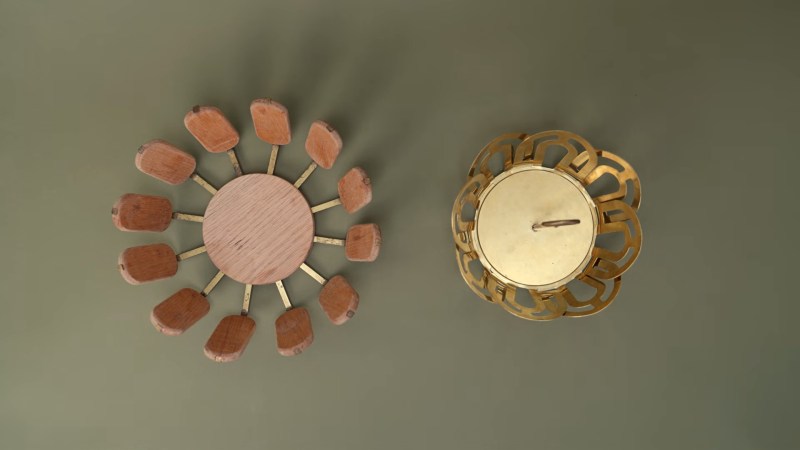
Fruit bowls have an unavoidable annoyance– not flies and rotten fruit, those would be avoidable if your diet was better. No, it’s that the bowl is never the right size. Either your fruit is sad and lonely in a too-large bowl, or it’s falling out. It’s the kind of existential nightmare that can only be properly illustrated by a late-night infomercial. [Simone Giertz] has a solution to the problem: a shape-changing fruit bowl.

See, it was one thing to make a bowl that could change shape. That was easy, [Simone] had multiple working prototypes. There are probably many ways to do it, but we like [Simone]’s use of an iris mechanism in a flat base to allow radial expansion of the walls. The problem was that [Simone] has that whole designer thing going on, and needs the bowl to be not only functional, but aesthetically pleasing. Oh, and it would be nice if expanding the bowl didn’t create escape routes for smaller fruits, but that got solved many prototypes before it got pretty.

It’s neat to see her design process. Using 3D printing and CNC machining for prototyping is very familiar to Hackaday, but lets be honest — for our own projects, it’s pretty common to stop at “functional”. Watching [Simone] struggle to balance aesthetics with design-for-manufacturing makes for an interesting 15 minutes, if nothing else. Plus she gives us our inspirational quote of the day: “As much as I feel like I’m walking in circles, I know that product development is a spiral”. Something to keep in mind next time it seems like you’re going around the drain in your own projects. Just be warned, she does have a bit of a potty mouth.

We’ve featured [Simone]’s design decisions here, if you’re interested in seeing how she goes the rest of the way from project to product. We’re pretty sure her face-slapping-alarm clock never made it into the SkyMall catalog, though.
Continue reading “Perfecting The Shape-Changing Fruit Bowl”

wood bowl cutting

Making A Wooden Bowl Without A Lathe

Typically, when creating a wooden bowl a crafts person would do so on a lathe. A chunk of wood would be bolted to the head stock and the bottom of the bowl turned to an appropriate shape. Then the half-bowl-shaped wood is flipped around on the lathe so that the material on the inside of the bowl can be removed. This traditional method of bowl turning requires a lathe, turning tools, and the serious technique and skill required for the task.

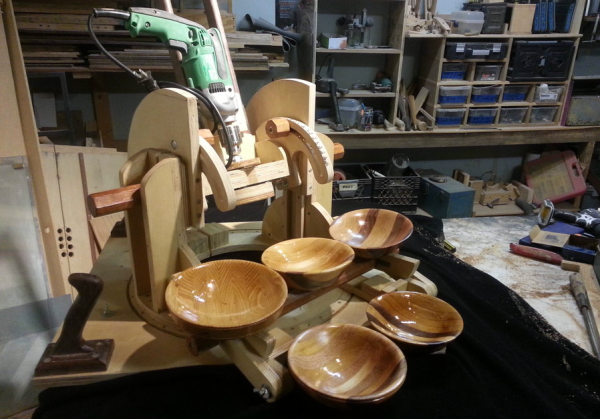
The master maker of weird wood working tools, [Izzy], decided to make a wooden bowl without the use of a lathe. He created a unique fixture to cut the shape of the bowl on a table saw, a piece of equipment that is a bit more common for the average DIYer to have. The fixture itself is made of wood and supports a standard hand drill in a vertical position. The soon-to-be bowl is bolted to the drill and hovers just above the table saw blade. The table saw is turned on and the fixture allows the work piece to rock back and forth creating the bowls outside shape. The drill rotates the piece so that the contours are consistent around the bowl.

The bowl is then flipped over and re-attached to the drill. This time to cut the inside of the bowl, the fixture is locked in the vertical position and the wood is dropped straight down on the spinning blade while being rotated. The saw blade cuts a perfectly hemispherical cavity in the wood. The final bowl looks great after a little sanding and an application of oil. Check out the video after the break.

This isn’t the first time [Izzy’s] projects have been here on Hackaday, check out his DIY Band Saw and Wooden Sphere Cutter.

Continue reading “Making A Wooden Bowl Without A Lathe”

Putting Two Years Into One Bowl

bowl


Over the last few months, [Frank Howarth] has been putting a lot of effort into a gigantic sequoia log he started milling two years ago. He recently completed a wonderful chair, but in the years these gigantic blocks of lumber have been sitting around, he’s always had one project in the back of his mind: a giant wooden bowl made from this sequoia log.

The wood for this bowl came from a relatively small cutoff from the original sequoia log. [Frank] had initially cut this cutoff into a circle to let it dry for an eventual run on a lathe. The bowl blank was so big, though, that he needed to create a jig to trim off most of the excess and keep from wasting many hours with a gouge.

With a bowl this large – about 20 inches across – simply screwing it onto the lathe wasn’t an option. [Frank] had to construct a jig for his chuck, capable of holding the bowl by the rim so he could shape the bottom.

The end product, coated with linseed oil and beeswax, is a work of art. Making anything this size on a lathe takes a lot of skill, and we’re thankful for [Frank] sharing it with us.