Old School High Voltage Capacitance


What would MacGyver do if he needed a high voltage capacitor but only had some foil, tape, water, salt, a nail and a plastic jug?  He would build a salt water Leyden jar, that’s what.  The Leyden jar is a very simple capacitor. Invented in 1745, it has been integral to many scientific experiments. Check the wikipedia entry to learn more about the history.

This specific type is quite easy to make. It uses a salt water interior instead of foil on the inside and outside. That means you could slap one of these together in a few minutes to impress your friends and/or electrocute yourself accidentally.  Please be careful as this is high voltage.

Reusing PCB Components


If you’re anything like us, you have a closet full of old electronics, some broken, some obsolete. You can stop using those as paperweights with the help of this guide that shows you how to recycle and reuse PCB components.

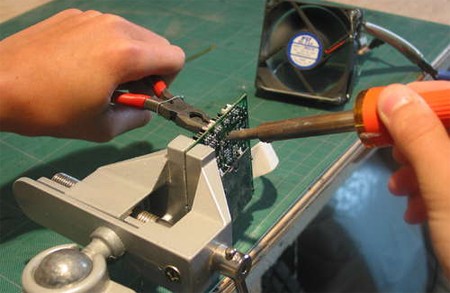
The first step of the process is finding electronics you don’t mind taking apart. Next place the PCB you’ll be stripping in a vice, with the components facing away from you and the solder side facing towards you. Grip the component you want with a pair of pliers, and apply a hot soldering iron to the solder that is holding the component. The solder will melt and allow you to safely and cleanly remove the component.

This process can be applied to virtually any component on an PCB, and the author of the guide, [Patented], got a lot of components this way, including resistors, capacitors, switches, audio jacks, and much more. Don’t forget to toss any free-floating metal or plastic parts in the recycle bin when you’re done. You can feel good about the fact that nothing was wasted, you found parts for your next project, and you cleared out some space.