Platinum-group metals (PGMs) are great catalysts, but they’re also great investments — in the sense that they are very, very expensive. Just ask the guy nicking car exhausts in the Walmart parking lot. If one could replace PGMs with a more common element, like, say the aluminum that makes up over 8% the mass of this planet, it would be a boon to the chemical industry, and a bane to meth addicts. Researchers at King’s College, London have found a way to do just that, with a novel form of aluminum called cyclotrialumane.
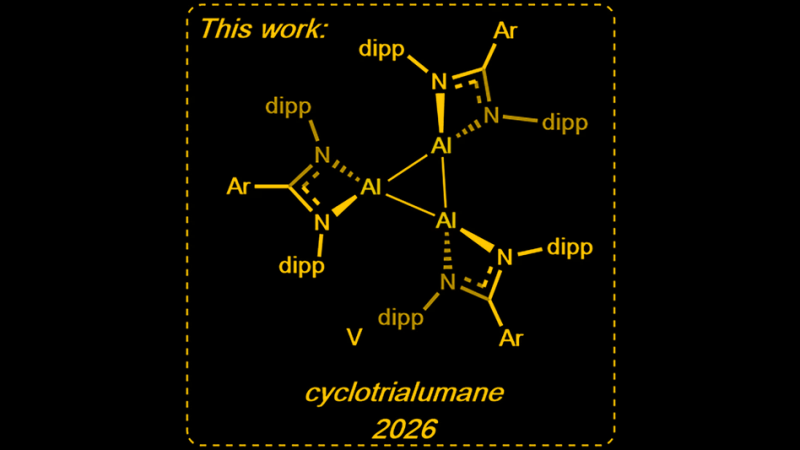
The aluminum trimer is exactly what the ‘tri’ in the name makes it sound like: three aluminum atoms, bonded in a triangular structure that is just pointy and stick-outy enough to poke into other molecules and make chemistry happen. OK, not really — you can see from the diagram above it’s not nearly that simple — but the point is that the shape makes it a good catalyst. The trimer structure is useful in large part because it is very stable, allowing reactions to be catalyzed in a large variety of solutions.
The researchers specifically call out their trialuminum compound as effective at splitting H2 in to H+ ions, as well as ethene polymerization. Both of those are important industrial reactions, but that’s only a start for this trialuminum wonder catalyst, because the researchers claim it can catalyze totally new reactions and create previously-unknown chemicals.
If you never took chemistry, or it’s been too many years since you last slept through that class, we have a primer on catalysts here. By accelerating chemical reactions, catalysts have enabled some neat hacks, like anything involving platinum-cure silicone.
Thanks to [Lightislight] for the tip! Hacks do appear here on their own, but you can always use our tips line to catalyze the synthesis of a particular article.
Header image adapted from: Squire, I., de Vere-Tucker, M., Tritto, M. et al. A neutral cyclic aluminium (I) trimer. Nat Commun 17, 1732 (2026). https://doi.org/10.1038/s41467-026-68432-1