
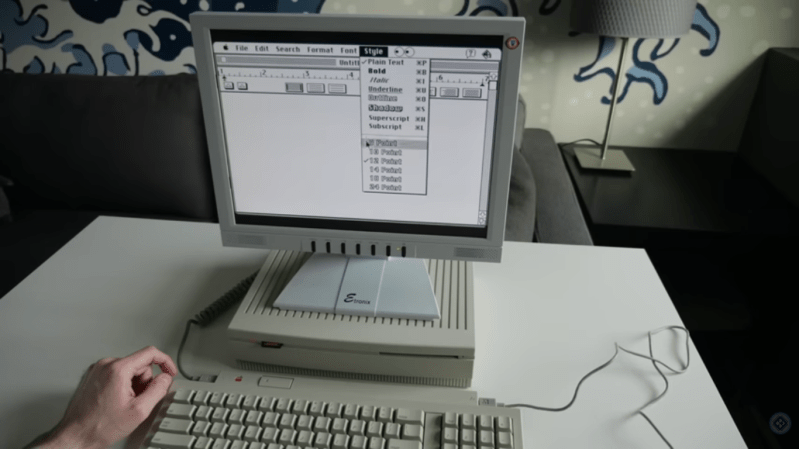
Apple’s Intel era was a boon for many, especially for software developers who were able to bring their software to the platform much more easily than in the PowerPC era. Macs at the time were even able to run Windows fairly easily, which was unheard of. A niche benefit to few was that it made it much easier to build Hackintosh-style computers, which were built from hardware not explicitly sanctioned by Apple but could be tricked into running OSX nonetheless. Although the Hackintosh scene exploded during this era, it actually goes back much farther and [This Does Not Compute] has put together one of the earliest examples going all the way back to the 1980s.
The build began with a Macintosh SE which had the original motherboard swapped out for one with a CPU accelerator card installed. This left the original motherboard free, and rather than accumulate spare parts [This Does Not Compute] decided to use it to investigate the Hackintosh scene of the late 80s. There were a few publications put out at the time that documented how to get this done, so following those as guides he got to work. The only original Apple part needed for this era was a motherboard, which at the time could be found used for a bargain price. The rest of the parts could be made from PC components, which can also be found for lower prices than most Mac hardware. The cases at the time would be literally hacked together as well, but in the end a working Mac would come out of the process at a very reasonable cost.
[This Does Not Compute]’s case isn’t scrounged from 80s parts bins, though. He’s using a special beige filament to print a case with the appropriate color aesthetic for a computer of this era. There are also some modern parts that make this style computer a little easier to use in today’s world like a card that lets the Mac output a VGA signal, an SD card reader, and a much less clunky power supply than the original would have had. He’s using an original floppy disk drive though, so not everything needs to be modernized. But, with these classic Macintosh computers, modernization can go to whatever extreme suits your needs.
Thanks to [Stephen] for the tip!












intel made it easier to port to mac?? i mean, maybe assuming little endianness is convenient. But it’s not the CPU that makes it hard to port to mac, it’s the APIs. Totally different GUI, different audio access, etc. Nothing against the OS X APIs, it’s just that’s the difference.
Binary compatibility. People in the non-open-source world may sell their company’s IP in binary form for things like software libraries. And yes, endianess is also a factor. It’s not hard to accidentally write code which is endian-dependent.
None of this is true. It’s not true that apple used unix or anything like it for much of their history, and it’s not true that they maintained any meaningful attempt at POSIX compatibility, and it’s not true that just being unix-like (or even “POSIX”) would guarantee compatibility.
Well, it is a hackintosh, but in one of the other meanings of the word.
wow! taking an original motherboard! how briliant! I would call this a casemod. and maybe the psu could be afapted, but scsi harddrives from a pc?? or the proprietary apple floppy drive? nope. the scsi maybe, but in my time those only resided in workstations, not in regular pc’s
As someone doing the actual case mods in the time, i got a quadra 660av without its cover. I moved all the hardware including a stripped down psu into a file binder common in europe and ran filemaker on it.
But yeah, printing a mac lc case for the se board is also cool.
Definitely a case mod here. As someone else mentioned the first real hackintoshes were Amigas
Using an original motherboard is certainly an easier path than a lot of more modern hackintoshes.
Not a mac SE in photo, that’s an LC40 (probably)
That’s the printed case, not original.
I find it fascinating that we can get this type of entertainment through Youtube. At the time when that Macintosh model was sold, people watched Dynasty or Cosby Show on TV and what the video describes existed only in William Gibson novels. Nowadays people watch Youtube videos of this kind of otakus that mod hardware with custom built parts instead of family soap operas on TV… Well, it’s true at least for the half a million subscribers this guy has.
Hi! I think similar. Youtube really made webTV and DIY content popular.
That being said, the technology was available before.
So Youtube wasn’t perhaps needed for thisvto happen eventually.
There was online streaming in early 90s already.
Real Video/Audio and QuickTime were available before 1995, I think.
I remember they had plug-ins for Netscape Navigator 2, too.
Windows 3.1 users also had Video for Windows in addition (equivalent built into Windows 95).
Other obscure formats and plug-ins had existed, as well.
MPEG, AVI and MOV videos were found on cover CDs of various magazines years before DVD was out.
They often had consisted of little reviews and behind-the-scenes videos.
There also had been video platforms such as, say, Clip Fish in early to mid 2000s.
https://en.wikipedia.org/wiki/Timeline_of_online_video
Many of these Video CDs can be found on archive.org
Rewinding even farther, going back all the way to the 1980s Computer Chronicles had both a radio show (!!) — podcasters before there were podcasts, you might say — and a PBS series that covered computing topics the same way Entertainment Tonight covered Dynasty and the Cosby Show.
Granted, their focus was a little more mainstream, so you’d see “this guy started a company to sell his hardware/software idea” more than “here’s something I made in my garage”. The democratizing of the platform to the point where any lone weirdo with an idea can conceivably present that idea directly to millions of people, without any sort of corporate or media gatekeeping… that’s definitely a post-internet sort of phenomenon. And YouTube for sure was, and even still is, at the very center of it.
Fair enough.
The era of home videos (self recorded footage) started with Super 8, even, I guess.
In the 70s (and 80s), portable video recorders and compact TV cameras become more popular, too.
The early simple formats were in black/white and meant for reporters and art projects, rather.
Um, before the internet it already was possible for the private person to share video footage with others over amateur radio.
The 70cm amateur band (430-440 MHz or 430 to 450 Mhz) was broad enough for ATV (amateur radio television).
It was a normal TV broadcast, basically.
Later, it was done at microwave bands and required a sat receiver and a custom antenna.
https://en.wikipedia.org/wiki/Amateur_television
Possibly before 1992, I played with VideoSpigot for Macintosh IIci and it had Quicktime to handle video compression.
jep. my copy of quicktime 1.0 on cd-rom is from 1991. very nice artwork:
https://www.todocoleccion.net/coleccionismo/cd-software-quicktime-1-0-for-developers-macintosch-1991-original-apple~x408069869
i would not pay that amount for it though..
It’s important to keep in mind that if you’re only seeing YouTube videos through the lens of Hackaday, then it’s easy to get such an impression, but there’s a lot more out there which is much closer to “classic” TV of that era. It’s just not posted here, as it’s not relevant to the typical Hackaday audience.
I’m a bit of a cooking nerd, and Townsends has the sort of calm, cozy feeling that I remember from growing up watching Norm Abram’s This Old House. Later in the 90’s and into the early 00’s I latched onto Good Eats, so imagine my shock and joy to find that about four months ago, Alton Brown rebooted his unique blend of science, comedy, and cooking via an already 18-episode-long series, Alton Brown Cooks Food, on his channel.
The latter, especially, is one of those “you wouldn’t get it if you weren’t there at the time” things – but whereas comments on YouTube are usually a cesspit of negativity, the comments on Alton’s first episode are overflowing with people in their 30’s, 40’s, into their 50’s and up to retirement age, all expressing joy that he’s back and still doing what he loves. Parents reminiscing about how they bonded with their kids by watching Good Eats back in the day. People in their 30’s talking about how they rushed over to their parents’ place the moment they found the episode, so they could watch it with their parents just like they watched Good Eats with them decades ago.
It’s really easy to get carried away with all of the bite-sized, jingling-keys content that gets spat out onto platforms like TikTok and YouTube, but it’s equally important to bear in mind that you can find pretty much whatever content you want, and some of it is done to a degree of quality that matches or exceeds what we grew up with in the 80’s or 90’s. Some of it can be positive, some of it can be negative, but at the end of the day you are the one in control of what you search for.
Is there an opposite of nostalgic, because I dislike this on so many levels, let me try to be respectful and take this as constructive criticism. Firstly, Hackintosh is to me using an x86(or x86_64) motherboard and running a Mac OS on it. This project is hacking a Mac, please leave out confusing “Hackintosh” label! Secondly at the time, 68k Apple Mac users were very proud and using cheap PC parts might have been desirable, but viscerally it felt like downgrading. Mac users would not even call their computers PCs! While IBM was playing a losing game at trying to get the public to use “Personal Computer” strictly for their own hardware, it was becoming used for “clones” (even non-completely-PC-DOS-compatible x86 “workalikes”, and the “Luggables”) Now the internet uses “PC” and “personal computer” to describe Macs and even earlier home computers. But at that time I’d laugh at the term as a pathetic label. Also from that time, “Here kid, here’s 5 cents, buy yourself a real computer!” For me, someone who for many years cherished a Quadra 650 with a DOS Card(486 chip, couldn’t be used simultaneously, and I never could get Windows, 3.x nor 95, working acceptably), well frankly the headline feels like deceptive clickbait. If you can get a 486 or Pentium running a pre-OS X Apple OS, or even perhaps running a Linux with a desktop that imitates OSX on vintage hardware… But hacking vintage PC parts into vintage Mac? Call it anything else but.
well put, this is nothing more than clickbait.
Back when the Mac Plus was the hot thing, I was able to find a Mac 128K motherboard for cheap. Someone had already published a Hackintosh article, I think in Byte magazine (or maybe Computer Shopper?), about how to convert the Mac video into something a generic monitor could eat, along with the pin-out of the analog board connector (for hooking up your own power supply). I upgraded the board to 512KB, but unfortunately made a mirror-image mistake when trying to neaten up the power supply connection, which swapped 5V and 12V. This blew out all the memory chips I’d just swapped, but somehow didn’t kill anything else. I had to put back in the 128KB until I saved up for another set of larger chips. I think I actually upgraded it to 1MB, using stacked chips. Not sure what happened to that setup. I got an Amiga 500 soon after, and the Mac got abandoned.
I would be curious to know if the PLA printed case will warp because of the heat generated internally and the weigth of the monitor put on the top.
Huh? First Hacintosh was Amiga 1200, that could run Mac OS 7 software, as far as I remember.