Hackaday Europe 2026: Open Source Hardware Goes Underground, Literally

These days open source is everywhere, and frankly, we couldn’t be happier about it. But even with as prevalent as open software and hardware has become, we still occasionally hear about a project that takes the concept somewhere unexpected. Which is precisely why we were so eager to hear more about the fascinating work [Phil Underwood] has been doing.

In his talk Open Source Caving: 20 Years of Making Cave Mapping Tools at Hackaday Europe 2026, [Phil] takes us through a series of progressively more advanced open hardware devices that he’s designed to increase the speed and accuracy of underground mapping efforts. Along the way, he’s learned a number of valuable lessons about designing hardware that’s robust enough to handle the uniquely challenging environment underground while still being accessible enough for a hobbyist to build and use.

Continue reading “Hackaday Europe 2026: Open Source Hardware Goes Underground, Literally”

Making Your Own Caving Headlamp

An important distinction between equipment used for caving, climbing, biking, and other outdoor activities is the level of stress that’s generally applied. For instance, while climbing helmets are built to withstand the impact of sharp rocks, they’re not made to protect a biker’s head from suddenly hitting the ground. Likewise, while camping headlamps may be able to survive a light rainfall, they’re probably not made to shine at the 800 lumens after being submerged underwater.

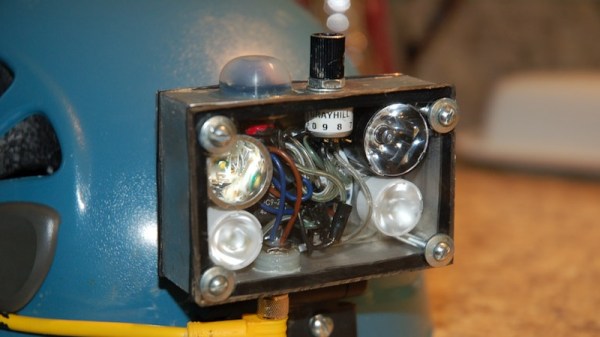
[LukeM] built himself a caving headlight, after being “fed up with what was available on the market”. While his project is a bit older, it’s still pretty helpful for any newer hobbyists looking to try their hand at building a custom headlamp. Many cavers have to carry around a few primary – one main light for general visibility and a secondary light for focusing on specific objects. These are typically worn on the helmet, attached somehow to prevent the light source from falling off mid-climb. From tricky operations, varying distances, cost, and ease of battery replacement, there are a number of reasons why a caver might want to build their own customizable head lamp.

The result is rugged, waterproof, reliable, bright enough to supplement flashes in caving photos and also dim enough for general use (30-700 lumens). It has options for wide and narrow beams, displays a neutral to warm color, and is relatively upgradeable without too much trouble. At the same time, it’s also fairly compact, with all of the components packed inside of a short section of 3″x2″ aluminum tubing, protected at the back and front by aluminum and acrylic backings. The LEDs used are four Cree XP-E R2 bin LEDs and a hipFlex driver from TaskLED with programmable settings for max output, thermal protection temperature, warning voltage, and lighting modes. I’m personally already smitten with the level of customizability of this build.

On top of all of that, it’s been cave tested and approved!

Hackaday Prize Entry: Cheap, Open LiDAR

[adam] is a caver, meaning that he likes to explore caves and map their inner structure. This is still commonly done using traditional tools, such as notebooks (the paper ones), tape measure, compasses, and inclinometers. [adam] wanted to upgrade his equipment, but found that industrial LiDAR 3D scanners are quite expensive. His Hackaday Prize entry, the Open LIDAR, is an affordable alternative to the expensive industrial 3D scanning solutions out there.

The 3D scan of a small cave near Louisville (source: [caver.adam's] Sketchfab repository)
The 3D scan of a small cave near Louisville from [caver.adam’s] Sketchfab repository
LiDAR — Light Detection And Ranging —  is the technology that senses the distance between a sensor and an object by reflectively measuring the time of flight of a light beam between the two. By acquiring a two-dimensional array of multiple distance readings, this can be used for 3D scanning. Looking at how the industrial LiDAR scanners capture the environment using fast spinning mirrors, [adam] realized that he could basically achieve the same by using a cheap laser range finder strapped to a pan and tilt gimbal.

The gimbal he designed for this task uses stepper motors to aim an SF30-B laser rangefinder. An Arduino controls the movement and lets the eye of the sensor scan an object or an entire environment. By sampling the distance readings returned by the sensor, a point cloud is created which then can be converted into a 3D model. [adam] plans to drive the stepper motors in microstepping mode to increase the resolution of his scanner. We’re looking forwards to see the first renderings of 3D cave maps captured with the Open LIDAR.

The HackadayPrize2016 is Sponsored by: