
DECing Out The Homelab With An AlphaServer 2100

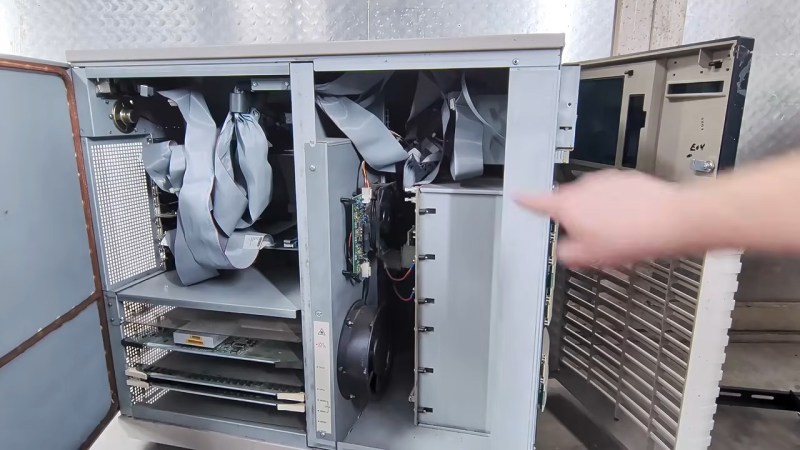
Retrocomputer enthusiasts have a bad rap as nerds who just want to play old video games. There’s some truth in this, but the reality is that we’re nerds who want to do all sorts of things with old hardware — everything from consoles to servers. Servers like the DEC AlphaServer 2100 [derelictelectronics] picked up at Vintage Computer Festival Midwest this year. He was kind enough to record a tour for those of us who missed seeing these early Alpha machines in their heyday.

DEC did sell these units with multiple-CPU reports from the get-go, but the [derelictronics] particular model hasĀ  a single CPU board carrying a 64-bit Alpha RISC processor. This machine from 1994 dates to near the height of the RISC wars when it seemed everyone needed to have their own high-end architecture, all of them RISC. While the machine could host up to 2GB of RAM, the example [derelictelectronics] found only has 256 MB, which was still not a small number for 1994!

Continue reading “DECing Out The Homelab With An AlphaServer 2100” →
The Weird Way A DEC Alpha Boots

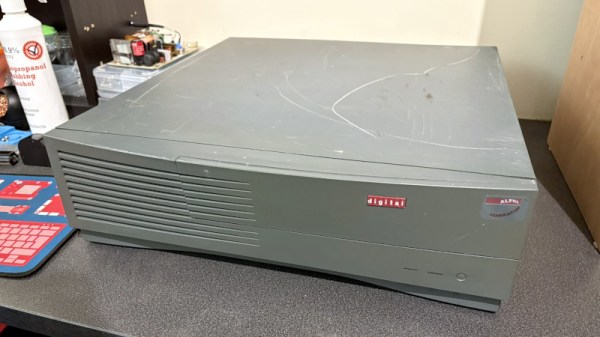
We’re used to there being an array of high-end microprocessor architectures, and it’s likely that many of us will have sat in front of machines running x86, ARM, or even PowerPC processors. There are other players past and present you may be familiar with, for example SPARC, RISC-V, or MIPS. Back in the 1990s there was another, now long gone but at the time the most powerful of them all, of course we’re speaking of DEC’s Alpha architecture. [JP] has a mid-90s AlphaStation that doesn’t work, and as part of debugging it we’re treated to a description of its unusual boot procedure.

Conventionally, an x86 PC has a ROM at a particular place in its address range, and when it starts, it executes from the start of that range. The Alpha is a little different, on start-up it needs some code from a ROM which configures it and sets up its address space. This is applied as a 1-bit serial stream, and like many things DEC, it’s a little unusual. This code lives in a conventional ROM chip with 8 data lines, and each of those lines contains a separate program selectable by a jumper. It’s a handy way of providing a set of diagnostics at the lowest level, but even with that discovery the weirdness isn’t quite over. We’re treated to a run-down of DEC Alpha code encoding, and should you have one of these machines, there’s all the code you need.

The Alpha was so special in the 1990s because with 64-bit and retargetable microcode in its architecture it was significantly faster than its competitors. From memory it could be had with DEC Tru64 UNIX, Microsoft Windows NT, or VMS, and with the last of which it was the upgrade path for VAX minicomputers. It faded away in the takeover by Compaq and subsequently HP, and we are probably the poorer for it. We look forward to seeing more about this particular workstation, should it come back to life.









