
Motion Control Via Belt

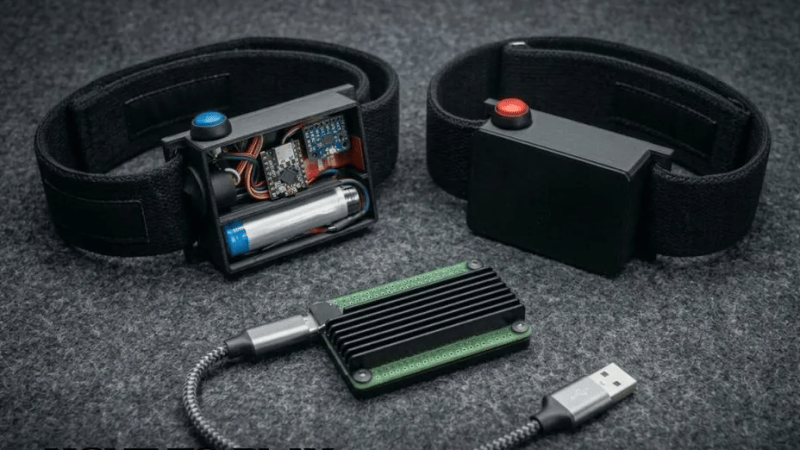
[Tolko] wanted to encourage kids to have some physical activity, but noted that they only wanted to play games. That led to BlobJump, a Raspberry Pi-based game sort of like the famous dinosaur runner game. The difference? Your body — or more precisely, a belt worn on your body — is the controller. Your jumping and ducking make your on-screen avatar do the same thing. Watch the video below to see the game in action.

Each belt contains an ESP32-C3, an MPU-6050, and enough rechargeable battery to make it all work. Everything is wireless, of course. We didn’t see any video of the actual kids, so we don’t know how active they were or whether they figured out they could just have a seat and move the belts in their hands. Even so, it looks like a fun game.

We couldn’t help but think that, beyond encouraging activity, this might be a great project to get a kid excited about building hardware and software. You could certainly do worse in that department.

This isn’t a totally new idea, but we liked the execution. If you are truly lazy, you can skip playing the game completely.

Continue reading “Motion Control Via Belt” →

ATtiny85 Plays The Chrome Dinosaur Game

If you’ve ever had your internet connection drop out while running Chrome, you’ve probably seen a little dinosaur pop up to tell you what’s going on. You might have then tapped a key and learned that it’s actually a little mini-game built into the browser where you have to hop your intrepid T-rex over a bunch of cactii. [Albert David] is well familiar with this little Easter egg, and set about building a system to automatically play the game for him.

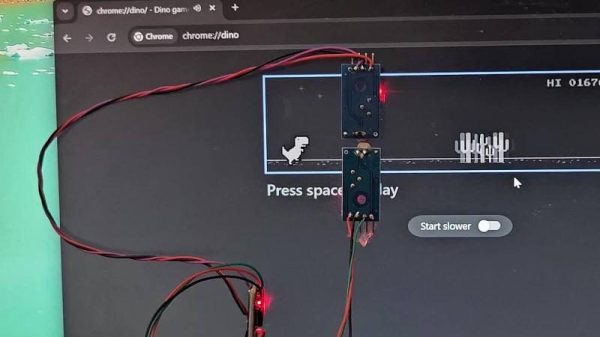
The build uses an Digispark ATtiny85 microcontroller board to run the show. It’s set up to plug in to a PC and enumerate as a USB HID device, so it can spoof the required key presses to play the game. To sense the game state, the device uses a pair of LM393 light-dependent resistor comparator modules. The bottom sensor is used to detect cactus obstacles in the game, while the upper sensor detects flying bird obstacles. Armed with this information, the microcontroller can deliver keypresses at just the right time to jump over cactuses while dodging birds overhead.

[Albert] does a great job of explaining how the project came together in the write-up. There are also useful calibration instructions that indicate how to place the sensors and tweak their thresholds so they trigger reliably and help you net a suitably high score.

Interestingly enough, this isn’t the first time we’ve seen a microcontroller take Chrome’s hidden game for a spin. The game itself has become popular enough that we’ve also seen it ported to other platforms.
Continue reading “ATtiny85 Plays The Chrome Dinosaur Game” →








