Motion Control Via Belt

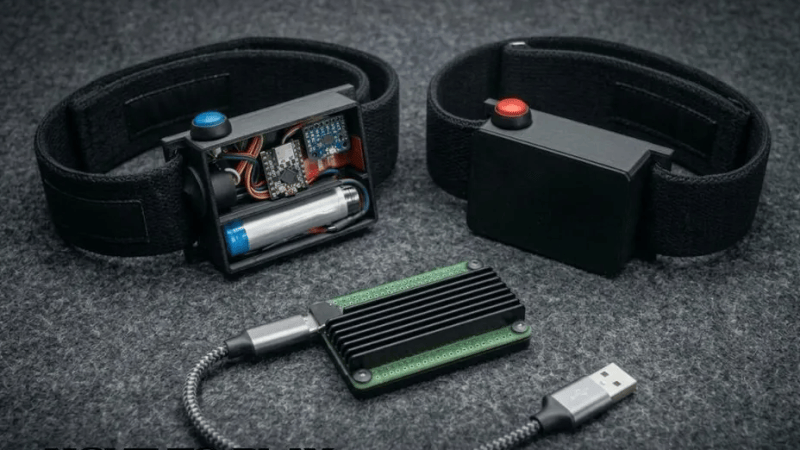
[Tolko] wanted to encourage kids to have some physical activity, but noted that they only wanted to play games. That led to BlobJump, a Raspberry Pi-based game sort of like the famous dinosaur runner game. The difference? Your body — or more precisely, a belt worn on your body — is the controller. Your jumping and ducking make your on-screen avatar do the same thing. Watch the video below to see the game in action.

Each belt contains an ESP32-C3, an MPU-6050, and enough rechargeable battery to make it all work. Everything is wireless, of course. We didn’t see any video of the actual kids, so we don’t know how active they were or whether they figured out they could just have a seat and move the belts in their hands. Even so, it looks like a fun game.

We couldn’t help but think that, beyond encouraging activity, this might be a great project to get a kid excited about building hardware and software. You could certainly do worse in that department.

This isn’t a totally new idea, but we liked the execution. If you are truly lazy, you can skip playing the game completely.


Continue reading “Motion Control Via Belt” →

Interconnected circuits for controlling the clock

Tick, Tock, Train Station Clock

We’ve seen a few H-bridge circuits around these parts before, and here’s another application. This time we have an Old Train Station Clock which has been refurbished after being picked up for cheap at the flea market. These are big analog clocks which used to be common at railway stations around the world.

This build uses an ESP32 C3-mini microcontroller (PDF) in combination with an A4988 Microstepping Motor Driver (PDF). The logic is handled with MicroPython code. The A4988 provides two H-bridge circuits, one for each of two stepper motors, only one of which is used in this build.

The controller for this clock needs to send an alternating positive then negative DC pulse every minute to register that a minute has passed so the clock can update its hour hand and minute hand as appropriate. The ESP32 and the A4988 H-bridge cooperate to make that happen. The wifi on the ESP32 C3-mini is put to good use by facilitating the fetching of the current time from the internet. On an hourly basis the clock gets the current time with a HTTP call to a time server API, for whatever is suitable for your time zone.

Thanks to [PiotrTopa] for writing in to let us know about his project. If you’re interested in learning more about H-bridge applications be sure to check out Introduction To The H-bridge Motor Controller and A H-Bridge Motor Controller Tutorial Makes It Simple To Understand.