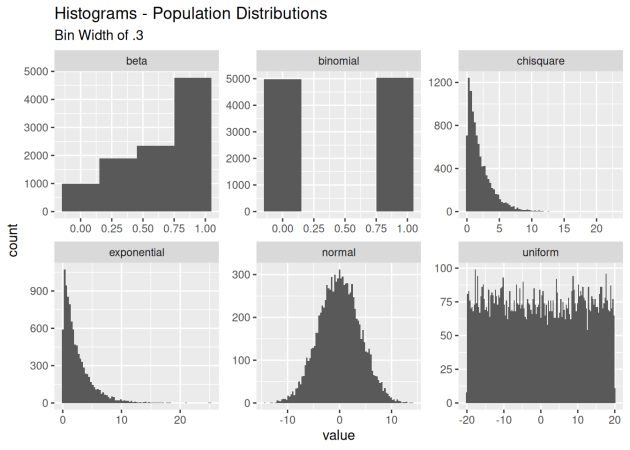
Simulating And Visualising The Central Limit Theorem

Statistics is one of those fields which people tend to love or hate when they’re confronted with it during their school time. Although incredibly useful and even essential in many fields, including finance and engineering, it’s not always easy to grasp even the basics such as those pertaining to distributions. The Central Limit Theorem (CLT) is an essential element there, which [Greg Foletta] tried to make easier to comprehend using some code samples and visualizations.

The essential summary of the CLT is that if you take the mean of each sample in a set, once you have enough (>30) samples, the distribution of the sample means approaches a normal distribution. This is quite the theorem to put out there, with the supporting proof and explanations on e.g. Wikipedia being very mathematics-heavy.

We’d be remiss not to also mention the excellent [3Blue1Brown] video on the topic, which has even snazzier visualizations if you’re more into learning in that fashion. Even if you don’t think that you need to learn statistics and how distributions work, chances are that you’ll come across a situation where it could have come in handy, or at least have deepened your understanding of a topic like the probability of something happening.

Continue reading “Simulating And Visualising The Central Limit Theorem” →

The Distroless Linux Future May Be Coming

Over the decades the number of Linux distributions has effectively exploded, from a handful in the late ’90s to quite literally hundreds today, not counting minor variations. There lately seems to be a counter-movement brewing in response to this fragmentation, with Project Bluefin’s Distroless project being the latest addition here. Also notable are KDE’s efforts, with KDE Linux as its own top-down KDE-based distro, but now with a switch to BuildStream from Arch likely as a distroless move.

It should be clear that there is no obvious course here yet, and that opinions are very much divided. The idea of ‘Linux’ becoming a more singular OS appeals to some, while to others it’s the antithesis of what ‘Linux’ is about. This much becomes clear in [Brodie Robertson]’s exploration of this topic as well.

The way to think about ‘distroless’ is that there is a common base using the Freedesktop SDK on which the customization layer is applied, such as Bluefin, KDE or Gnome’s environments. You could think of this base as the common runtime, using the Freedesktop standards for interoperability for a user-selected layer that’s installed on top. This way the idea of basing a distro on a specific distro is tossed out in favor of something that’s vaguely reminiscent of the Linux Standard Base attempt at standardization.

Continue reading “The Distroless Linux Future May Be Coming” →