Perfecting The Shape-Changing Fruit Bowl

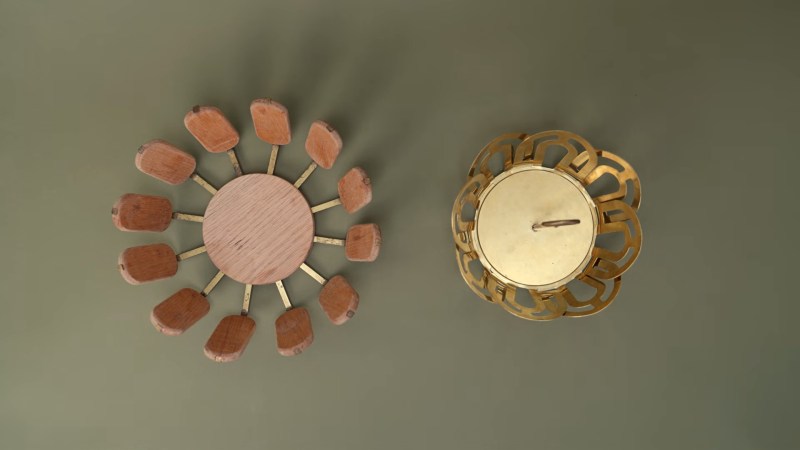
Fruit bowls have an unavoidable annoyance– not flies and rotten fruit, those would be avoidable if your diet was better. No, it’s that the bowl is never the right size. Either your fruit is sad and lonely in a too-large bowl, or it’s falling out. It’s the kind of existential nightmare that can only be properly illustrated by a late-night infomercial. [Simone Giertz] has a solution to the problem: a shape-changing fruit bowl.

See, it was one thing to make a bowl that could change shape. That was easy, [Simone] had multiple working prototypes. There are probably many ways to do it, but we like [Simone]’s use of an iris mechanism in a flat base to allow radial expansion of the walls. The problem was that [Simone] has that whole designer thing going on, and needs the bowl to be not only functional, but aesthetically pleasing. Oh, and it would be nice if expanding the bowl didn’t create escape routes for smaller fruits, but that got solved many prototypes before it got pretty.

It’s neat to see her design process. Using 3D printing and CNC machining for prototyping is very familiar to Hackaday, but lets be honest — for our own projects, it’s pretty common to stop at “functional”. Watching [Simone] struggle to balance aesthetics with design-for-manufacturing makes for an interesting 15 minutes, if nothing else. Plus she gives us our inspirational quote of the day: “As much as I feel like I’m walking in circles, I know that product development is a spiral”. Something to keep in mind next time it seems like you’re going around the drain in your own projects. Just be warned, she does have a bit of a potty mouth.

We’ve featured [Simone]’s design decisions here, if you’re interested in seeing how she goes the rest of the way from project to product. We’re pretty sure her face-slapping-alarm clock never made it into the SkyMall catalog, though.
Continue reading “Perfecting The Shape-Changing Fruit Bowl”

World’s Greatest Bubble Machine Born Of Space Program

[GordonKirkwood] needs soap bubbles. Big soap bubbles. Why does he need soap bubbles? Because – soap bubbles!

Actually, [Gordon] is a photographer, and he wants to capture candid moments and fleeting expressions. What better way to inspire wonder and amazement than to be able to produce a giant soap bubble on demand? And what better way to do it than with an intricate, computer controlled giant bubble machine?

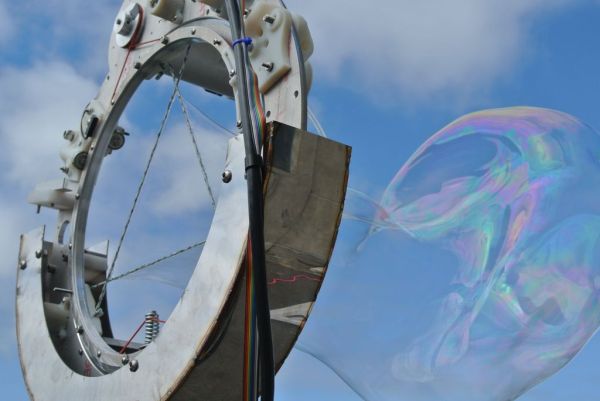
[Gordon’s] inspiration for the bubble producing mechanism comes from the end effector of the Canadarm robotic Space Shuttle arm, which used a cable-grapple design to snare and secure payloads. [Gordon] uses a similar principle to interweave bubble juice-soaked strings and pull them apart in a plane to form a soap film. A puff of wind or a quick shot from a fan inflates and launches the bubble, which the mechanism can pinch off for precise control of size.

The amount of work [Gordon] put into the machine is impressive. His Instructables post is incredibly detailed and goes into not only his build but also his design process and prototyping, the science of soap bubble instruments, and even a nod to the work of other pioneering bubble enthusiasts. And he thoughtfully includes a recipe for professional-grade bubble juice, with a secret ingredient that may surprise you.

You say your bubble-producing needs run more toward quantity than quality? Try using the juice in this homemade bubble robot.

Continue reading “World’s Greatest Bubble Machine Born Of Space Program”

Mechanical Iris Will Make You Want A Laser Cutter Even More

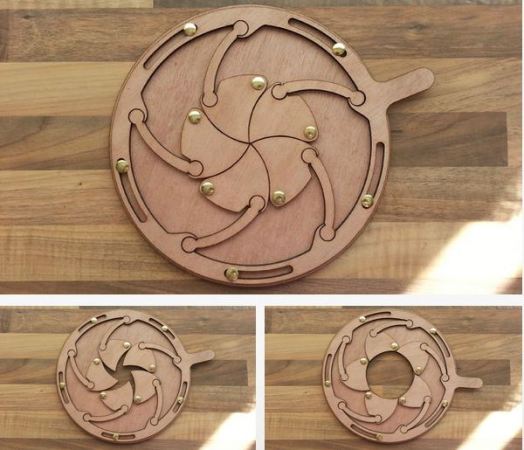
Mechanical irises are very intricately designed mechanisms that are mesmerizing to see in action — and if you have a laser cutter, you could make one in less than 10 minutes.

Our “Teacher of Science”, Instructables’ user [NTT] has revised a previous Instructables design on a mechanical iris to improve it. The original design used three layers of components and dowel pins for every joint. What [NTT] has done is reduced this to two layers, and eliminated half of the pins required by designing clever circular cutouts. The result is a very slick mechanical iris that is very easy and quick to build — provided you have the tools.

Stick around to see the original iris open and close — unfortunately there’s no video of the new design — but we think you can imagine the differences.

Continue reading “Mechanical Iris Will Make You Want A Laser Cutter Even More”