Hackaday Links Column Banner

Hackaday Links: June 14, 2015

You know we’re running this gigantic contest to build hardware and send someone to space, right? We’re doing community voting right now. If you’re on Hackaday.io, head over there and pick the best project. We’re giving away t-shirts and $1000 gift cards to people who vote. The drawing for this round is next Friday.

MicroPython is a pretty interesting development in the area of interpreted languages running on microcontrollers. It’s Python, the BASIC of the modern era, and now it’s being funded by the ESA. Great news, there’s going to be a port to SPARC, and it looks like MicroPython is going to be in a few satellites.

[EloquentlyMawkishBunny]’s calculator stopped working on the morning of his AP Physics test. It was the ribbon cable for the display. What did he do? He grabbed some magnet wire and made it work. If I’m reading this right, he did this the day of his AP test. Wow.

[Will] has made a name for himself by building roller coasters in his backyard. He’s also worked on the ProtoPalette, and now he’s building a hackerspace in Concord, California.

[Josh] needed to drill some very large holes with his mill. He decided a hole saw was the easiest way to do this, but his hole saw has a hex shank. He ended up chopping the shank of a hole saw extension, basically turning it into a hex to round adapter.

Did you know the Arduino IDE on Raspbian is stuck at version 1.0.5? The newest version is 1.6.4, and there’s useful stuff like autosave in the IDE now. Amazing. [CRImier] got the latest Arduino IDE working on the Raspberry Pi 2. Yes, there’s an issue up but if for some reason you’re programming Arduinos on the Pi, you should probably do this yourself.

Oooohhhh, case modding. The Intel NUC is a pretty interesting platform for case modding; it’s small, and I shouldn’t have to remind anyone of all the cool case mods that were created when the Mini-ITX format gained popularity in the early ‘aughts. [Femke] got herself an Intel NUC, made a case, and the results are amazing. How’d she get that metal bowl? Metal spinning. Very cool.

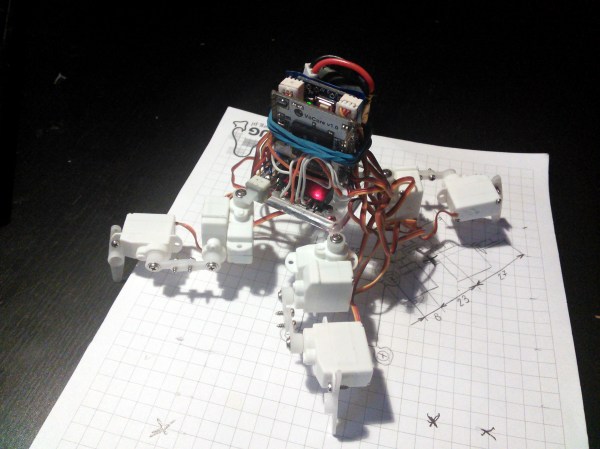
Pico-Kubik Quadruped Fits In The Palm Of Your Hand

Most of the legged robots we see here are of the hexapod variety, and with good reason. Hexapods are very stable and can easily move even if one or more of the legs has been disabled. [Radomir] has taken this a step farther and has become somewhat of an expert on the more technically difficult quadruped robot, building smaller and smaller ones each time. He has been hard at work on his latest four-legged creation called the Pico-Kubik, and this one will fit in the palm of your hand.

The Pico-Kubik runs Micropython on a VoCore board, which allows for it to have a small software footprint to complement its small hardware footprint. It accomplishes the latter primarily through the use of HK-282A Ultra-Micro Servos, an Arduino Pro Mini, and a tiny lithium ion battery. It’s still a work in progress, but the robot can already crawl across the tabletop.

This isn’t [Radomir]’s first time at the tiny quadruped rodeo, either. He has already built the Nano-Kubik and the µKubik, all of which followed the first (aptly-named) Kubik quadruped. Based on the use of SI prefixes, we can only assume the next one will be the hella-Kubik!