The Maths Behind A Chord Recognition Engine

A key part of any tertiary musical education is learning about all the wonderful (and less wonderful) types of chords out there. Typically this involves a great deal of exercises involving the identification of a given chord from its component notes. But how would you do this programmatically? Well, thankfully, the developers behind the WhatChord tool are happy to explain just how it’s done.

The problem with classifying chords is that the way musicians use them and construct them can be quite varied. Names can also be applied somewhat differently depending on the musical context of a given set of notes. To suit the musical reality of real players and composers, WhatChord uses a specially-developed scoring algorithm to try and nut out what a chord is actually supposed to be.

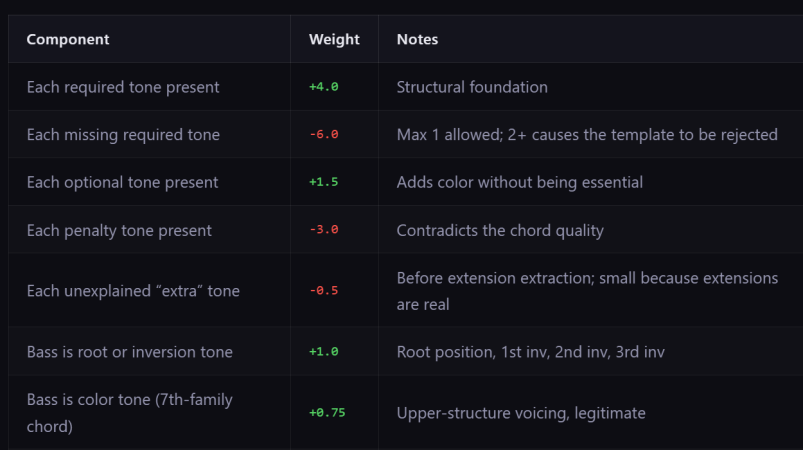
As an example, a major chord must require a root note and a major third interval. It can optionally include a perfect fifth. However, if there is a minor third, minor seventh, or major seventh present, then you’re almost certainly not looking at a simple major chord. WhatChord takes these things into account by weighting the different tones present and seeing which chord gets the highest score. The required notes add weight, while notes that shouldn’t be there add a penalty to the score. Then there are extra penalties for ambiguous “unexplained” tones, extensions, and a few other parameters to disambiguate edge cases.

If you’d like to see how it works in practice, you can check out the WhatChord app and see how good it is for yourself. Alternatively, explore some of the other chord-focused projects we’ve featured over the years, or send your best musical projects into the tipsline.

[Thanks to baschwar for the tip!]
Rock Out Without Getting Knocked Out

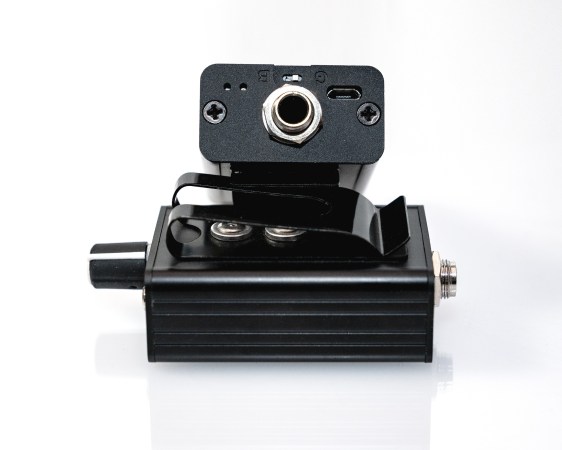
It’s a constant battle for musicians — how to practice your instrument without bothering those around you? Many of us live in apartments or shared accommodation, and having to wait until the apartment is empty or only being able to practice at certain times of day can be restrictive, especially if you need to practice for an upcoming gig or if the creative juices start flowing and it’s 3 AM! [Gavin] was having this issue and started developing Porter, a guitar/bass practice device which works with all effects pedals and is portable and rechargeable. So you can grind away your epic heavy metal solo no matter the time of day!

While there have been similar solutions, many musicians weren’t satisfied with the sound and often couldn’t support inputs from distortion pedals. They usually chewed through batteries and were just not a great solution to the problem. [Gavin] has spent the last two years fine-tuning the design. It’s a fully analog design, with built-in rechargeable batteries to boot. So it not only sounds great, but it can last as long as your practice session does with a 15-hour runtime when fully charged!

Initially, the project began as a headphone amplifier but morphed into a design specifically for guitar and bass, with preamp and power amp stages and adjustable input impedance – 500kΩ for guitars and 1MΩ for bass. The latest revision also changed to a different power amp that further reduced THD and led to an even better sound. The schematics are up on the Hackaday.io project page, but [Gavin] is also hoping to do a crowdfunding campaign to get these devices out into the hands of guitarists everywhere!

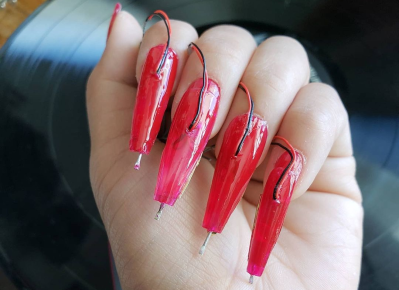
Glue-on nails with vinyl record pickups pierced through them that are used on a vinyl record

The Sound Of Nails On Black Vinyl Records

[Victoria Shen] modifies glue-on nails to give her the ability to play vinyl records with her fingers. Details are light but from the many glamour pictures, it looks like she pushes record player needles through glue-on nails with thin pickup wire that then presumably goes to an audio jack for amplification.

Photograph of hand with record needs through glue-on nails

[Victoria] experiments with novel musical tools for use in her art and performances. Be sure to check out the videos of the nails in action. The combination of “scratching” and ability to alter the speed of vinyl with the free fingers creates a weird and eerie experience.

Using her “Needle Nails”, [Victoria] has found she’s able to play multiple records simultaneously (Nitter). Thanks to the different diameters of 33, 78 and 45 vinyls, she’s able to stack them up while still keeping her fingers on them.

Glove like musical instruments are nothing new but the novel use of fashion, glamour and technology allow [Victoria Shen] the freedom to create something uniquely weird and cool, so much so that Beyonce used it in a video shoot for Vogue (Nitter).

Continue reading “The Sound Of Nails On Black Vinyl Records”

Travel Guitar Hacked With Digital FX Setup

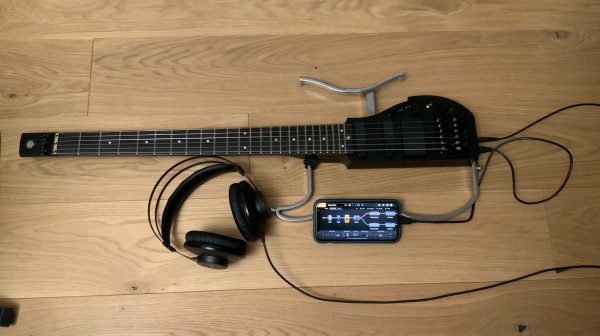
[Courcirc8] was a big fan of the ALP AD-80, with the travel guitar being a surprisingly competent instrument despite its folding form-factor. However, the onboard headphone amp left something to be desired, so it was time to get hacking.

To achieve better audio output, [courcirc8] decided to purchase an iRig HD 2 guitar interface, and installed it inside the body of the compact guitar. The original volume pot on the guitar was instead spliced into the iRig circuit, and a switch hooked up to allow the guitar to output clean tones to an amp or the digital audio output of the iRig instead. It’s a tight fit inside, but it all nestles in there rather neatly when finished.

The result is a compact guitar that has a capable digital FX platform built in to the body; all one has to do is hook up a smartphone to gain access to a broad selection of software effects.  It makes the guitar much more of a Swiss Army knife when playing on the road.

We’ve seen others before installing guitar effects into the instrument itself; it remains perhaps one of the best ways a hacker can express themselves with a completely individual instrument!

Live Jam Kit Helps Electronic Musicians Stay In Sync

Jamming live with synths and drum machines can be fun, but for [Christian], there was a little something missing. He was looking for a way to keep everyone in the group on the beat and rocking out, and decided to build something to help.

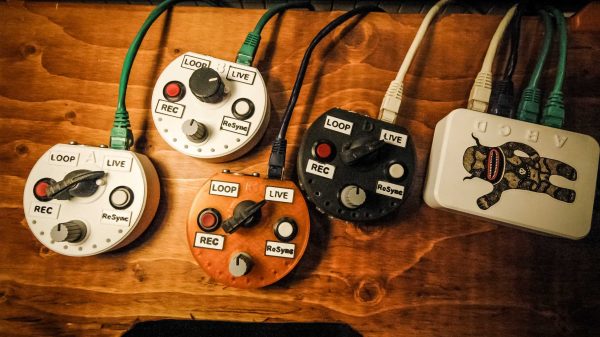
The ethos of the build was to put one person ultimately in charge of the mix using Ableton. This stops the volume race, as each musician turns their own volume up and the jam devolves into a noisy mess. Each musician also gets a sync button they can hit if their instrument has drifted out of time. Everyone in the jam also gets their own monitor signal in their headphones, as well as a looper as well.

Individual players in the electronic jam can whip up a cool little loop, and spit it out to the main controller running Ableton using the looper. Then, they can mix up something else in their headphones without disrupting the main mix, before spitting it out as a loop again.

[Christian]’s demo video does a great job of showing how it all works. We particularly like the sync button, which gets rid of the usual frustrations when a sequencer in the jam trips over the tempo signal.

It’s all built with a Teensy, and seems like a great way to organize a jam with a bunch of different synths and drum machines. We’d certainly love to join in the fun.

We’ve seen other fun jam kits too, like this neat networked solution. Video after the break.

Continue reading “Live Jam Kit Helps Electronic Musicians Stay In Sync”