One fascinating thing about a pulsed laser is that, though the average power may be measured in watts or milliwatts, the peak power can easily reach millions of times that. This happens even in normal operation, but as [Les’ Lab] demonstrated, adding a Q-Switch can considerably enhance the peak power.
A Q-switch is an optical attenuator; when placed in the laser cavity, it keeps the cavity from reaching resonance. This greatly limits stimulated emission, allowing energy to build up in the chamber as the gain medium becomes increasingly saturated. Eventually, at some energy level, the Q-switch suddenly stops blocking light, and the cavity lases in a very short, powerful pulse. The Q-switch doesn’t increase the energy in a laser shot, but it does release it much more quickly. In this case, [Les] used chromium-doped yttrium aluminum garnet crystals as the Q-switch and compared performance across several different crystals.
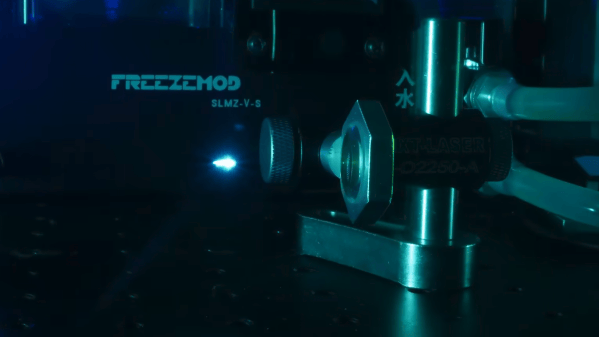
[Les] likes lasing lasers, and who doesn’t? [Les] likes larger lasers than lots of folks, with his current project being an Nd:YAG (that’s Neodymium:Yttrium Aluminum Garnet) flash pumped laser intended for tattoo removal. Like most of its ilk, the YAG crystal at the heart of that device is a rosy purple color, so when [Les] spotted a Yellow YAG with different doping promising powerful pulses, he purchased it promptly.
Specifically, the retailer was claiming a 30-50% efficiency increase for this yellow rod, thanks to cerium doping. It’s still considered an Nd:YAG, though you can label it as an Nd:Ce:YAG for clarity. The efficiency gain comes from the cerium atom taking unused energy from the flashbulb pulse — which is much broader-wavelength than the thin absorption line of the Nd ions in the rod — and giving that energy to the Nd atoms that do the lasing via fluorescence. He doesn’t try it, but reports on a paper showing these crystals can actually lase with reasonable efficiency from sunlight alone, which we’d love to see. Send us a tip if you try.
His original Nd:YAG rod produced 72.8 mJ pulses, while in the same setup with the yellow laser is peaking at 153 mJ, more than double the original output. That’s even better than the 30-50% [Les] expected, but he reckons it is because the old YAG is, well, old. The coatings break down over time, and UV light from the flashbulbs degrades the crystals too. That’s another benefit of tossing cerium in there, as apparently it acts as sunscreen for your laser rod. It lasts longer and works better, making it a no-brainer of an upgrade.
We’ve seen [Les]’s laser-based hacking before, like this diode-laser PSU and we’re always glad to take a look with our remaining eye. We also featured his tattoo removal laser back when he started working on it, along with less-lasery projects like his crystal-growing rig.
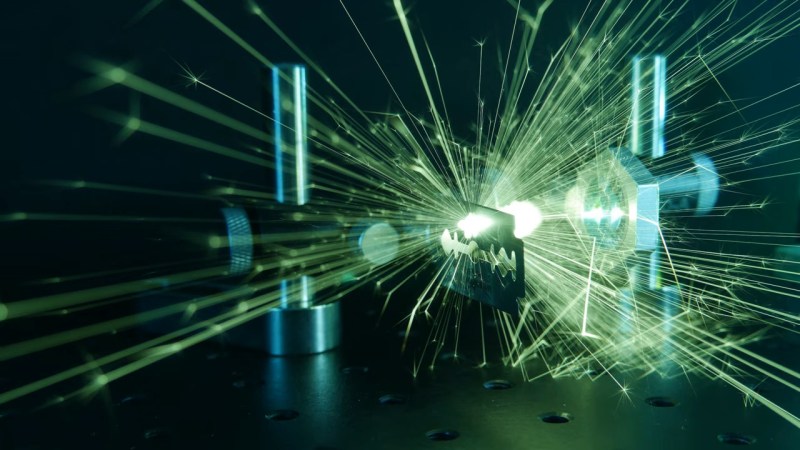
Here at Hackaday, we love projects that result in useful lab equipment for a fraction of the cost of professional gear. [Lorenz], over at Advanced Tinkering, built his own instrument for Laser-Induced Breakdown Spectroscopy, or LIBS, and it’s quite an impressive device. LIBS is a technique for analyzing substances to find their chemical composition. Basically, the idea is to zap a sample with a powerful laser, then look at the little cloud of plasma that results and measure the wavelengths emitted by it.
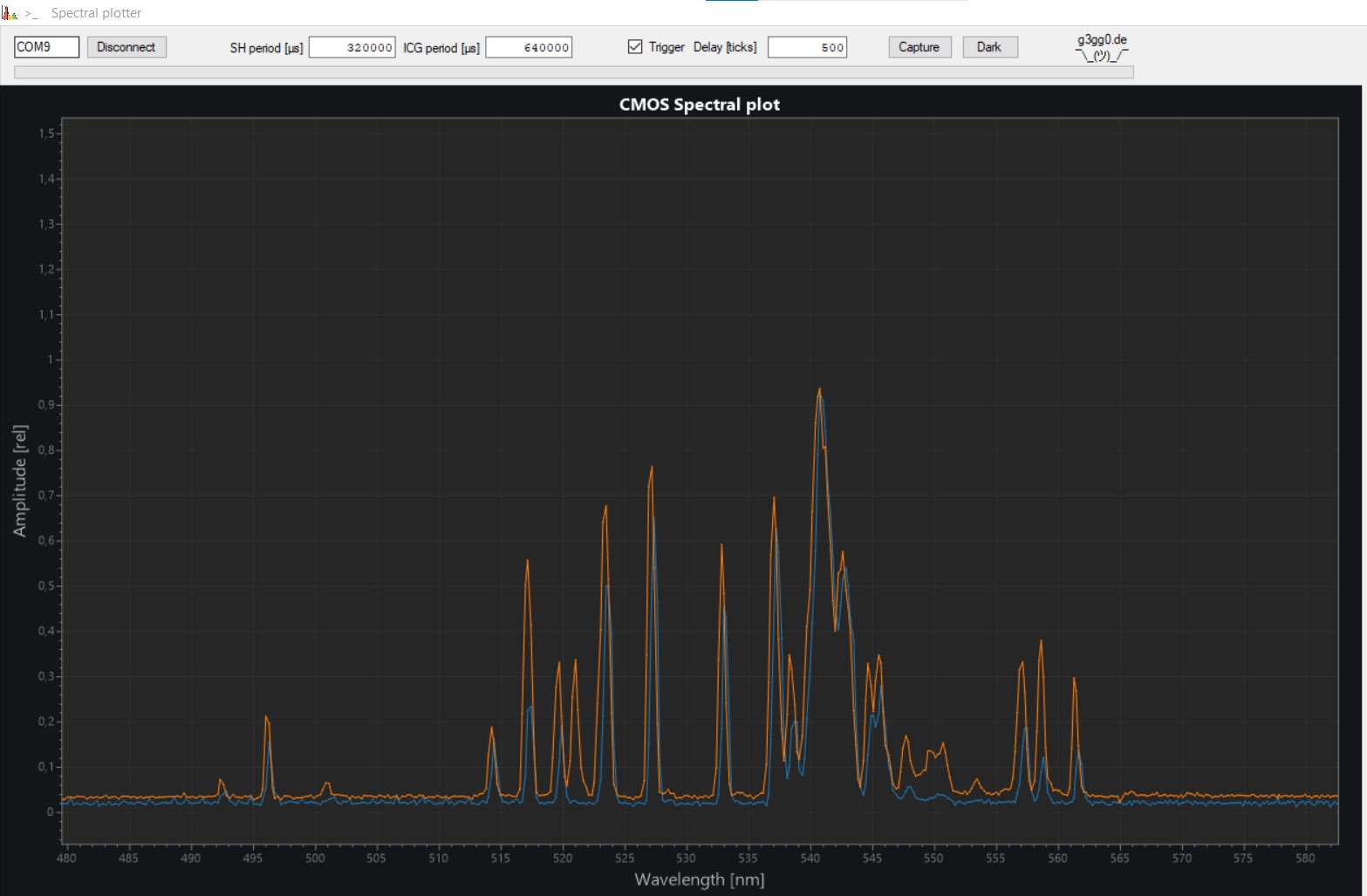
The spectrum of hematite (iron oxide), compared to that of pure iron
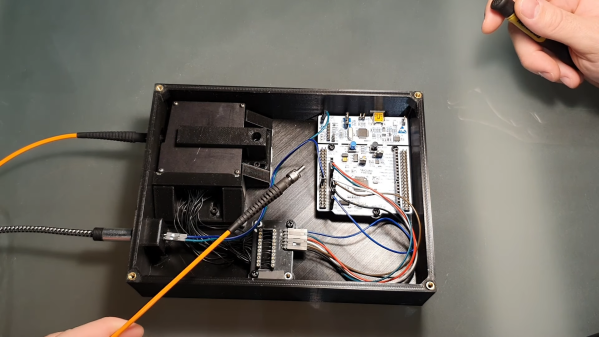
The laser [Lorenz] used is a Nd:YAG unit salvaged from a tattoo removal machine. After it fires a pulse, a photodiode detects the light and triggers a spectrometer, which consists of a diffraction grating, a few lenses and mirrors, and a linear CCD sensor. The grating splits the incoming lights into its constituent components, which fall onto the CCD and trigger its pixels. An STM32 Nucleo board reads out the results and sends them to a PC for further processing.
That processing bit turned out to be a full project on its own. [Lorenz] called upon [g3gg0], who software that simplifies the operation of the spectrometer. First, it helps with the instrument’s calibration. Point the detector at a well-known light source like a laser or a fluorescent lamp, then select the expected wavelengths on the resulting spectral plot. The software then automatically calculates the correct coefficients to map each pixel to a specific wavelength.
The software also contains a database of spectra corresponding to chemical elements: once you’ve taken a spectrum of an unknown sample, you can overlay these onto the resulting plot and try to find a match. The resulting system seems to work quite well. Samples of iron oxide and silver oxide gave a reasonable match to their constituent components.