

Hackaday Links Column Banner

Hackaday Links: August 23, 2026

We’ll start this week off with some disappointing, though not entirely unexpected, news — the ambitious commercial mission to save NASA’s Neil Gehrels Swift Observatory is officially a bust. The space agency provided an update earlier this week explaining that the attitude control issues with the LINK spacecraft that started a few weeks after it launched will prevent it from being able to safely dock with the Swift Observatory and boost its altitude. As such, the space telescope is now expected to reenter the Earth’s atmosphere and burn up before the end of the year.

Although LINK won’t be able to live up to its name, NASA did say operator Katalyst Space has been given permission to continue with the rendezvous attempt. The two craft won’t actually make contact with each other, but teams on both sides feel there’s lessons to be learned and data to be collected by seeing the orbital dance of these two vehicles play out for as long as possible.

Speaking of hardware that couldn’t quite hit its design goals, TechCrunch is reporting that a class action lawsuit has been filed against Oura by customers that say the company made misleading claims about the sleep-tracking accuracy of their smart rings. Namely, that the rings could somehow detect which stage of sleep the wearer was in with only the pulse and temperature sensors it has onboard.
Continue reading “Hackaday Links: August 23, 2026”

Detect COVID-19 Symptoms Using Wearable Device And AI

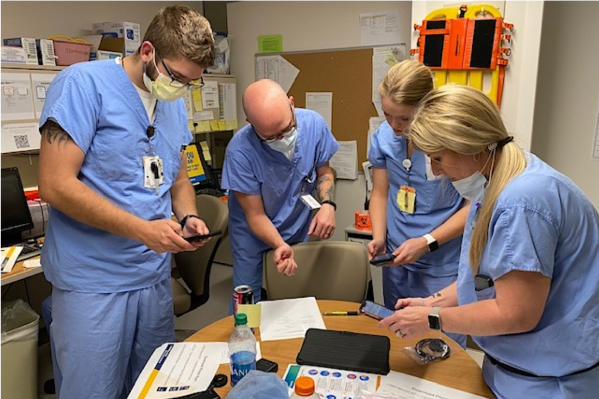
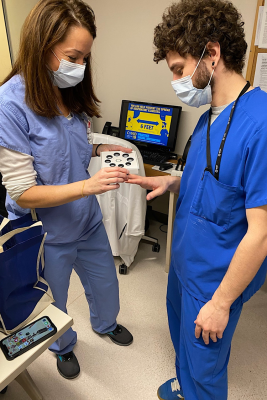
A new study from West Virginia University (WVU) Rockefeller Neuroscience Institute (RNI) uses a wearable device and artificial intelligence (AI) to predict COVID-19 up to 3 days before symptoms occur. The study has been an impressive undertaking involving over 1000 health care workers and frontline workers in hospitals across New York, Philadelphia, Nashville, and other critical COVID-19 hotspots.

The implementation of the digital health platform uses a custom smartphone application coupled with an Ōura smart ring to monitor biometric signals such as respiration and temperature. The platform also assesses psychological, cognitive, and behavioral data through surveys administered through a smartphone application.

We know that wearables tend to suffer from a lack of accuracy, particularly during activity. However, the Ōura ring appears to take measurements while the user is very still, especially during sleep. This presents an advantage as the accuracy of wearable devices greatly improves when the user isn’t moving. RNI noted that the Ōura ring has been the most accurate device they have tested.

Given some of the early warning signals for COVID-19 are fever and respiratory distress, it would make sense that a device able to measure respiration and temperature could be used as an early detector of COVID-19. In fact, we’ve seen a few wearable device companies attempt much of what RNI is doing as well as a few DIY attempts. RNI’s study has probably been the most thorough work released so far, but we’re sure that many more are upcoming.

The initial phase of the study was deployed among healthcare and frontline workers but is now open to the general public. Meanwhile the National Basketball Association (NBA) is coordinating its re-opening efforts using Ōura’s technology.

We hope to see more results emerge from RNI’s very important work. Until then, stay safe Hackaday.









