A UPS For Your Pi That’s A Little Different

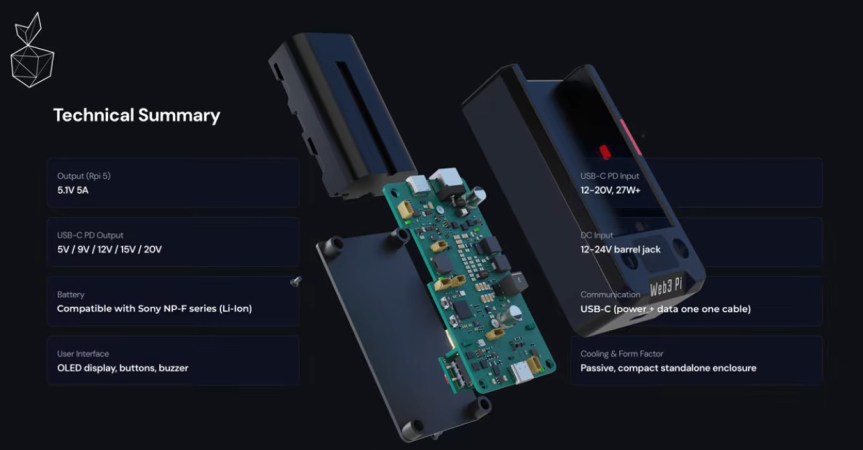
There are many uninterruptible power supply (UPS) solutions for the Raspberry Pi that take the form of HATs with a battery on board, but they’re not suitable for every situation. Web3-Pi are using the Pi 5 as an Ethereum node, and found the need for a UPS that didn’t sit on top of the Pi. Their solution is the Web3 Pi UPS, a device that sits in the USB power chain.

It’s a box that takes three power inputs, USB-C PD, a barrel jack, or a hot-swappable Sony camera battery, and puts out the constant 5 V at 5 A the Pi requires. The USB output isn’t just for power, it can communicate with the Pi to deliver telemetry and ask the OS to shut itself down if power reserves are failing. Inside are a CH32 RISC-V microcontroller that handles the power circuitry, and an RP2040 that handles control and an OLED screen for a UI. The project’s web site also mentions provision for an LTE add-on for remote monitoring, however this doesn’t at the time of writing appear to be fully implemented in the GitHub repository.

While it’s probable that few of you are mining Ethereum on your PI, we can see that there are plenty of other situations that this project could find a home in. It’s not the first Pi UPS we’ve seen, though some of them are considerably less complex or capable.

Continue reading “A UPS For Your Pi That’s A Little Different”
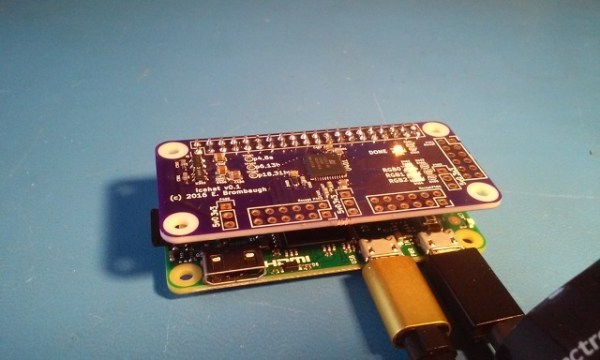
Icehat on a Raspberry Pi Zero

Give Your RPi A Cool FPGA Hat

Need additional, custom IO for your Raspberry Pi? Adding an FPGA is a logical way to expand your IO, and allow for high speed digital interfaces. [Eric Brombaugh]’s Icehat adds a Lattice iCE5LP4K-SG48 FPGA in a package that fits neatly on top of the Raspberry Pi Zero. It also provides a few LEDs and Digilent compatible PMOD connectors for adding peripherals. The FPGA costs about six bucks, so this is one cheap FPGA board.

The FPGA has one time programmable memory, but can also be programmed over SPI. This allows the host Pi to flash the FGPA with the latest bitstream at boot. Sadly, this particular device is not supported by the open source Icestorm toolchain. Instead, you’ll need Lattice’s iCEcube2 design software. Fortunately, this chip is supported by the free license.

Icehat is an open source hardware design, but also includes a software application for flashing a bitstream to the FPGA from the Pi and an example application to get you started. All the relevant sources can be found on Github, and the PCB is available on OSHPark.

While this isn’t the first pairing of a Raspberry Pi and FPGA we’ve seen, it is quite possibly the smallest, and can be built by hand at a low cost.

Introducing Hat A Day! Not To Be Confused With The Real HaD Of Course…

Hat a Day

With the release of the Raspberry Pi B+ model comes a whole slew of extra GPIO connectors, a whopping 40 of them in fact — Almost double the original B model! A HAT stands for Hardware Attached on Top, and Adafruit is celebrating by trying to create a new hat, every day.

A HAT is a rectangular board measuring 65x56mm with mounting holes for the Raspberry Pi B+ and a 40 pin GPIO header. That doesn’t sound too special by itself, but two of the header pins are reserved for a special auto-configuration system that allows your Pi to have automatic GPIO and driver setup! Now we’re talking!

So far Adafruit has made a handful of prototype HATs including the Perma-proto HAT, a GPS HAT, a TFT HAT, an Arcade HAT and even a Servo HAT. But they’re looking for more! We think they’ve slipped up on the one a day record though…

We’re excited to see more integrated projects with the B+ since it’s so much more friendly for add-on hardware than the original — What kind of hardware would you like to see in HAT form? Do you like the idea of HATs?