
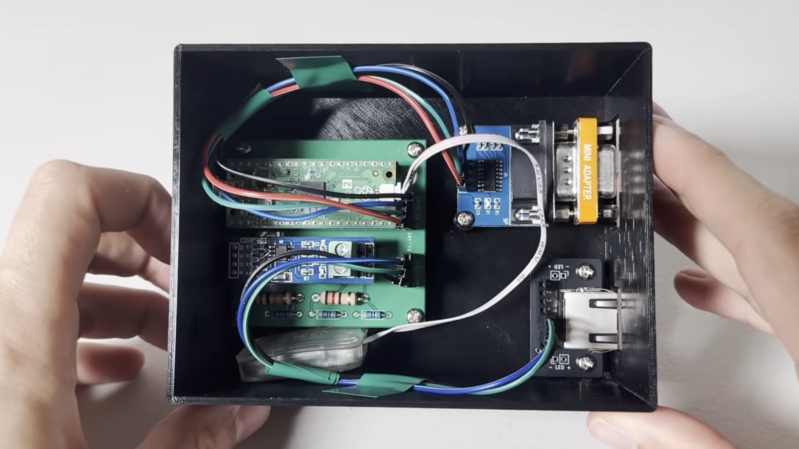
A black plastic box is shown, with a green circuit board inside. The circuit board is wired to an RS-232 connector and an RJ-45 connector.

A High-Vacuum Controller For An Eventual Electron Microscope

[Chris Doble] has high ambitions: he’s making his own scanning-electron microscope, and as the first step he’s built a high-vacuum system. This required its own controller to manage the various electronics involved in the system, which he’s documented and open-sourced.

The vacuum system itself starts with a rotary-vane roughing pump, which can bring a chamber down from atmospheric pressure to about 10-3 millibar. This is still too high a pressure, so the second stage is a turbomolecular high-vacuum pump, which can operate from 18 millibar down to 10-7 millibar. To protect the turbomolecular pump in case the roughing pump suddenly stops, it includes an anti-suckback valve. Connected to these pumps is a pressure gauge which uses a pair of sensors to sense the entire pressure range. All this setup worked well, but the turbomolecular pump and the pressure sensor each used their own interfaces, while [Chris] wanted a single interface for the eventual microscope.

[Chris] therefore designed his own controller based on the Raspberry Pi Pico 2, with firmware written in Rust. The pressure gauge uses an RS-232 interface, which he connected to the Pico’s UART pins using an RS-232 level shifter, with a null modem to swap over the transmitting and receiving pins. The turbomolecular pump used an RS-485 interface, which required a converter circuit and some level-shifting resistors. A custom PCB and 3D-printed case hold the final circuit, which provides a host computer with a single USB interface. When [Chris] tested the controller, the vacuum chamber reached a pressure of 10-6 millibar, and was still slowly falling when he ended the test.

This isn’t the first vacuum chamber controller we’ve seen. Of course, this assumes that the pressure gauge already has a controller; if not, we’ve also covered one of those. To see the inspiration for [Chris]’s project, check out [Ben Krasnow]’s scanning-electron microscope.
Arduino-Powered Steampunk Steam Gauge

steampunkGauge

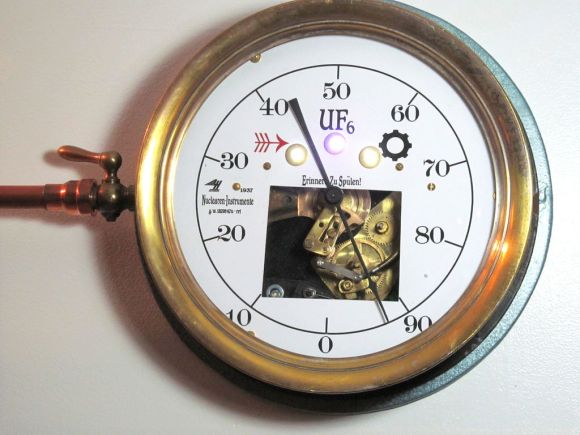
[Murphy’s_Lawyer] had some empty space on the wall in his kitchen, so he decided to fill it with a whirring Steampunk gizmo: an Arduino-driven steam gauge.

The build began as an old 10″ Ashcroft pressure gauge sourced from eBay, which [Murphy’s_Lawyer] dissected to determine the state of its guts. Finding the gauge’s Bourdon tube intact, he got to work constructing a method of generating motion without the need for actual steam. The solution was to mount a continuous rotation servo between the tube and the case. The servo lacked the strength to flex the tube on its own, so [Murphy’s_Lawyer] fashioned a simple lever out of brass to help it along.

The electronics consist of an Arduino Uno and an accompanying homemade PCB. The code for the Uno generates random motion for twirling the servo, and three LEDs built into the face reflect values generated for speed, pause and run time. The final upgrade came in the form of a new dial face, which provides some updated text as well as a cutout square that lets you see the previously obscured gears in action. Check out the video below, then see another Steampunk overhaul: the Edwardian Laptop.

Continue reading “Arduino-Powered Steampunk Steam Gauge”

Too Much Time, Not Enough Pressure

pressure-guage-clock

[Audin] got a hold of a pressure gauge and decided to turn it into a clock. We were under the impression that these types of gauges were filled with oil but he didn’t detail cleaning it up for his purposes. Once he gained access to the guts he replaced them with a stepper motor. The motor connects to an Arduino with the help of a Darlington array for handling the large load. [Audin’s] plans include using a real time clock (on order) and moving to an AVR ATmega8 microprocessor once the prototyping is finished. In the mean time, he has posted the code used in his current prototype.

Stay with us past the page break for some video of this in action. He’s got the needle dialed in for very precise movement and has coded a “jitter” effect as well. We’re not sure this would be the most convenient clock, but we’d love to affix it to our kitchen stove for a gnarly looking timer. [Audin] acquired the gauge at his local Habitat for Humanity ReStore, a place we’ve used many times to source reclaimed and unused items of all kinds for our projects.

Continue reading “Too Much Time, Not Enough Pressure”









