Dotterboard smt counter

Tame The Tape: Open-Source Dotterboard For Bulk SMT Parts

One of the great things about building electronics today is how affordable SMT components have become — sometimes just fractions of a cent each. That low price often means ordering far more than you need so you’ll have spares on hand the next time a project calls for them. Keeping track of exactly how many of each part you actually have, though, is rarely easy. To solve that problem, [John] built the Dotterboard, an open-source SMT tape counter.

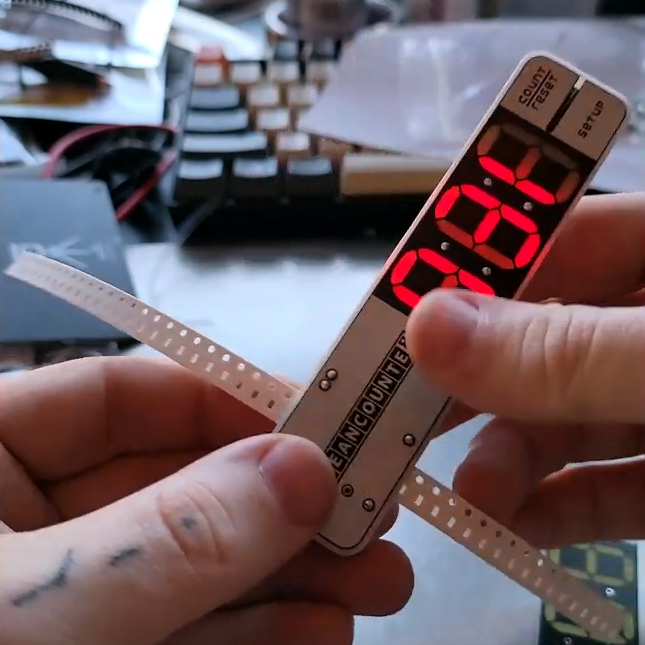
While working on some of his other projects, [John] found himself managing thousands of tiny SMT parts and decided it was time to automate the counting. The Dotterboard takes inspiration from the BeanCounter — a compact, portable SMT tape counter — but expands the design to handle larger components beyond the 8 mm tapes the BeanCounter targets.

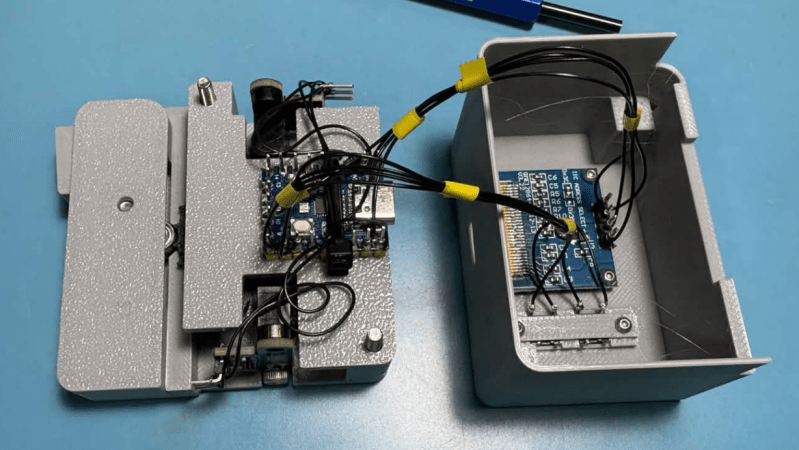
The Dotterboard is mostly 3D-printed and uses just a few common hardware parts such as springs and ball bearings. An OLED displays the current count, which comes from an encoder tracking movement and multiplying by the number of components per hole. At the heart sits an RP2040 Zero that needs nothing more than a single USB-C cable for power, unlike the bulky industrial SMT counters that demand AC outlets and desk space.

Be sure to check out all the details of the build on [John]’s website, and grab the files from his GitHub if you want to make your own. Let us know what are some projects you’ve done to save you the headache of doing the same task by hand for hours on end.

Continue reading “Tame The Tape: Open-Source Dotterboard For Bulk SMT Parts”
SMT Part Counter Aims To Ease Taking Inventory

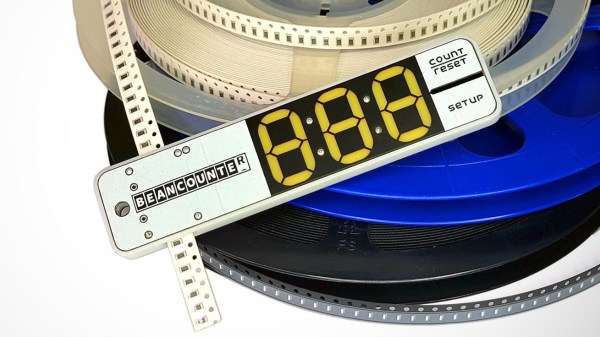
[Nick Poole] has an interesting idea for a new tool, one that has the simple goal of making accurate part counts of SMT reels as easy as pulling tape through a device. That device is the BeanCounter, an upcoming small handheld unit of his own design that counts parts as quickly as one can pull tape through a slot. The device is powered by a CR2032 cell and and works with 8 mm wide tapes up to 2 mm in height, which [Nick] says covers most 0805 or smaller sized parts, as well as things like SOT-23 transistors.

Why would one want to make such a task easier? Two compelling reasons for such a tool include: taking inventory of parts on partial reels or cut tape, and creating segments that contain a known number of parts.

The first is handy for obvious reasons, and the second is useful for things like creating kits. In fact, the usefulness of this tool for creating tape segments of fixed length is perhaps not obvious to anyone who hasn’t done it by hand. Sure, one can measure SMT tape with a ruler or a reference mark to yield a segment containing a fixed number of parts, but that involves a lot of handling and doesn’t scale up very well. In fact, the hassle of cutting tape segments accurately and repeatedly is a common pain point, so making the job easier has value.

If you looked at the photos and suspected that the big, 7-segment numeric display is done with clever PCB fabrication options (making segments by shining LEDs through PCB layers, a trick we always like to see) you’re not alone. After all, [Nick] has a lot of experience in getting clever with board fabrication, and eagle-eyed readers may even suspect that the reset and setup buttons on the edge of the tool are created by using flex PCB segments as switches. Want the nitty-gritty details? Visit the GitHub repository for the project and see it all for yourself at the CAD level.