It’s Pi Day, and while we know that many of you celebrate privately, those that take a moment to put aside their contemplation of all things circular and join us on this mathematically-significant day will likely know the name [Cristiano Monteiro]. Since 2022 he’s made it a yearly tradition to put together a themed project every March 14th, and he’s just put the finishing touches on the 2026 edition.
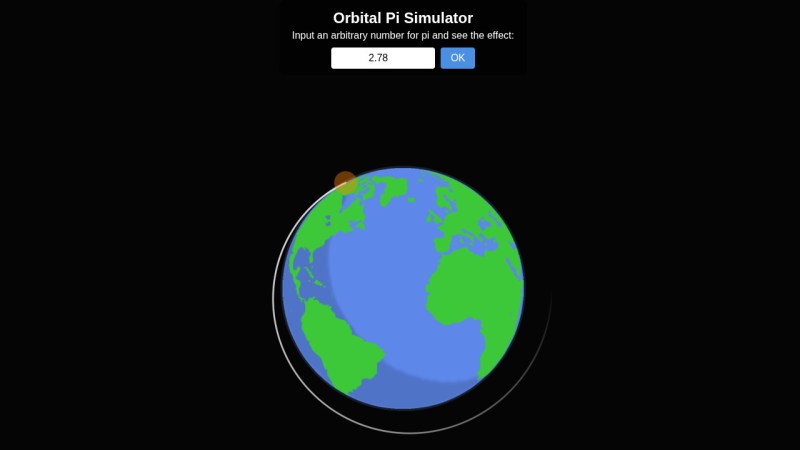
Generally, [Cristiano] sends in some interesting hardware device that visualizes the calculation of pi, but this year he surprised us a bit by delivering a software project. His Orbital Pi Simulator allows you to see what would happen to an orbiting spacecraft if it’s navigation system suddenly believed the value of pi was something different.
 In broad strokes, we can imagine what would happen. If you plug in something significantly higher than 3.14, the orbit becomes elliptical to the point that the craft can fly off into deep space. Drop the value down, and the orbit will intersect with the Earth — a guaranteed recipe for a bad time.
The Kerbal Space Program players in the audience will no doubt point out that in the absence of drag a spacecraft in a stable orbit would more or less stay on that same trajectory indefinitely and not need to manually adjust its velocity in the first place. Further, they would argue that said spacecraft suddenly firing its thrusters retrograde because a flipped bit in its computer resulted in the value of pi suddenly being 1.2 isn’t very realistic. Those people would be correct, but they would also be no fun at parties.
Fans of math and/or circles will no doubt be interested in the previous devices [Cristiano] has built to mark this date. Last year he put together a robotic hand that counted out pi with its 3D printed fingers, and in 2024 he used the Pepper’s Ghost illusion to great effect. For those wondering, not everything he does is pi-related. The portable GPS time server he sent out way in 2021 was a particularly slick piece of hardware.