Thermoacoustic Sterling Engine Is Now Fully 3D Printable

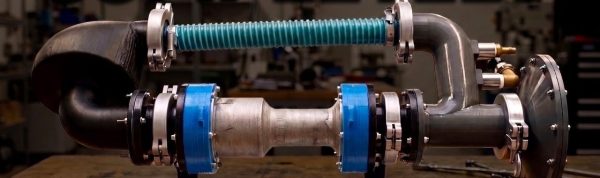
Would you like to make your own energy? Why, who doesn’t in this era of rising costs! A sterling engine always looks like a good fit for that: highly efficient, with no risk of a boiler explosion. A thermoacoustic sterling engine looks even better, since it has only one moving part at the output end. A thermoacoustic sterling engine you can 3D print yourself looks best of all, and that’s what [my engines] has on offer, now that even the burner and hot end of his thermoacoustic engine are designed for SLA metal printing.

We previously reported on the open-source engine, but there’ve been some improvements worth talking about. For one thing, he’s integrated a biogas/methane burner directly inside the 3D-printable hotend. For another, that 3D-printed design allows for an excellent heat exchange geometry that would be very hard to get any other way. The whole thing is open source with plans available at OwnEnergy.org, where you can find links to the apparently-mandatory Discord channel and now an old-style forum to actually collaborate on the design, which is open-source. The site is also now the home of all data and discussion about [my engines]’s homescale biogas plant, which is the power source for this little engine.

If you’d rather print a combustion engine, you can do that, too, but you’ll need more “vitamins” than this unit requires.

Continue reading “Thermoacoustic Sterling Engine Is Now Fully 3D Printable”
If You Like The Sound Of A Thermoacoustic Stirling Engine, Check Out These Plans

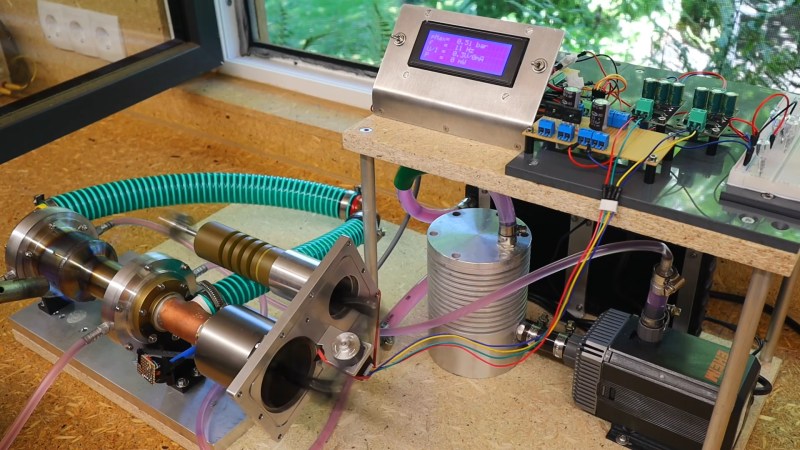
[My Engines] has been doing some sterling work on Stirling engines for some years now. Their thermoacoustic engine is now finally far enough along to open-source, so the magic of collaboration can speed technological advancement.

You’ve probably heard of Stirling Engines, but what’s this “thermoacoustic” business? Hot sound? Well, that’s the translation, and it’s not a bad starting point for understanding what’s going on: the engine converts heat into high-amplitude sound waves — that is, waves of pressure — which means the engine itself has no moving parts. Well, almost. Obviously moving parts are required to get power out. In [My Engines] case he’s using a piston and linear generator, but otherwise it makes for a very simple, very reliable engine that can be fueled by any available source of heat. Say like burning methane from [My Engines]’s home biogas plant.

[My Engines] promises more videos to help you understand the construction in a way his previous videos might not detail, and has put 3D models and drawings at a public Google Drive. There’s also a Discord you can join, because apparently that’s the only way to communicate about projects these days.

The whole build is very much within range of a home maker, though there’s a lot more to it than the toy Stirling engines you may have made out of tin cans back in the day. If you want to play with thermoacoustics but [My Engines]’s design seems like a little much to get started with, you can make a demonstrator with some steel wool and a test tube. Be careful, though: model engines can be an addictive hobby.

Continue reading “If You Like The Sound Of A Thermoacoustic Stirling Engine, Check Out These Plans”

Thermoacoustic Engine Has Only One Moving Part

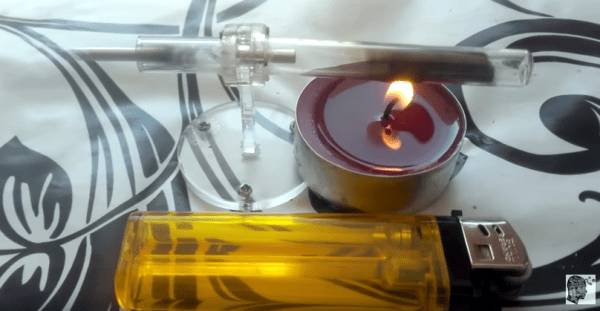
Modern internal combustion engines have around 500 parts, with many of them moving in concert with the piston. But have you seen an engine with only one moving part, out of four in total? In the thermoacoustic engine, the power piston is the only part in motion. [YTEngineer] has built a very simple prototype that works on power provided by a tealight.

His little engine, slightly larger than a cigarette lighter, is composed of a test tube that serves as the cylinder, a smaller tube, called the choke, that fits inside the test tube, the stack, which is nothing more than some steel wool, and the power piston. [YTEnginer] nicely explains how the engine works: basically a temperature difference is used to induce high-amplitude sound waves that create the piston’s back-and-forth movement. The engine can be easily converted to an electricity generator by adding a magnet to the piston and a coil surrounding it.

The thermoacoustic engine is a particular type of Stirling engine. They have been proposed as electricity generators for space travel using radioisotopes as the heat source, among other applications. You may be interested in the history of Stirling engines, or perhaps even build a simple one.

Continue reading “Thermoacoustic Engine Has Only One Moving Part”