
University Of Utah’s TRIGA Research Reactor Set To Produce Electricity

Research reactors come in many forms and sizes, with the TRIGA class being commonly found at universities. The TRIGA reactor at the University of Utah was installed in 1975, and for the past half century the thermal energy it produced was bled off into cooling systems. Now for a world’s first, the reactor will be used to generate electricity instead.
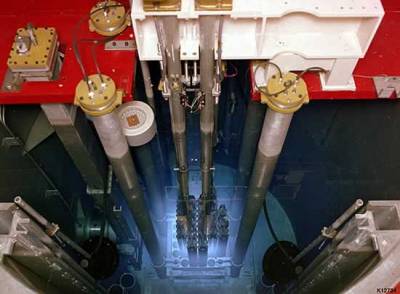
A TRIGA reactor core, with the blue glow from Cherenkov radiation. (Source: DoE, Wikimedia)

What makes the TRIGA design so practical for small research reactors is its inherent safety due to the use of uranium zirconium hydride (UZrH) fuel, which imposes a strong negative thermal coefficient on the reactivity. Along with no need for any kind of containment, these pool-type, water-cooled reactors thus allow for a pretty good look at the literal internals of the reactor core.

Their thermal power outputs range from 0.1 – 16 MWth, with the University of Utah reactor generating on the low end of the scale here, at 50 kWth. This energy will be partially used by a generator that has been developed by Elemental Nuclear, a startup company who looks to be trying to commercialize TRIGA fuel for microreactors with sodium coolant.

The installation at this TRIGA reactor should thus be seen as a proof-of-concept for Elemental Nuclear’s generator design, which uses a closed Brayton cycle with helium gas to generate an output of about 2-3 kWe from the ~13 kW generated by the turbine. This generated power will – of course – be used to power some racks with GPUs for ‘AI’ tasks. If successful, it could show the way for TRIGA-based microreactors to power datacenters.


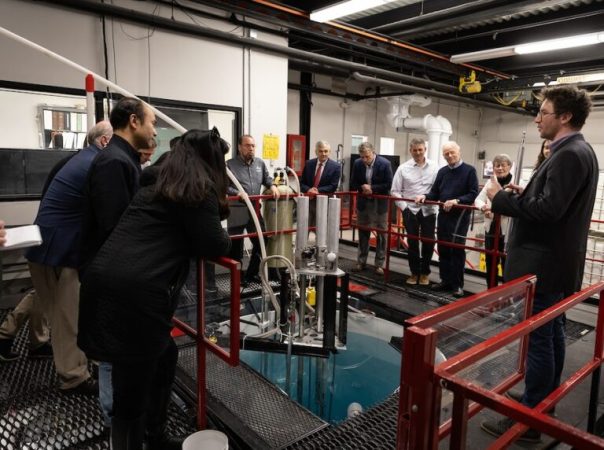
Top image: the TRIGA reactor during a tour. (Credit: University of Utah)
The Legacy Of One Of Science’s Brightest Stars: Freeman Dyson

Of the many well-known names in science, few have been as reluctant to stick to one particular field as Freeman John Dyson. Born in the UK in 1923, he showed a great interest in mathematics and related fields even as a child. By the time he was 15 he had won a scholarship at Trinity College, in Cambridge, where he studied mathematics. Though the war forced him to work at the Air Force’s Operational Research Section (ORS), afterwards he would return to Trinity to get his BA in mathematics.

His subsequent career saw him teaching at universities in the UK and US, before eventually ending up at Cornell University, where he joined the Institute for Advanced Study at the invitation of its head, J. Robert Oppenheimer. Here he would meet up with such people as Richard Feynman with whom he would work on quantum electrodynamics.

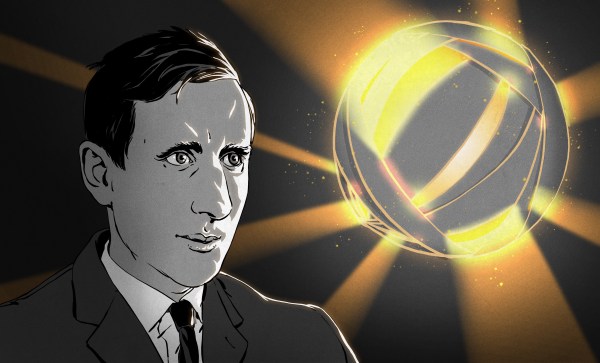
Beyond mathematics and physics, Dyson would also express great interest in space exploration — with Dyson spheres being well-known — and genetics, both in the context of the first formation of life and in genetic manipulation to improve plants to deal with issues today. He also worked on the famous Project Orion, which used nuclear bombs for propulsion.

In this article we’ll take a look at these and other parts of Mr. Dyson’s legacy, as well as the influence of his works today.

Continue reading “The Legacy Of One Of Science’s Brightest Stars: Freeman Dyson”









