Watch A Recording Lathe From 1958 Cut A Lacquer Master Record

Most of us are familiar with vinyl LPs, and even with the way in which they are made by stamping a hot puck of polyvinyl chloride (PVC) into a record. But [Technostalgism] takes us all the way back to the beginning, giving us a first-hand look at how a lacquer master is cut by a specialized recording lathe.
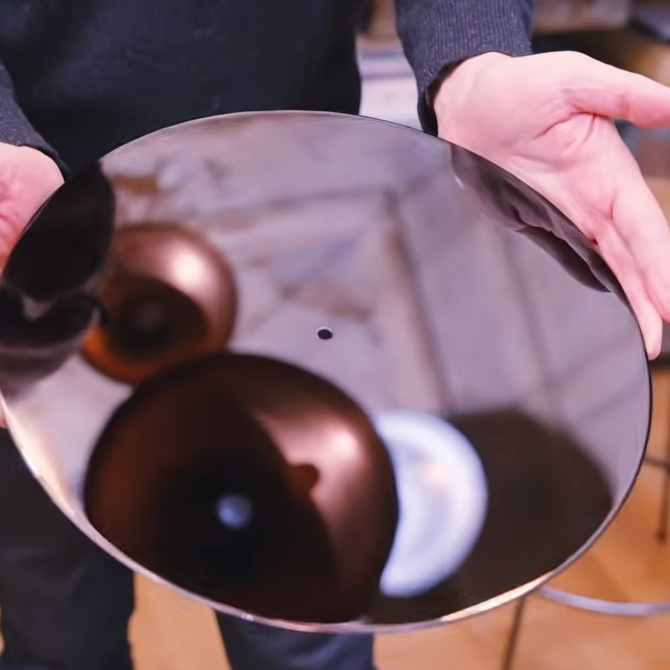
An uncut lacquer master is an aluminum base coated with a flawless layer of lacquer. It smells like fresh, drying paint.

Cutting a lacquer master is the intricate process by which lacquer disks, used as the masters for vinyl records, are created. These glossy black masters — still made by a company in Japan — are precision aluminum discs coated with a special lacquer to create a surface that resembles not-quite-cured nail polish and, reportedly, smells like fresh paint.

The cutting process itself remains largely unchanged over the decades, although the whole supporting setup is a bit more modernized than it would have been some seventy years ago. In the video (embedded below), we get a whole tour of the setup and watch a Neumann AM32B Master Stereo Disk Recording Lathe from 1958 cut the single unbroken groove that makes up the side of a record.

The actual cutting tool is a stylus whose movement combines the left and right channels and is heated to achieve the smoothest cuts possible. The result is something that impresses the heck out of [Technostalgism] with its cleanliness, clarity, and quality. Less obvious is the work that goes into arranging the whole thing. Every detail, every band between tracks, is the result of careful planning.

It’s very clear that not only is special equipment needed to cut a disk, but doing so effectively is a display of serious craftsmanship, experience, and skill. If you’re inclined to agree and are hungry for more details, then be sure to check out this DIY record-cutting lathe.
Continue reading “Watch A Recording Lathe From 1958 Cut A Lacquer Master Record”
DIY Record Cutting Lathe Is Really Groovy

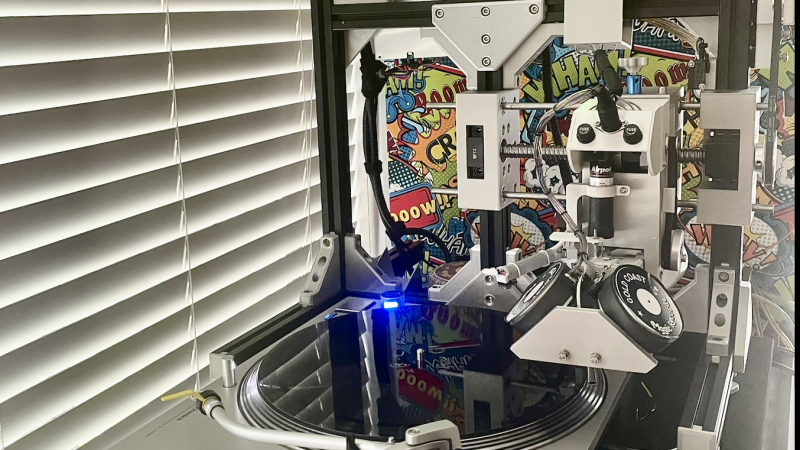
Back in the day, one of the few reasons to prefer compact cassette tape to vinyl was the fact you could record it at home in very good fidelity. Sure, if you had the scratch, you could go out and get a small batch of records made from that tape, but the machinery to do it was expensive and not always easy to come by, depending where you lived. That goes double today, but we’re in the middle of a vinyl renaissance! [ronald] wanted to make records, but was unable to find a lathe, so decided to take matters into his own hands, and build his own vinyl record cutting lathe.

photograph of [ronald's] setup
[ronald’s] record cutting lathe looks quite professional.
It seems like it should be a simple problem, at least in concept: wiggle an engraving needle to scratch grooves in plastic. Of course for a stereo record, the wiggling needs to be two-axis, and for stereo HiFi you need that wiggling to be very precise over a very large range of frequencies (7 Hz to 50 kHz, to match the pros). Then of course there’s the question of how you’re controlling the wiggling of this engraving needle. (In this case, it’s through a DAC, so technically this is a CNC hack.) As often happens, once you get down to brass tacks (or diamond styluses, as the case may be) the “simple” problem becomes a major project. Continue reading “DIY Record Cutting Lathe Is Really Groovy”

Cutting Records Out Of CDs

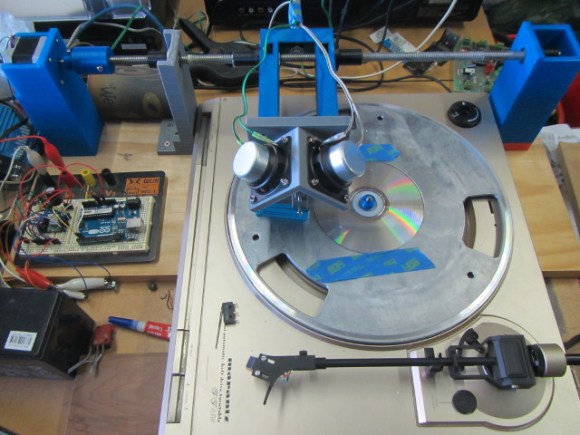
3D Printed Record Lathe

Lovers of records rejoice! Did you know you can cut your own vinyl using something called a record lathe? [Beau Walker] just put the finishing touches on his 3D printed record lathe, and the results speak for themselves!

A Recording Lathe was once used for cutting records, and previously, wax cylinders – if you want to get really old school. [Beau], being an analog lover, decided he had to try making his own. He designed the whole thing in FreeCAD and got 3D printing. A single stepper motor drives the lead screw which moves the writing head back and forth as the record spins in place. As to not waste materials, he’s reusing old CD’s for his newly created vinyls. Two 25W speakers cause vibrations in the needle to cut into the disc, via a clever little mechanism.

The system works pretty well, but he wants to replace the turntable with another stepper motor for finer control of the recording — sometimes the turntable slows down during recording under load which messes up the sound. There’s a video of it in action on his site that we can’t embed here, so you should definitely go check it out!

Of course you could skip the middleman and go straight to 3D printing your records…