
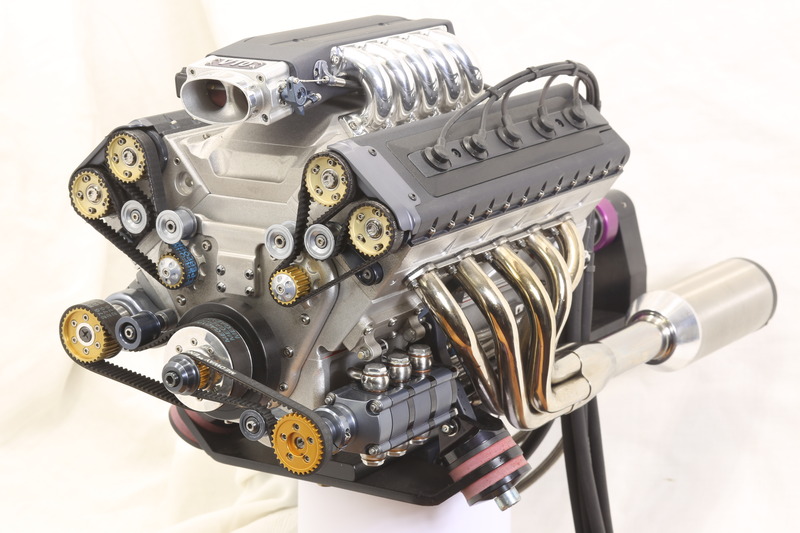
Nearly three years in the making, behold the raw power and precision of this 1/3-scale V10 engine.
Coming in at 125 cubic centimeters displacement, [Keith Harlow]’s fuel injected masterpiece isn’t too far from the size of some motor scooter engines. We doubt the local Vespa club would look upon it as legit mod, but we’d love to see it. [Keith]’s build log is a long series of forum posts, but from what we’ve seen it looks like every part was made by hand with the exception of the fuel injection system. Even the caps for the spark plugs were custom injection molded right in [Keith]’s shop. And it appears that no CNC was used – even those intake headers and the rotors for the supercharger were hogged out of aluminum using a manual mill. The exhaust headers alone are straight up works of art. There’s a staggering amount of work here, which begs the question: why? The answer in this case is obviously, “Because he can.”
Few builds compare to the level of craftsmanship on display here. The Clickspring skeleton clock comes to mind, but for model engine builds we’d have to point to [Keith]’s earlier 1/4-scale V8 engine. And we’ll hasten to add that as much time as [Keith] has spent building these works of mechanical art, he’s probably dedicated just as much time to documenting them and giving back to his community. We can all learn a lesson from that.








Motor scooter? More like motorcycle.
I thought so too, but I looked up low-end bikes and they all clocked in at well above 125cc. Vespas and the like all seemed to be in the 100-150cc range, hence the reference.
Heck, even a Vespa beats the hell out of the second-hand Honda 50 minibike we had as kids. With a dodgy centrifugal clutch and anemic engine, we spent way more time pushing it than riding it.
A Vespa’s more like a motor scooter grown to the lowest-end motorcycle size, though. Smaller motorcycles certainly used to exist (I’ve got a 125 cc 1972 Honda), and they have a bit of a resurgence now, too. I always think of motor scooters at the 50 cc (OK, ’49 cc’) level, since in certain states that allows them to avoid a motorcycle license/insurance/etc. Then I have to remember that those Vespas and clones are *huge* comparatively.
There’s dirtbikes with 80 cc engines, and that was a common modification for the minibikes as well. 16mm carburettor instead of the 11mm stock, and an 80 cc cylinder with racing ports and carbon fiber intake reeds, then drill out the chokes in the exhaust or put a racing pipe in, and the engine goes from 1-2 HP to 10-20 HP.
A buddy of mine had a minibike that went 110 kph on the straight, until the chain started glowing red. Mine did just 75… 85 downhill.
A 125cc fuel injected V10 will get as fast as you would want to go on something that doesn’t have wings – probably 80 – 100mph.
And it would look the perfect piece in a light weight sports bike.
Modern larger bikes are more about show than speed because they can all go so fast that your probability of surviving becomes very thin.
I have ridden motorbikes of all sizes and am still here, as have plenty of others. I think you mean that if one has an accident there is a high risk of fatal injury. Or did you really mean to say that if one rides a high-speed bike one will, by default, have a high mortality? I’d like to see the data on that.
Reasons to own a high powered bike….
1: Hitting a semi tractor head on while accelerating, the last thing that goes through your mind is your arse, but at least you scratched the bastards bumper.
2: It’s a purging experience to spend huge wads of disposable income on back tires monthly.
3: Hunter S Thompson made the Vincent Black Shadow sound cool.
4: Why get minivan mileage with the speed an acceleration of a minivan *cough*harley*cough*
Ive been pondering a 1/3 scale v8 for my mini chopper (mini bike) im building, i think it would be rad and alot better a choice than a snowmobile 440
Screw scooter or cycle, put the bloody thing in an ultralight!
Does anyone know what one of Keith Harlows v 10s cost to buy. I’m wanting to make a Ed car with v10. Please comment
Stunning, just stunning
Words fail me. What a project. Now, what’s he gonna put it in?
It even *sounds* like a full scale engine.
Hell I’d put it in a coffee table
its going in a RC car
I don’t think there’s a supercharger on there. It is a real marvel though. I can’t imagine the hours spent.
From one of the builder’s YouTube comments:
“I have made a supercharger for this but not fitted it. Haven’t decided whether to continue with this project or sell it and do a W16 Veyron type engine.”
o_O
I Triple-Dog-Dare him to do that last thing.
Thinkerer created a slight breach of etiquette by skipping the triple dare and going right for the throat!
Already done, By A Swede https://www.youtube.com/watch?v=-DijdisWkAE
Per Gillbrand actually used to work for first Volvo, then Saab, biggest contribution is that he was the man that actually got turbocharging working reliably in a family car with the Saab 99.
After he retired he spent his days home in the basement building miniatures
He recently died.
Yeah, he really knew how to build engines. He was doing a really interesting project for saab in the 90’s. He had designed a variable compression engine of HCCI-type (homogenous charge compression ingnition). This type of engine may run on any combustible fuel, diesel, gasoline, ethanol, hydrogen etc. This would have been a true flexifuel engine and would also have been very efficient on all types of fuel. GM killed that project before it ended up in a saab. Guess oil companies don’t like the idea of an independent fuel source engine…
They actually had a working prototype. As I recall it had a displacent of 1.6litres and produced around 300hp with a impressive torque. I wonder what happened to the prototype…
Vila i frid Per!
The prototype(s) of the variable displacement SAAB motors are at the Valmet Automotive museum in Uusikaupunki, Finland.
Couple other interesting SAAB prototypes on display there, too, like a SAAB V8 made out of two B202 four cylinders stuck together at a 65 degree angle.
GM killed a lot of interesting things slated to come out of Trollhattan. :/
W engine, sounds fun. For a real challenge? Try for a W6, around the 60cc size.
The Anzani W3 powered Louis Blériot across the English Channel in 1906. W6 motors are rare, bordering on non-existent.
The idea of a W6 variant of the Anzani motorbike engine, powering a modern Vespa or similar is appealing.
They are rare because they are needlessly complicated… a good old “V” configuration can get you all the power you dare to put into a vehicle (and more), so the only “W” in production is mostly “because we can” showing off…
A couple of the pictures in the thread show beautiful rotors for a Roots-type blower being milled. One shot even shows the blower fitted and powered by a timing belt off the back of the engine. I was confused because normally you see the blower pulley up front, but there it was.
Amazing, but why is it considered 1/3 scale? Unless it’s a copy of something, surely it’s full scale – just small?
Because it’s 33% the size of the real one?
What “real” one? (that was the point)
Scooter? I’d love to see that mounted on a go-kart… Now that would be fun :D
I was about to say that. ????
This thing would make an EPIC cart.
Scaled down T-bucket type rod would be about ideal according to moi.
Forget that. Put in on the most epic of riding mowers. Now that would be sweet. Don’t forget the Optimus Prime flame job either.
There was a time when this sort of modeling was a necessary proof of concept step in the design of complex machines. The British Museum of Science has several of these on display from the Age of Steam. They are of particular value in my opinion, as the full-sized machines have often been broken up and these models stand as witnesses to this technology. It may be that these miniature ICE models may serve the same end one day.
This is how engineering was done once upon a time – a miniature was made and scaling factors applied.If you read through an engineering manual from the 19th century, there are all kinds of variations on this. Imagine committing a rail line to a thousand foot long bridge based on a small model!
The analytical tools of the day would only take you so far so if you were doing something substantial you’d have to start building prototypes a lot earlier in the process than we do now (one of the reasons for the continuing development of modeling (FEM/CFD etc.) software. Easier to make mistakes in silico than in steel.
Also cf. Patent Models (which usually didn’t have to work completely as much as demonstrate the innovation): https://en.wikipedia.org/wiki/Patent_model
I think you mean: “Easier to CORRECT mistakes in silico than in steel.” You have to wonder how many “Oh shit” moments those old model makers had and were forced to start over.
Small scale models are fine for construction details, but they don’t give you much about the material properties or fluid flows because these things behave differently at different scales. Hence it’s not a substitute for FEM – you still got to do the calculations so your bridge won’t sag – or find an analog material that behaves proportionally at scale.
Which is one of the reasons the method fell out of favor, and why engineers at the time over built most things using far more material than we would find cost-effective today.
Plus you can’t construct a million tiny rivets in miniature, so you can’t check whether the joints hold.
Why not nake a full size engine, and drop it in his car? So much time spend on a coffee table engine.. : (
Love the work, detail en detication.
He may be making the max size his tooling allows.
Or they could be retired and just not give a crap because they enjoy building things for the sake of building things or practicing their decades of finely honed skills, practicality be damned?
https://www.youtube.com/watch?v=m3KdpzL3Hkk
why ruin a cool project by trying to make it practical?
^ this, at least he’s not playing golf or some other tedious thing, he’s making cool stuff and showing us how, so we can make cool stuff too.
So awesome!
Kinda shocking when his hand comes into frame and you understand the scale.
This is just amazing work. When I go down to my small machine shop I am lucky to get things working full size. The next step is to build the rest of the car to go with it. something like the Ferrari in this You-tube video from 10 years ago.
https://www.youtube.com/watch?v=vxYRa0pqxlw
Wow, amazing — an inspiration.
That right there is a Master Engineers business card. More than 3/4 of the engineers at GM could not do what he did.
“So… did you bring a copy of your resume?”
*Places engine on desk.*
“When can you start?”
:D
LoL
:-D
Or “Ffffff….how do you expect the Mexicans to make that???” ;-)
lol
Go on, make a kit! (He’d have to CNC it then though…)
Having just googled, I found Conley Precision Engines 609 Stinger…
That Conley engine kit is over $8k and at 100cc only develops 5.5hp… Seems light on power and a bid expensive…
bit expensive… why is there no edit….. aaaaaaargh…
FYI, Honda once had a 5 cyl. 125cc racing engine. I think it dominated that class for a while. Maybe it was “ruled out” like the STP Turbine at Indy.
There were even more cylinders with even less volume… yes, they did dominate, but were incredibly touchy and took quite a lot of persuasion to get moving…
But just listen to that thing :D
https://www.youtube.com/watch?v=vDd0kVnnqfg
crap, wrong one…
5 cylinder, 125CC
https://www.youtube.com/watch?v=qLYo8io6fBA
Is that a 5 cylinder 2-stroke engine?
It’s a 125cc 4-stroke DOHC 4-valve/cylinder inline 5
Back in the day… there was a hobby shop closing up ( :-( ) and they reduced their on hand Cox 0.020 glow motors to under $10 … so was coming up with wild schemes like making a V12 out of them for a Spit or ‘stang… nothing much backing that but wild youthful enthusiasm, so only result was the initial purchase of one, which I still have.
Has anyone found a link to how he did the Engine Control Module and his monitoring setup?
Beautiful work.
He uses a megasquirt http://megasquirt.info/
It is an open-ish source (the source code is available, but is only license for use with hardware purchased from the producer) motor controller. They are quite nice systems and can easily be configured for non-standard setups like this.
I’m ALMOST certain that megasquirt itself is open source. That link is from a company that sells kits.
*edit* Nevermind, last time I looked at the project 10 years ago people were running it on arduino megas. Times have changed it seems
I wonder if it has a real oil system? I’ve seem scale engines that didn’t and required manual oiling, and were not intended to run long.
it does, check page 13 of the original thread
Wow, this is amazing. Not only is it functional but if it has a cooling system (I cant tell if it does or not) it would have everything needed to actually be built into a vehicle of some kind.
Imaging building THIS into one of those Power Wheels kiddie cars… :)
Nitpick time: http://begthequestion.info/
A thing of beauty and the sound is almost sensual. It is the Marilyn Monroe of engines. https://www.youtube.com/watch?v=fSIIEn1abc8
LOL, oops! try this https://www.youtube.com/watch?v=1K4Zeg7K8q8&feature=youtu.be
That other video is pretty interesting too, but way off topic, hahahahahaaaa
Compost for anarchists? :D
Yup, philosophical ones. LOL!
Not supercharged though…
Yes and no. As shown in the video, the supercharger looks like it has been removed. But back in November of 2015 it was clearly in progress and mounted:
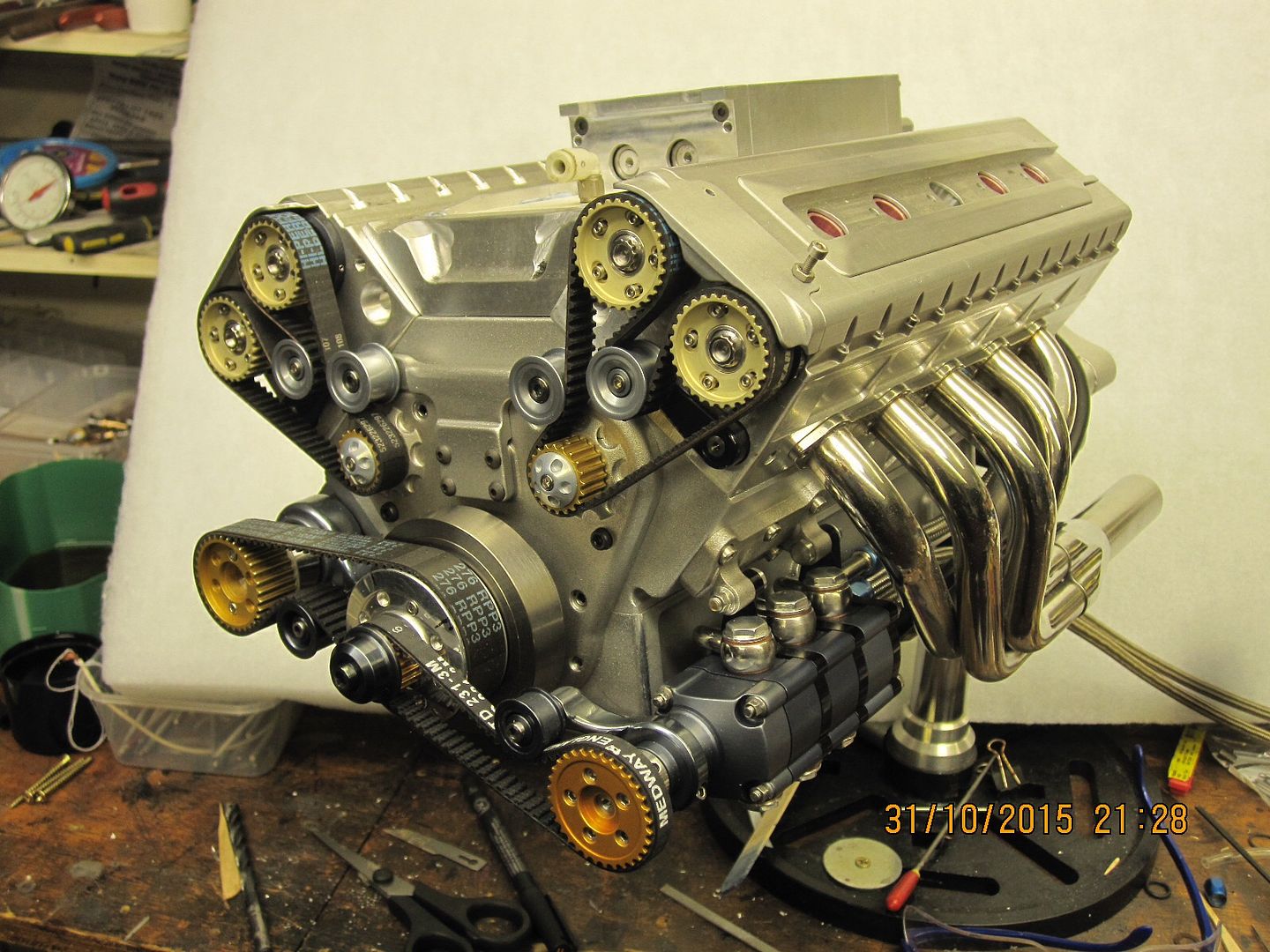
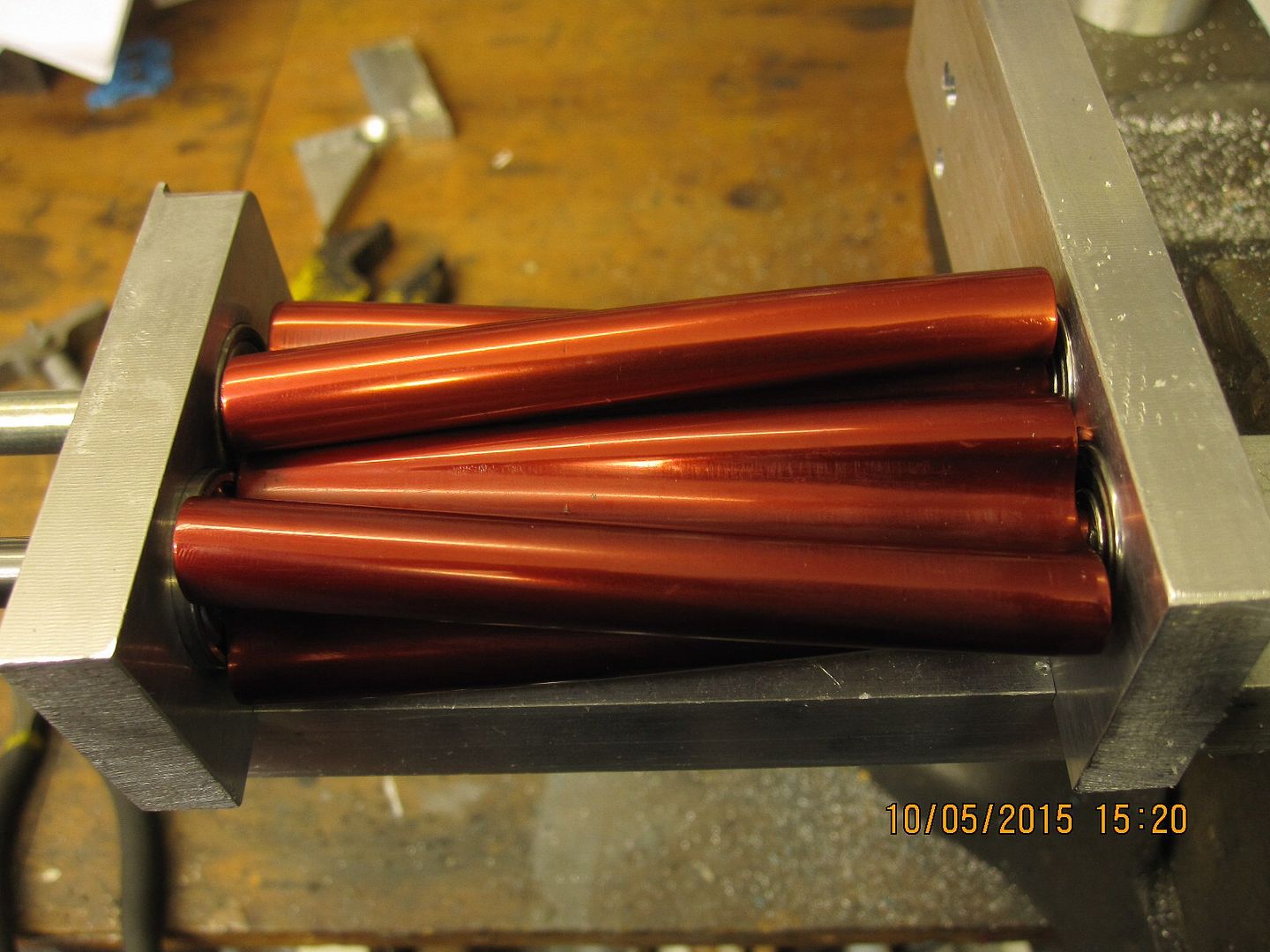
This picture confused me. I think you can understand why:
Just before Christmas [Keith] decided to shelve blower development in favor of just getting the engine started. Can’t blame him, what with it being on the bench for three years. I have no doubt he’ll finish the blower and mount it, so I’m going to stick with the claim that the engine is supercharged.
If you are in the Eastern US you can see a lot of engines like this up close and personal. The biggest US show is next weekend, Jan 14 and 15 at Lebanon PA. Its called Cabinfeverexpo.com there will be a few hundred exhibitors and many gas, steam, stirling engines, all running and with the maker sitting there to talk to.
Put it in a 1/3 scale rc P51.
I’m wondering if I can adapt this to my DeLorean. I need a new engine and this thing has a lot more power than the stock PRV. ;D
Does anyone know Where can I buy something like this in kit form ?
are the engine drawings for sale?
How much is one of these V10 motors do they come with transmission if not how much for one of them as well, i hope you do make trans for them.
I’d like to see someone do this 1/2 scale with tranny snd about 200 to 400+ Horsepower, so i can drop it in mu Miata!!!
where from I can buy this engine Supercharged, Fuel Injected V10 Engine, at 1/3 Scale
I am biulding a 1/3 scale funny car may be think about one in it please keep me posted