
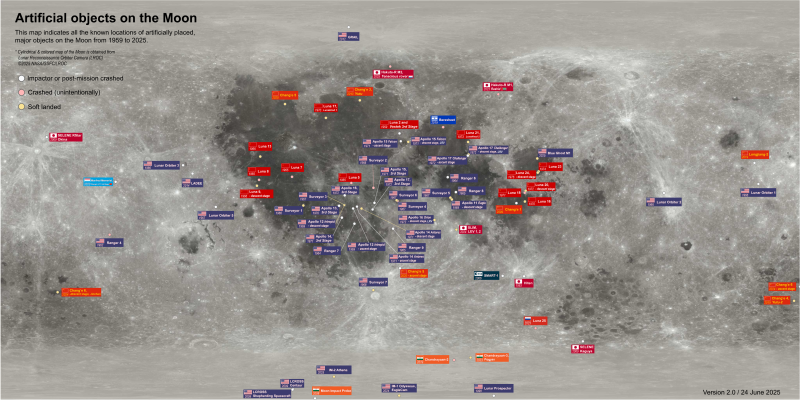
If you read a headline that signs of intelligent life were found on the moon, you might suspect a hoax. But they are there! Humans have dumped a lot of stuff on the moon, both in person and via uncrewed rockets. So after the apocalypse, what strange things will some alien exo-archaeologist find on our only natural satellite?
The Obvious
Of course, we’ve left parts of rockets, probes, and rovers. Only the top part of the Apollo Lunar Excursion Module left the moon. (See for yourself in the Apollo 17 ascent video below.) The bottoms are still there, along with the lunar rovers and a bunch of other science instruments and tools. There are boots and cameras, as you might expect.
But what about the strange things? As of 2012, NASA compiled a list of all known lunar junk that originated on Earth. The list starts with material from the non-Apollo US programs like the Surveyor and Lunar Prospector missions. Next up is the Apollo stuff, which is actually quite a bit: an estimated 400,000 pounds, we’ve heard. This ranges from the entire descent stage and lunar overshoes to urine bags. There are even commemorative patches and a gold olive branch.
After that, the list shows what’s known to be on the surface from the Russian space program, along with objects of Chinese, Indian, Japanese, and European origin.
The Sentimental
Charles Duke on Apollo 16 left a framed family photo on the Moon’s surface with an inscription on the back. We figure if you go looking for it now, the sun will have bleached it white, but we appreciate the sentiment.
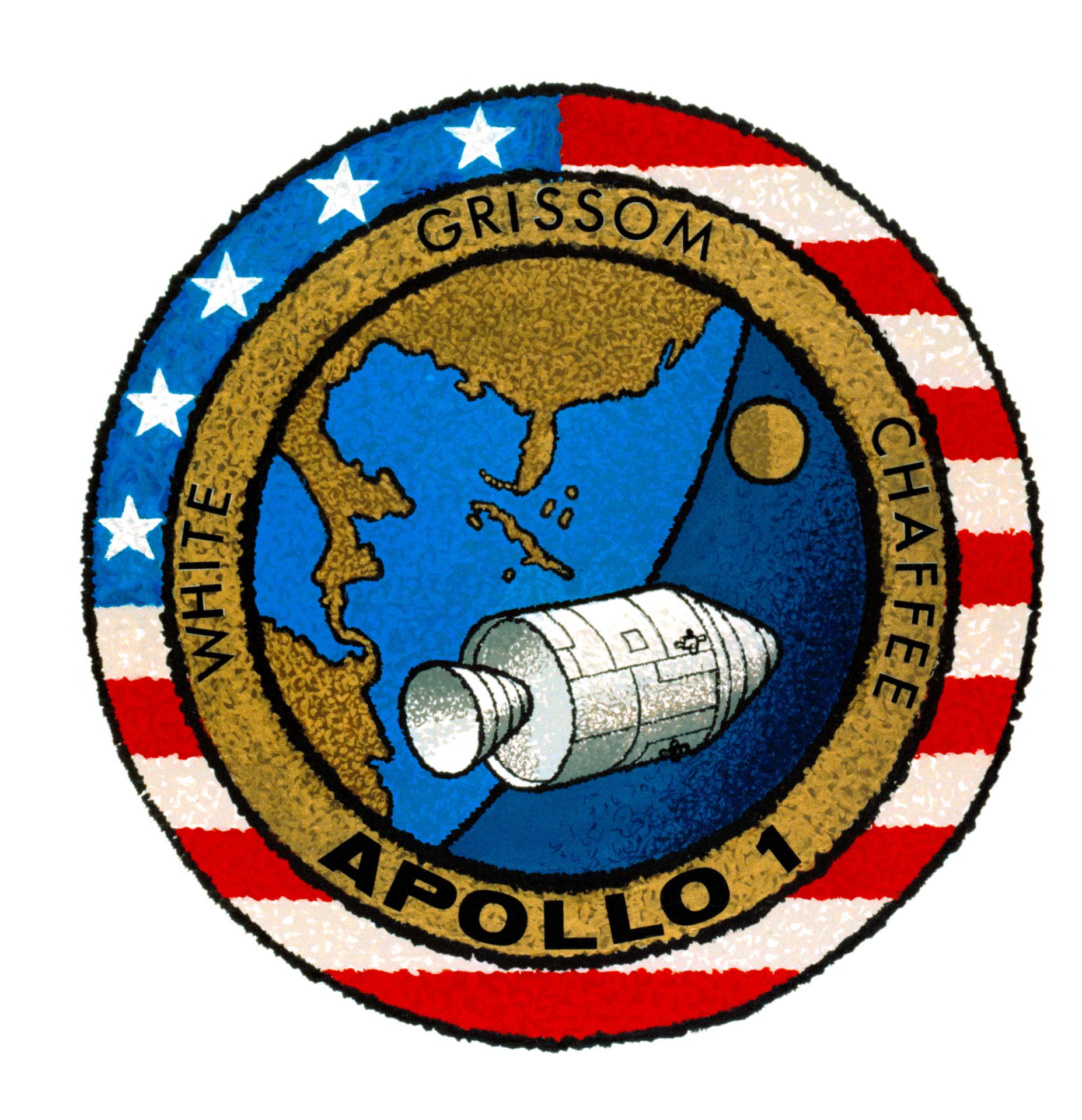
There are several objects meant to commemorate fallen astronauts and cosmonauts, including an Apollo 1 mission patch. You may recall that a fire during training killed all three of Apollo 1’s crew.
Lunar Prospector brought a portion of the ashes of Gene Shoemaker, a geologist who trained Apollo astronauts, to the moon. The capsule of ashes holds a quote from Romeo and Juliet:
And, when he shall die
Take him and cut him out in little stars
And he will make the face of heaven so fine
That all the world will be in love with night,
And pay no worship to the garish sun.
To date, Shoemaker is the only person who has remains on the moon.
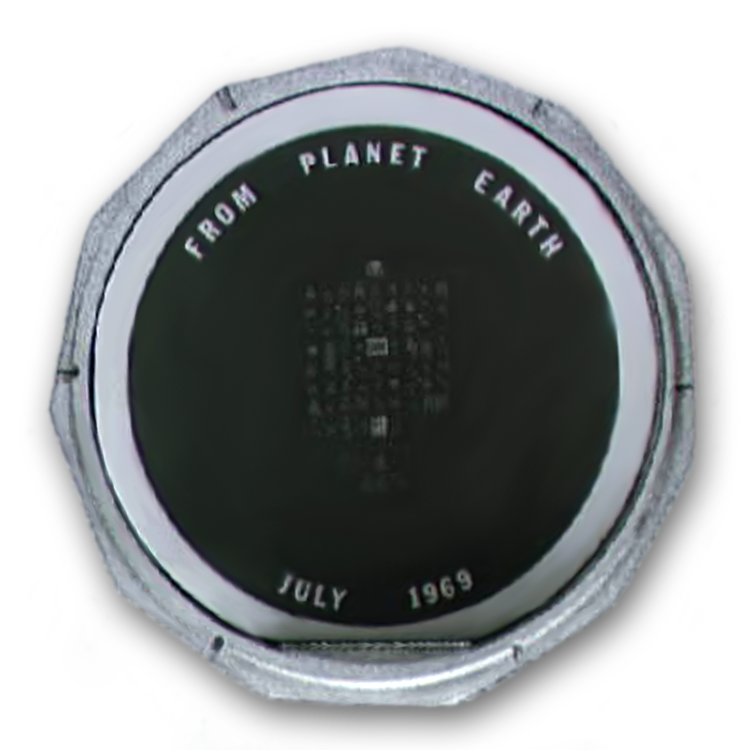
While not exactly sentimental, NASA did send a silicon disc to the moon with Apollo 11 containing goodwill messages from 73 countries. The whole thing is about the size of a US half dollar, so if you want to read the messages, you might be better off reading the associated document.
Making tiny silicon wafers with finely-detailed etchings was pretty high tech in the late 1960s. GCA Corp used a reduction camera to make a negative photomask containing all the letters plus an inscription around its edge at its final size. This mask was given to Sprague, who etched it.
The Odd
One of the strange things on the NASA list is a falcon feather. That was left by Apollo 15’s Davis Scott, who carried out the classic experiment of dropping a feather and a hammer to note that they fell at the same speed, even in the weak gravity of the moon. The feather was from Baggin, the Air Force Academy’s mascot, and remains on the lunar surface today.
Speaking of Baggin, there are 96 bags of human waste sitting up there. Probably best not to bring that up the next time you and your partner are gazing at the romantic moon overhead.
The Unconfirmed
Forrest Myers created a small ceramic wafer with tiny artwork from six artists, like Andy Warhol, titled “Moon Museum.” The tile features six drawings, including a stylized “AW” (Warhol), a line (Robert Rauschenberg), a black square (David Novros), a diagram (John Chamberlain), Mickey Mouse (Claes Oldenburg), and an interlocking design (Myers). Apparently, Novros and Chamberlain were inspired by circuit diagrams of some kind.
Bell Labs created the wafer. However, NASA failed to approve the project, and Myers sought an alternative.
Reportedly, Myers gave the chip to an unnamed Apollo 12 engineer who affixed it to the leg of the lunar module. However, NASA has not confirmed this, so we don’t know for sure if it is up there or not. Perhaps if you get to the neighborhood, you can check it out and let us know?
To the Dump
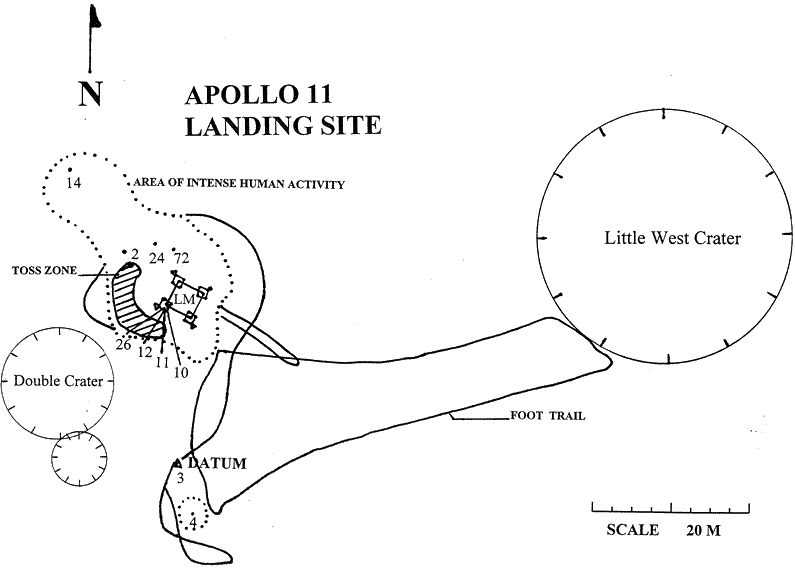
You might wonder why so much stuff was left, but if you think about it, it makes sense. The rockets can only bring back so much stuff. Every camera you leave behind means more moon rocks you can bring home. You can buy a new camera, but you can’t buy more moon rocks.
According to the Lunar Legacy Project, Apollo 11, and presumably the other missions, had designated toss zones. (We guess “dumps” didn’t sound good.)
If you are looking for a more up-to-date list, the Wikipedia article can help fill in the gaps, at least for vehicles. There’s been quite a bit added since the NASA list, including items from the UAE, Israel, and Luxembourg. Plus, there are many new additions from other countries.
With the advent of high-resolution orbital cameras, you can see some of the landing sites better than ever. For example, the video below shows the Apollo 17 site imaged by the Lunar Reconnaissance Orbiter Camera.
Of course, we are on our way back to the moon, and so are other space programs. So there will probably be even more human debris on the moon soon. It is only a matter of time before lunar waste management becomes a hot topic.
Title image “Map of artificial objects on the Moon” by [Footy2000]












Most of that can be recycled / reused up there, when the place gets a bit more developed. It is cheaper to use a piece of metal that is already there than to bring one from Earth.
Sounds like a premise for a scifi story.
But I sure hope we don’t devolve to be hunter-gatherers on the Moon, forced to scavenge, unable to make our own stuff to survive.
I highly recommend you check out “Seveneves” by Neal Stephenson
Not much left of the moon in that one!
Not his best, but more readable than many. Still enjoyed it.
Methusela’s Children, Robert A. Heinlein.
One of the major plot points later on in the novel is tonnage of space ships going to the moon.
It’s cheaper to lift all the equipment and power supply for recycling from Earth to Moon than to bring another piece of metal from Earth? Where’s the break-even point Professor? No lunar bamboo, no lunar coconuts. It’s not Florida in the 1920s, it’s not going to be “developed”. Blue sky thinking is all well and good, but there’s a notable absence of blue sky on the moon.
Build in place. That is where the RepRap movement meets its moment. Plenty of raw material in space and less biologic sensitivity to mess with.
All building is building in place. Else where are you building? Good luck with harvesting and processing and fabricating all that raw material.
If im not mistaken, 3d printers mostly print with stuff made from oil. Ancient biological juice. Not likely to find a reservoir of that on the moon (or anywhere in space, as far as out indications go).
Google “additive manufacturing of lunar regolith.”
I wonder if most of the mass of additively-fabricated (“3-d printed”) artifacts is actually concrete, not plastic. Takes a lot of tchotchkes to equal one building.
Though it could be argued that concrete, like most food, is oil-derived due to the energy source for cement or fertilizer.
However, yeah, sintered regolith doesn’t need anything but heat.
“Most of that can be recycled / reused up there”
The amount of useful material on the Moon at any one spot is a rounding error in terms of the amount of material you’d send for lunar development.
The problem with calculating the cost of sending stuff to the Moon is that you don’t send it a pound at a time, you send it several tons at a time, and getting a few pounds of metal is just pointless.
Leave a few pieces intact for museum!! Otherwise Futurama won’t come true with the discovery of Apollo 11 module.
I have thought along similar lines. They say how expensive it is to get things into orbit and about how much is floating around the earth that they want to burn up on re-entry. With solar panels, batteries, metal, the ISS among many other things, why not shift it to the moon and use it there. If they could land the ISS safely they have pre built accomodations. Recycling is the term of the century 👴
“If they could land the ISS safely”
If you just completely ignore the space logistical issues (it’s a totally different environment in terms of both particulates, radiation, and communication), it’s not clear you could actually get the ISS to the Moon, since there’s no guarantee you could thrust with enough force without tearing the station apart to get it into TLI or into a stable orbit.
ISS reboost procedures typically have a total delta-V of around ~1 m/s and take ~10 minutes. TLI from LEO delta-V is 3200 m/s which would require thrusting for nearly a month (and to be clear, orbital dynamics doesn’t work like that).
“about the size of a US half dollar”
How many football fields is that? :-/
Seriously — I’ve never seen a half dollar. I doubt the majority of the US population even knows it exists, let alone can say how big it is. How big is it? lmgtfm: 6.2 microleagues, about 2 millicubits bigger than a Toonie.
id be happy if they just used whatever set of units was most comfortable for them, we all know how to convert units, that’s like 90% of engineering.
Must be a youngster :) . Used half dollars a lot growing up. Still run into them once in awhile. Used a lot when I was doing coin magic back when I was teen as well, so have a pile somewhere around here…
Feather, hammer experiment. Perfect.
“50 cent”?
“Seriously — I’ve never seen a half dollar. I doubt the majority of the US population even knows it exists, let alone can say how big it is.”
There’s another comment here that points out “we all know how to convert units, that’s like 90% of engineering” and this is totally right.
But also – another huge part of engineering is rough scale estimates, and a half-dollar is a perfectly fine comparison for scale estimates. It doesn’t matter that it’s not common. It’s a coin. It’s not the size of a dinner plate. It’s not the size of a grain of rice. Should they have said “a bit bigger than a US quarter?” Or just “about the size of a coin”? Probably. Does it matter? Not really.
The ability to understand scale estimates and convert units rapidly is just a huge indicator of a really good engineer in my experience. For one thing, it lets you recognize obviously wrong statements and measures so you waste far less time.
Fold a dollar bill in half, it’s the same order of magnitude and good enough to keep the know nothing party happy.
Rip a dollar in half and you will immediately see two half dollars
They are still in circulation but few people asks for it because it’s large and heavy and most machines doesn’t take it. Half dollar coin is the largest physical US currency in circulation at 1.205 inches diameter or 30.6mm
About 2,987.5 half dollar spans a standard US football field excluding end zones, 3,585 if you included both end zones.
reply STOP if you don’t want any more useless information :)
MORE
How big is that in gallons?
How many “cubic US half dollars” in pint? :)
Everything but meric.
There are no metric US coins I expect :)
They should use SI based units (30.61 mm) and include them to describe any coin they seemingly HAVE to use.
And NASA and Blue Origin et cetera should also use SI derived units.
“There are no metric US coins I expect :)”
All US coins are metric. All US measurements, period, are defined relative to SI standards.
The idea that any agency should use “SI derived units” is silly because that concept is so vague as to be useless. By now all units used by industry are based in SI in some way, and which of those units are acceptable is just flat-out random by industry and agency, not just in the US, but also worldwide. What units you use doesn’t matter, you just have to agree on them.
(The most famous “NASA failure due to wrong units” (MCO) was really due to complete and total failure of communication between the operations team and spacecraft provider – they were required to provide specific units – which were metric – they just didn’t, and they also couldn’t even model the trajectory of the spacecraft for months after launch due to file format and orientation issues. The MCO investigation board summary is honestly an ‘ayfkm’ read).
League is not well defined. The most commonly accepted value is 3 statute miles, but varies by time and place from 1.4 mi. to 4.9 mi.
I won’t have a clear picture until I know how much that is expressed in random body parts.
The Moon lander crew threw out a bag of trash even before Armstrong climbed down to the Moon’s surface. Typically human, I say! ;-P
BUT … I think looking for life in the trash “we” left on the Moon should be at the top of “our” to do list! We might see some surprises!? We’ll only know when we do look.
Well, when we have a permanent presence on the moon, hook up a camper and travel to the landing sites and stay awhile :) .
Technically, you can buy new moon rocks. It’s just very, very expensive.
Harry Broderick: “I want to build a spaceship, go to the moon, salvage all the junk that’s up there, bring it back, sell it.”
You don’t suppose that Elon is really Andy Griffith in disguise?
Salvage 1 was a great tv show and I was saddened that it didn’t go on.
Wait, wait: This is an article about things we’ve left on the Moon… and you didn’t mention the most useful ones.
The retroreflectors. There are seven optical retroreflectors that were left on the Moon – three by Apollo, two by Russian probes, 1 by an ISRO probe (Chandrayaan-3), and one most recently by the CLPS mission Blue Ghost Mission 1.
The retroreflectors are constantly used to measure the distance to the Moon to millimeter precision continuously over the past 50 years, a dataset precise enough that it’s used for general relativity tests.
“Wait, wait: This is an article about things we’ve left on the Moon… and you didn’t mention ” Tommy Lee Jones.
ahhh, from the documentary “Space cowboys” (2000)
Need a picture of Cousin Eddie holding a septic hose connected to a lunar lander.
Re-use of the things, different countries led on the moon, seems to be a good idea. But really? Noone will re-activate a 70’s Hasselblad camera with analog film, even ist’s wonderful camera.
Maybe when they take someone with for the next missions form the hackaday-group, to awitch the Hasselblad to a moon rover… Or may be a Pakistani mechanic, they re-use everything, anyway, I’ve been told.
Best way cold be to fund a „museum of early men on moon“. For further generations.
Someone let their robodogs out, get lost and wander over to the Apollo 11 landing site. They find liquid stains on the legs of the lander and pad prints everywhere. Meanwhile over at another landing site tagged and trashed sits history. Like deep ocean mining they will scour whole areas, I can just hear the project manager bot complaining about scraping up a small historic site they were supposed to keep out of.
I do wonder what it would take for a hobbyist to get a small payload to the moon.
Carry a rocket to the edge of the atmosphere with a dozen weather balloons.The tricky part might be getting it pointed in the right direction once it’s up there.
Google “Tyranny of the Rocket Equation.”
To escape Earth’s gravity, you need to reach an escape velocity of approximately 11.2 km per second. Just imagine how much fuel you would need for that.
But that fuel itself weighs something. And because that fuel also has to be accelerated, you need even more additional fuel. And that additional fuel also weighs something. That creates a vicious circle, and in the end you need an extreme amount of fuel to escape gravity even with only a small payload. So forget about a dozen weather balloons.
“Carry a rocket to the edge of the atmosphere with a dozen weather balloons.”
The other poster mentioned the rocket equation, but to add on to that: altitude isn’t the problem. Velocity is. Yes, the idea of a balloon-assisted rocket (a rockoon) is real, but it really just doesn’t help significantly. Certainly not the multiple factors you would need.
Were already traveling pretty fast. If only a way could be found to stay still and let the earth fall out from under you.
^We’re
Yeah, that’s not how it works.
Yes, you want to use the Earth’s rotation to help. You know where your linear velocity’s fastest? The equator.
Do you know what the winds do at the equator? They’re opposite that direction. Trades are east to west, not west to east. Because the Earth is spinning and dragging the air along. Which means if you use a balloon to go up… It’s like launching in the wrong direction.
Rockoons were used in early days to get to altitude, not orbit. There are companies trying to revive them now, but they’re not exactly doing well because the benefits are not large – it’s mainly “we don’t need ground infrastructure” – they always tout fuel savings but it’s not really significant.
Maybe instead of looking for aliens, we should be looking for what they throw away because that’s the sign of an intelligent species. Doubly so if it has any signs of commercialism on it.
Some “planetary protection officer” spent an entire month cleaning the LM with liquid hydrazine to get rid of every single bit and piece of organic matter and DNA so we don’t pollute moon with fake, earth-based life forms that would casue issues with science missions in future years. Two dummies in astronaut costumes went there and dumped their dumps in a ziploc bag that’s going to decay from UV in about a month and polluted the moon with their faecalia… pretty much forever.
IMHO the whole “human things colonize the space” should be treated the same way we now refer to colonizing the Africa. We didn’t bring them progress and humanity. We enslaved those people and forced OUR way of life, OUR cultural traits and OUR religion on them. We destroyed Africa for thousands of generations and only now people are starting to take notice and thinking about restoring that continent to it’s pre-colonial form.
How are we going to enjoy researching Mars if probably on day one after landing we’ll pollute it with our filth?
The LM cleaning wasn’t designed to protect the Moon, it was designed to avoid possible contamination of lunar samples. Post-Apollo contamination didn’t matter from their point of view. Even the ‘decontamination’ procedure for Apollo post-landing was for the most part a farce, since no one seriously considered it an actual risk.
What I learned from this is that NASA put an insane person on the moon with Apollo 8.
Not sure why that was needed, even when the insane make up so much of humanity I don’t think they need to be represented on the moon.
And image being locked in a small capsule in space with an insane person during the journey. That takes a lot of calm.
Oops sorry, that should be Apollo 15.
Although I don’t know if any of the other missions had insane people on board.