
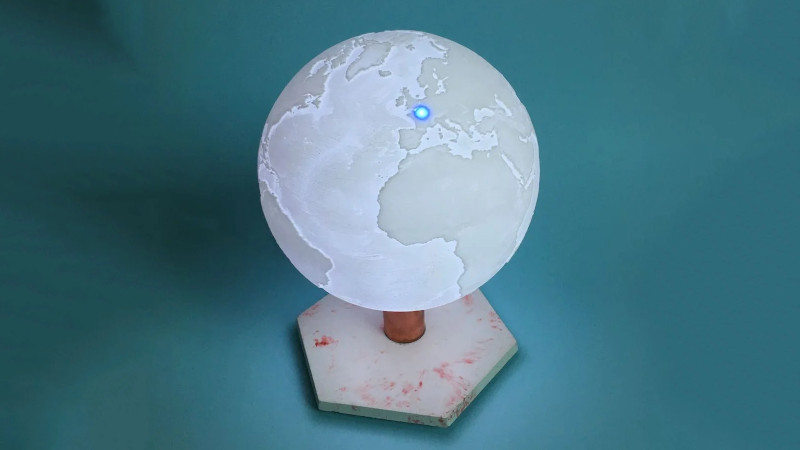
Assuming you don’t work at a major space agency, you probably don’t really need to know the exact location of the International Space Station at all times. If you’d like to know just because it’s cool, this lamp is for you.
The lamp is driven by a Wemos D1, which pulls in data on the space station’s current location from Open Notify. A stepper motor and servo motor serve to control a pan-tilt assembly, aiming a 405nm laser at the inside of a 3D printed globe to indicate the station’s position above Earth. As a nice touch, there’s also a ring of NeoPixel LEDs that are controlled to glow on the sunny side of the planet, too.
This is a fun project that makes it easy to know when to bust out your ham gear to chat to the team overhead, and would also make a great conversation starter. It’s not the first hardware ISS monitor we’ve seen, either! Video after the break.










That is wicked cool !
It has all the hallmarks of a great idea – you would think that such a device would exist and be available for sale, but it isn’t.
Excellent idea !
100 mw laser enclosed in an easily shattered plastic dome…what could go wrong?
If things around your house get shattered easily, probably should forego the 3d printer also….
Have I missed where the power of the laser is claimed at 100mW?
The author answers in the comments with a link to a 100mW(!) UV(!) laser, I’m not sure he has any idea how powerful that is…
Ah yes, I see. I personally doubt the listing, the laser doesn’t have the look of a 100mW module to me, but I’m no expert.
Not as easily shattered as a light bulb, drinking glass, mirror or a punch bowl to name a few but all could lead to fatal results….oh the humanity.
Neat build. Thanks for posting. My son was watching and said, “I had no idea the ISS could make those kind of tight corners. :D
That was when I started to question the whole project. Bad Code, Bad Video? Not a good sales pitch for it.
I don’t have a lot of space and think I’ll just go with a simple flashing light when it passes overheard.
https://www.instructables.com/ISS-Globe-Blinks-When-the-ISS-Passes-Overhead/
Interesting the op went with a laser, at first glance I thought it was a simple gimbal system with an LED that sweeps the inside just under the outer plastic shell.
You mean the daylight indicator doesn’t represent axial tilt??? sigh
Wait. That can’t be right. I saw this guy on YouTube who swears the earth is really flat. And that the ISS is fake. Now I’m so confused!
Everyone knows the ISS is the goddess Nut’s nipple ring!
And when the light gets stuck somewhere in the region of Syria, it becomes a globe that tracks ISIS for you! Hidden feature!
Idea for version 2:
Make only HALF the globe lighted, perhaps a few LEDs mounted on a flat circular baffle centered on the sphere’s center, and rotate that assembly at one turn per day in sync with the time, so only the daylight side of the planet is lighted. The distance from the baffle’s border to the sphere’s inner surface should provide enough “twilight”. Of course, the baffle should be made to tilt ±23° according to the seasons.
The laser could be fixed pointing up from the base, and a small mirror in a hole in the center of the baffle could direct the beam.