

Today, if you can find a pneumatic tube system at all, it is likely at a bank drive-through. A conversation in the Hackaday bunker revealed something a bit surprising. Apparently, in some parts of the United States, these have totally disappeared. In other areas, they are not as prevalent as they once were, but are still hanging in there. If you haven’t seen one, the idea is simple: you put things like money or documents into a capsule, put the capsule in a tube, and push a button. Compressed air shoots the capsule to the other end of the tube, where someone can reverse the process to send you something back.
These used to be a common sight in large offices and department stores that needed to send original documents around, and you still see them in some other odd places, like hospitals or pharmacy drive-throughs, where they may move drugs or lab samples, as well as documents. In Munich, for example, a hospital has a system with 200 stations and 1,300 capsules, also known as carriers. Another medical center in Rotterdam moves 400 carriers an hour through a 16-kilometer network of tubes. However, most systems are much smaller, but they still work on the same principle.
That Blows — Or Sucks?
Air pressure can push a carrier through a tube or suck it through the tube. Depending on the pressure, the carrier can accelerate or decelerate. Large systems like the 12-mile and 23-mile systems at Mayo Clinic, shown in the video below, have inbound pipes, an “exchanger” which is basically a switchboard, and outbound pipes. Computers control the system to move the carriers at about 19 miles per hour. You’ll see in the video that some systems use oval tubes to prevent the tubes from spinning inside the pipes, which is apparently a bad thing to do to blood samples.
In general, carriers going up will move via compressed air. Downward motion is usually via suction. If the carrier has to go in a horizontal direction, it could be either. An air diverter works with the blower to provide the correct pressures.
History
This seems a bit retro, but maybe like something from the 1950s. Turns out, it is much older than that. The basic system was the idea of William Murdoch in 1799. Crude pipelines carried telegram messages to nearby buildings. It is interesting, too, that Hero understood that air could move things as early as the first century.
In 1810, George Medhurst had plans for a pneumatic tube system. He posited that at 40 PSI — just a bit more than double normal sea-level air pressure — air would move at about 1,600 km/h. He felt that even propelling a load, it could attain a speed of 160 km/h. He died in 1827, though, with no actual model built.
In 1853, Josiah Latimer Clark installed a 200-meter system between the London Stock Exchange and the telegraph office. The telegraph operator would sell stock price data to subscribers — another thing that you’d think was more modern but isn’t.
Within a few years, the arrangement was common around other stock exchanges. By 1870, improvements enabled faster operation and the simultaneous transit of multiple carriers. London alone had 34 kilometers of tube by 1880. In Aberdeen, a tube system even carried fish from the market to the post office.
There were improvements, of course. Some systems used rings that could dial in a destination address, mechanically selecting a path through the exchange, which you can see one in the Mayo Clinic video. But even today, the systems work essentially the way they did in the 1800s.
Famous Systems
Several cities had pneumatic mail service. Paris ran a 467 km system until 1984. Prague’s 60 km network was in operation until 2002. Berlin’s system covered 400 km in 1940. The US had its share, too. NASA’s mission control center used tubes to send printouts from the lower floors up to the mission control room floor. The CIA Headquarters had a system running until 1989.
In 1920 Berlin, you could use the system as the equivalent of text messaging if you saw someone who caught your eye at one local bar. You could even send them a token of your affection, all via tube.
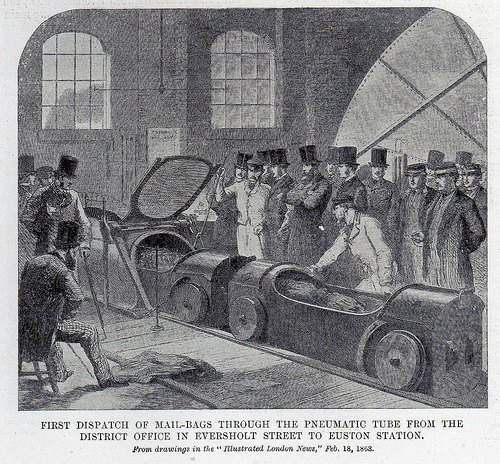
In 1812, there was some consideration of moving people using this kind of system, and there were short-lived attempts in Ireland, London, and Paris, among other places, in the mid-1800s. In general, this is known as an “atmospheric railroad.”
As a stunt, in 1865, the London Pneumatic Despatch Company sent the Duke of Buckingham and some others on a five-minute trip through a pneumatic tube. The system was made to carry parcels at 60 km/h using a 6.4-meter fan run by a steam engine. The capsules, in this case, looked somewhat like an automobile. There are no reports of how the Duke and his companions enjoyed the trip.
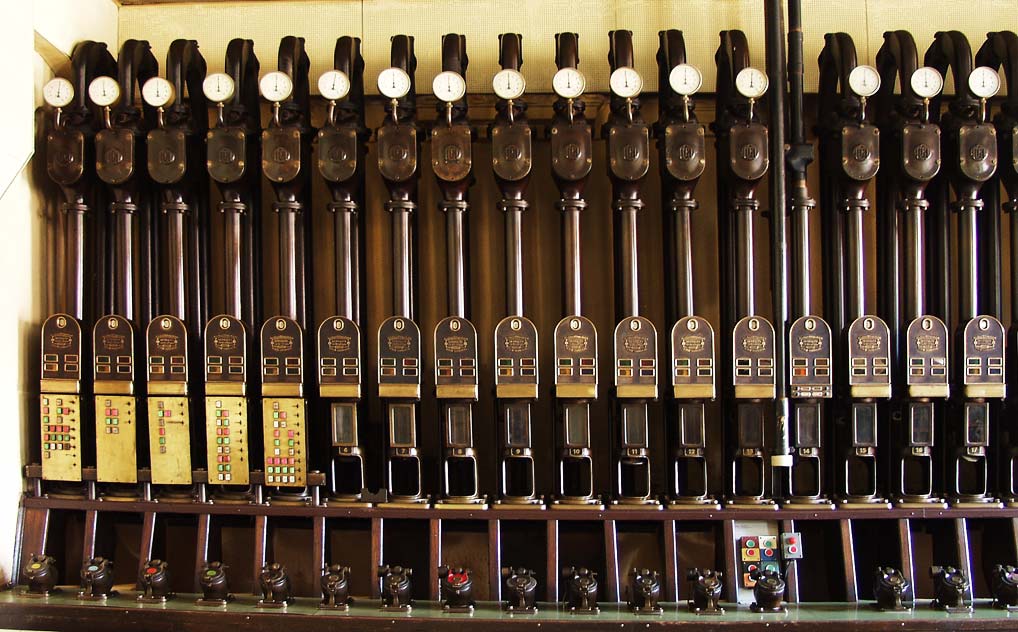
A 550-meter demonstration pneumatic train showed up at the Crystal Palace in 1864. Designed by Thomas Webster Rammell. It only operated for two months. A 6.7-meter fan blew air one way for the outbound trip and sucked it back for the return.
Don’t think the United States wasn’t in on all this, too. New York may be famous for its subway system, but its early predecessor was, in fact, pneumatic, as you can see in the video below.
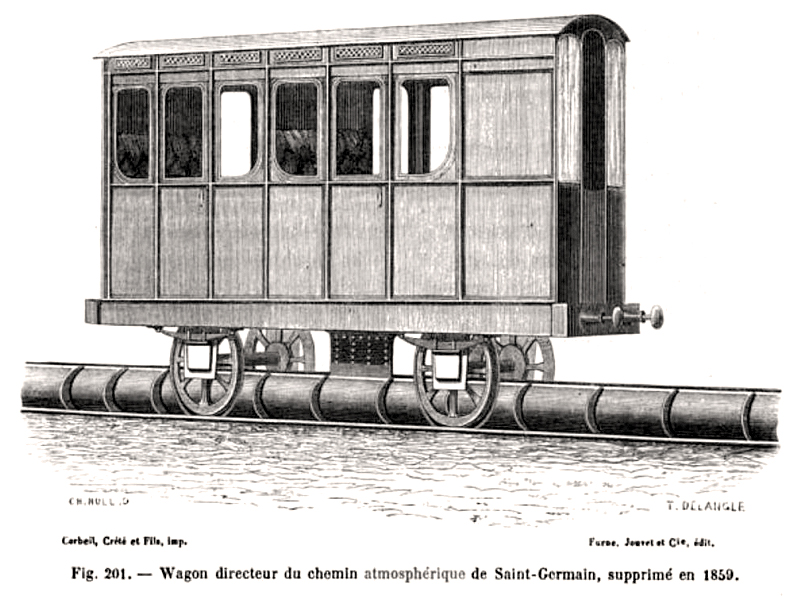
Many of these atmospheric trains didn’t put the passengers in the capsule, but used the capsule to move a railcar. The Paris St. Germain system, which opened in 1837, used this idea.
Modern Times
Of course, where you once would send documents via tube, you’d now send a PDF file. Today, you mainly see tubes where it is important for an actual item to arrive quickly somewhere: an original document, cash, or medical samples. ThyssenKrupp uses a tube system to send toasty 900 °C steel samples from a furnace to a laboratory. Can’t do that over Ethernet.
There have been attempts to send food over tubes and even take away garbage. Some factories use them to move materials, too. So pneumatic tubes aren’t going away, even if they aren’t as common as they once were. In fact, we hear they are even more popular than ever in hospitals, so these aren’t just old systems still in use.
We haven’t seen many DIY pneumatic tube systems that were serious (we won’t count sucking Skittles through a tube with a shop vac). But we do see it in some robot projects. What would you do with a system like this? Even more importantly, are these still common in your area or a rarity? Let us know in the comments.










I was involved in the restoration of the pneumatic tube system on the historic NS Savannah nuclear merchant ship, which is currently docked in Baltimore. The system was used to send messages to be transmitted ship-to-shore to the radio room from the purser’s desk. The system hadn’t operate for decades but was surprisingly easy to get working again. A new rubber belt and some cleaning was all that was needed. The original capsules also cleaned up well.
You forgot to include the video: https://youtu.be/auUEqhPMGHk
Yeah, I was too lazy to look it up. Thanks for posting it.
These tubes were put to major use when I worked production at a large daily newspaper.
I worked in the central hub of production in the Camera Plate dept. This was back in the days of lithographics and everything centered around our Process Cameras and films were stripped and composited onto contact duplicating films.
The photo lab was up in the newsroom and photographic prints would be shot down the tubes by the photo editors. The prints shot into halftones and sent to pasteup where editors and pasteup artists built the pages and pages would be sent to be shot on litho films on process cameras. The negatives would be shot up another tube delivery circuit across the plant into the pressroom where the platemaking dept would recieve the negs to produce printing plates. Every evening I used to send a velox print of the days crossword puzzle to my friend up in platemaking. One night I stripped the clues from one puzzle with the squares of a different puzzles negative and burned a print of the composited puzzle and shot it up the tubes. I happened to gobup ro the plateroom the next day and in the office on the desk was a very marked up and incomplete puzzle next to four or five pencils with erasers worn to the nub…
Famous, not mentioned: https://en.wikipedia.org/wiki/Pneumatic_tube_mail_in_New_York_City
Not famous, not mentioned, but cool: The Rabbit Line, fires radioisotopes from the TRIUMF particle accelerator 2.5 km to the point of use: https://ingeniumcanada.org/channel/innovation/down-rabbit-line-transporting-medical-isotopes and featured by Tom Scott https://www.youtube.com/watch?v=eMTZvA8iFgI
In recent years the EU has actually regessed on that front. Instead of robots taking out and sorting our trash, we have to do it ourselves.
All plastic bottles now have deposit fee on them. You are NOT allowed to dump them into “plastics” bin anymore. They must be taken back to the store and fed to the so-called “reverse vending machine”: https://en.wikipedia.org/wiki/Reverse_vending_machine
Because “plastics” bins now have less plastic in them, local companies operating trash disposal earn less money from renewable resources and in turn had to increase rates we pay for trash collection.
tl;dr
Soda costs more because of “eco” deposit on plastic bottle.
We have to bring empty bottle back to the store and hope vending machine isn’t “temporarily out of order”.
We pay more for trash disposal because we produce less plastic.
🤡 Clown world at it’s finest 🤡
The Scottish Government was going to set this up here but the plan was half-baked and too expensive, and had to be abandoned.
Hi,
IIRC the motive for requiring a deposit on plastic bottles (and metal cans!) was the excessive littering with same, especially in areas without public cleaning
Hi,
the motive for this required deposit on plastic bottles and metal cans(!), that the reverse vending machine gives back, was IIRC the excessive littering, especially in areas without public cleaning.
regards, recook
But remember, you produce less waste, as the bottles are recycled directly!
People actually oppose bottle deposits? Keeps the cities clean and you can just take the empty cans or bottles with you the next time you go to the store
You can toss your recyclable plastic bottles in the plastic bin. You would be stupid to do so, however, because then you don’t get your deposit back.
Way back in the beginning, returning the bottles was a pain in the ass. You had to take the bottles back to the same store that you bought them from. That wasn’t a requirement, but a practical reality. The stores only took back bottles from articles they sold. If you brought in a bottle for a product they didn’t sell, then they couldn’t take it back.
These days, the bottle machines all belong to third parties, with some kind of agreement with the bottlers. You can take a bottle to nearly any store and they’ll accept it.
The system works pretty well.
Most stores have more than one machine, so if one is down the other is usually operating.
It’s not nearly as much a problem as you make it out to be.
Returning bottles is no fun. The machines are slow. If its a drop-off they still have to check each one before you get YOUR MONEY back.
Whenever I hear of a new bottle bill proposal I want to drop 10000 bottles on the state house steps and leave a note “you turn them in a****s!
m
Maybe I should just send them to you.
I recall encountering (and using) one of these machines in Germany back in ’04 or so to get my Pfand (deposit) back on beer bottles. Pretty neat to watch it in action, as the sides were transparent and one could watch the internal mechanisms.
Funny enough I was at a new hospital in Austria today, and I was pleasantly surprised to see a nice modern system sending blood samples and other stuff all around the hospital. I was even graced with watching the end point plop out and suck in some canisters, so the tech is alive and well.
The banks in my area got rid of the tubes at drive throughs years ago. Now, the lane closest to the building has a slide out drawer and the other lane(s) have ATMs
The Safe House in Milwaukee features a pneumatic tube system to deliver its signature “Spytini” from the bar to guests. The drink is shaken, not stirred, then sent through the tube, which travels 600 feet around the restaurant before being poured into a chilled glass for the customer. This is one of many unique, spy-themed features at the restaurant, which include secret passages and other gadgets shown in this YouTube video.
https://youtu.be/bo1hjpb2fMo
It’s really one of my favorite places in all of the Midwest, along with American Science & Surplus.
I hear the internet is a bunch of tubes too.
Hmmm….thinking station wagon (tube capsule) full of magtapes (SD cards) here, and wondering what the throughput of a typical pneumatic tube system might be…
And it’s sucking more and more as time goes by.
about pneumatic tubes :D
https://www.themarysue.com/vacuum-thieves-paris/
They are very common in the US. Just about in every hospital. How do you think they move medication, blood samples, urine samples and such around quickly. Swisslog healthcare is one of the systems providers.
No discussion of pneumatic tubes is complete without mention of the Alameda-Weehawken Burrito Tunnel.
https://idlewords.com/2007/04/the_alameda_weehawken_burrito_tunnel.htm
Oh, man, that’s great. Truly great work. I’m shocked I had not heard of that one before. Thanks for that.
Kinda reminds me of the (in)famous burrito command line tool from sometime around 1990. Either the internet bitrot has lost it or my google-fu fails me, and I can’t find the man page for it. But around that time, if you happened to be at Sun Microsystems, you could order a burrito from the command line. The server running the script would generate a fax and send that by phone to a local burrito place. It was pretty funny at the time. Now, with phones and Uber Eats it just isn’t have the same.
The man page for “burrito” all by itself was funny.
Hi Paul,
regarding the manpage, here you are: http://wiki.yak.net/1175 “that BURRITO command”.
A modern variant pased on the infamous nodejs might be https://github.com/escott-/burrito
regards, recook
Ah, thanks for finding that. It’s not quite the one I remember (which was formatted like a genuine manpage), but it’s the same thing. And I guess it was Adobe, not Sun. Darned neurons fade.
Inquiring minds want to know why the publication was held back for 6 days.
I always thought the absurd prevalence of pneumatic-tube drive-thru banks in the USA was simply because bullets can’t go around the bends in the pipes…
There are some safety concerns, but, the main reason they were sold was for speed. One teller can service a patron while the next person in line is pulling up.
“You’ll see in the video that some systems use oval tubes to prevent the tubes from spinning inside the pipes, which is apparently a bad thing to do to blood samples.”
Free centrifuge.
Hospitals still use pneumatic tube systems. They are usually routed above the on-call sleep rooms so you hear THUMP-thump_thump all night long. Amazing.
I stumbled upon such a system in Christchurch, New Zealand, that delivered food to your table. The system had a steam punk look to it — fun to watch, since the tubes were all clear plastic, and were mounted along the walls and ceiling.
Research nuclear reactors use pneumatic tube delivery systems (called rabbit tubes) to irradiate samples near the reactor core. For example, see https://reactor.engr.wisc.edu/pneumatic-tube-rabbit-tube-2/
I work for the Diebold Nixdorg which sold most of the banking pneumatic tubes. The cool thing about the banking systems is that the end point has an engineered end point. The carrier is pulled down by gravity and momentum and is cushioned by the air in front of it. The seals are made to bleed off pressure to let the carrier land slowly. Pretty neat!
The Beach system covered about a block, according to the book, “The World beneath the City”. And in fact it did a much better job of moving people around, then the initial plans for the subway that were being proposed. Funny thing, downtown the original line is preserved as part of the same system he didn’t like.
A few years ago I was at the Beamish museum in the UK, a ‘living history’ museum. This includes a shop that has a mechanical precursor to the pneumatic tube system: the Lamson cash ball system. It uses wooden balls (which open up to reveal a cylindrical space inside) that roll along tracks made from metal wire. To transfer something, you use a pulley system to lift the ball to the ceiling, onto the tracks which are all inclined so the balls roll under gravity.
Good thing we can use electrons now to send information…
I have always thought that the “Vectorr” rail system is a really inspiring idea. It’s essentially a pneumatic tube magnetically coupled to a train car.
http://www.flightrail.com/our-prototype.html
Too bad it didn’t catch on.
On a more pedestrian level air is used to move, for example plastic pellets to injection moulding machines and 3d printers.
Pneumatic tube systems were used in major department stores in my city until the late 1960’s instead of cash registers. The customers cash and “sales slip” (in duplicate) were sent to a central cash room and the change with a receipt were returned usually within a minute or so. Efficienct and secure: no time and effort wasted reconciling multiple registers, investigating errors (shortages), multiple users as needed, no cash to tempt a hold-up. Fifty plus years later a newly designed supermarket opened last week in my area that accepts cash payment at one checkout only and payment is handled exactly that way. (There’s actually three such checkouts; there are three distinct areas -it is a big store.)
It doesn’t cover the fact that nearly 100 percent of every large hospital has such a system. You can’t send lab samples in a PDF. Pharmacy meds don’t usually transmit well electronically. Hard copy medical records are by nature a paper only entity. Here in Washington state I have been working on well over 100 such systems for the last 30 years and I can guarantee you they won’t go away in many places.
When I started at the Surrey branch of the Royal Marsden Hospital in 1977 they had a functioning tube system. It worked by vacuum and the front if the tube had 2 concentric dials to input the required destination (eg C5). Iinside were a number of reeds (as in a harmonica) and the air funneling past them created a chord sound that the intended receiving station could ‘listen’ for, and activate a diverter to intercept it.
I asked how it worked at the ‘end of the line’ and what happened if the intended destination was behind rather than in front, but I never found out.
Its use was discontinued when major building works were carried out.
https://media.ccc.de/v/30C3_-_5610_-__-_saal_2_-_201312271245_-_seidenstrasse_-_m_-_jeff_mann_-_frank_-_diani_barreto
And there used to be this DIY thing at CCC events.
Called “seidenstrasse” german for “silkroad”
I helped build a system like this for a research cyclotron. It was fully automated using pneumatics to pull a freshly irradiated plate off the beamline, load it into a rabbit, and send it off to another part of the facility. Reason being you don’t want to carry a radioactive sample around by hand, and this thing went really really fast to minimise exposure.
The first prototype used PVC pipes clamped to various parts of our lab, and it was terrifying. It took a bit to get the air cushion tuned right, so this huge aluminum slug would slam into the exit at 60 km/h