
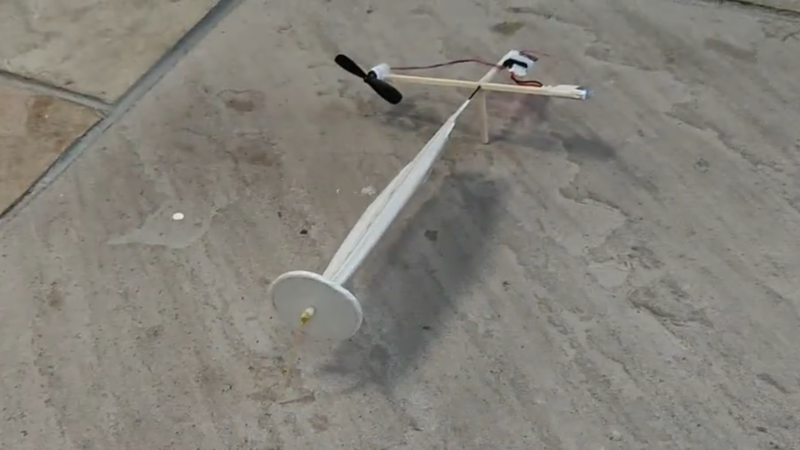
By now we’re all familiar with the quad-rotor design most popular among modern drones, and of course there are many variants using more or less propellers and even fixed-wing drones that can fly autonomously. We’ve even seen drones that convert from rotorcraft to fixed-wing mid flight. But there are even more esoteric drones out there that are far more experimental and use even more bizarre wing designs that look like they shouldn’t be able to fly at all. Take [Starsistor]’s latest design, which uses a single motor and an unconventional single off-center wing to generate lift.
This wing, though, is not a traditional foil shape typically found on aircraft. It uses the Magnus effect to generate lift. Briefly, the Magnus effect is when lift is generated from a spinning object in a fluid. Unlike other Magnus effect designs which use a motor to spin a cylinder, this one uses a design inspired by Savonius wind turbines where a wing is free to rotate around a shaft. A single propeller provides a rotational force to the craft, allowing this off-center wing to begin spinning and generating lift. The small craft was able to sustain several flights but was limited due to its lack of active control.
[Starsistor] went through a number of iterations before finally getting this unusual craft to fly. His first designs did not have enough rotational inertia and would flip over at speed, which was fixed by moving the propeller further away from the center of the craft. Eventually he was able to get a working design to prove his conceptual aircraft, and we hope to see others from him in the future.












Given the low altitude in all of the videos, could there be a ground effect limitation?
Careful. You’re in the youtube corner of amateurs namedropping random unrelated concepts that may have nothing to do with the stuff they’re trying to do, backed up by math and theory that may be misunderstood, misapplied, or fake. It’s your typical anti-gravity magnet motor channels, but applied to RC-planes.
Combine with the common truth of RC-planes: you can make a brick fly if you put enough power in the propeller, and you see how that can generate compelling content for collecting clicks.
Mostly true, you do have to counter the torque somehow.
That means another propeller (perhaps connected to the same engine using a reductor), or a control surface, also needing an actuator, which basically is another engine.
But since rotation of the aircraft is the meaning of rotating the rotor in order to provide lift, that means that losing rotation is losing lift. So, either find a way to rotate the rotors or use them instead if helicopter main blades.
Another point is that, from what I saw, the rotating cylinder is usually the size of the wing that it replaces. So, from space occupied is the same as a normal wing. Kind of useless because is a moving part. Not to mention that it won’t self rotate if the power is down, so if you lose power, you’re done.
Nah, you just put the brick sideways.
Who cares if it spins, as long as it’s going up?
I’m reminded of a “flying saucer” toy that Cox made a few decades ago. It had a small glow-plug engine (.02 or .049 cc) mounted vertically, propeller up. This was mounted on a multi-bladed disc, and that was all there was to it. The propeller provided upward thrust directly, but more importantly, it provided torque that turned the whole disc, whose blades provided the rest of the lift.
Quite true, and an important caveat on any build like this.
At least his intermediate designs do seem to using the magnus effect to generate some lift, since they fail to take off unless the auto-rotating “wing”(?) is actually rotating. If it was just acting as a crappy airfoil, that wouldn’t be the case.
Just because it’s rotating doesn’t mean it’s the Magnus effect, or that it’s contributing to lift.
Remember the Veritasium video where the guy lifts a spinning weight on the end of a pole above his head with one hand, just by the gyroscopic precession of the weight? The fact that he kept it spinning around made it “lift itself up”.
Point being that gyroscopic effects are not true lift. They just keep the device from tilting over and plowing into the ground.
So perhaps the spinning wing’s key contribution is just as a gyroscopic stabilizer, and unless it’s spinning, the whole craft is too wobbly around its main axis to even get up to takeoff speed? That’s a fair point.
Agreed that it looks like magnus effect, and I don’t understand the skepticism here. Magnus effect isn’t strange science. As the video points out, it’s why curve balls curve.
Here, it’s strange because he’s making a maple-leaf-style (samara) monocopter with it. But it’s not like we haven’t seen that done a ton as well.
https://hackaday.com/2025/08/20/one-motor-drone-mimics-maple-seeds-for-stability/
https://hackaday.com/2021/08/07/helicopter-seed-robot-can-also-drop-like-a-rock/
https://hackaday.com/2016/05/04/your-quadcopter-has-three-propellers-too-many/
As he points out in the video, the hard part is going to be controlling this thing.
Anyway, I don’t think the point is to make an efficient flying vehicle, but rather the strangest flying vehicle. And for that, it’s looking pretty good, IMO. :)
The reason for the skepticism is that for the size of the thing, its rate of rotation around any axis, etc. the back of the envelope calculations about the amount of possible lift available fall short of explaining why the thing would fly.
The common theme in bunk experiments is that the effect, if present, does not work properly because it depends on some property or quality like the Reynold’s number (ratio between inertial and viscous forces), which is not the same when you scale your airfoil down by a factor of 20-50. Just the geometric effects: volume vs. surface area vs. material stiffness, does not scale equally, so your airplane becomes much lighter, stronger, and more powerful and able to fly at proportionally lower speeds when it is small. This is for the same reason why an ant can lift 50 times its own body mass with ease, while an average human struggles with one fifth of theirs.
The result is that while you can calculate some exotic thing like the Magnus effect, or the perennial favorite Coanda effect, etc. using formulas that apply at one scale, the result is going to be pure nonsense at another. This pure nonsense is then “confirmed” by the fact that the model plane seems to be flying surprisingly well, which is attributed to the “effect” instead of the fact that it’s just easier to make it fly in the first place.
This “positive” result is then extrapolated back up to the large scale, making the same error twice going forwards and backwards, and the person starts to imagine that they’ve discovered some new science that nobody else has. Then they go onto Youtube and post a video about it.
I just worked out the physics behind the Magnus effect. It makes things flail and crash up!
I’m not knowledgeable on theses topics but even with just the wiki page they show in their vid – it doesn’t look like the build device actually uses the Magnus effect.
More like some type of https://duckduckgo.com/?q=flying+tree+seed
I don’t buy it either. Show me a design with no fan please. Flat cylinders like Flettner rotors would be impressive, even if there were multiple.
it never left the ground. what you have their is the worlds most unstable ekranoplan.
I think that might not be magnus effect. Looks like it just starts spinning fast enough and the rotor gets to a least energy angle and that starts providing lift like any flat surface in the wind.
The AI reading the poorly worded copy to accompany the video is super annoying. To the author : just present it yourself next time. Can’t listen to this …
YouTube did that to you. Feel free to listen to the original Spanish if you want to. (I did.)
If I were building something like this, the “wing” would be a ball , or a cylinder or a cone, and the propeller would be a cyclorotor, and they would share a shaft, so that a single motor could spin the flettner rotor one way and spin the cyclorotor the other way.