
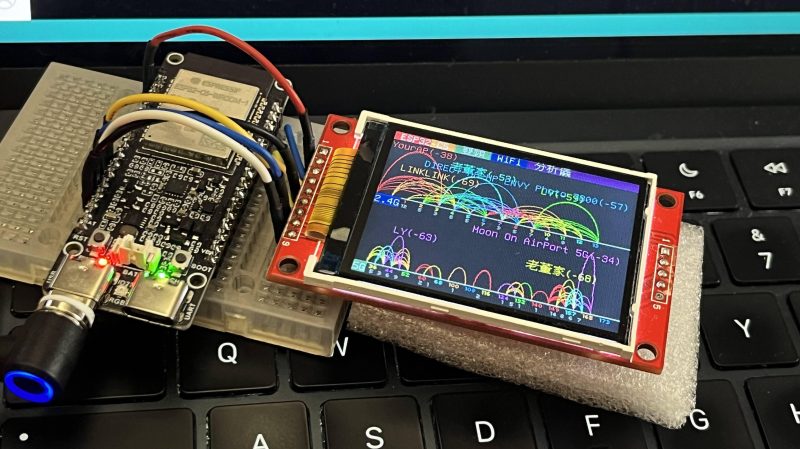
Wi-Fi! It’s everywhere, and yet you can’t really see it, by virtue of the technology relying on the transmission of electromagnetic waves outside the visual spectrum. Never mind, though, because you can always build yourself a Wi-Fi analyzer to get some insight into your radio surroundings, as demonstrated by [moononournation].
The core of the build is the ESP32-C5. The popular microcontroller is well-equipped for this task with its onboard dual-band Wi-Fi hardware, even if the stock antenna on most devboards is a little underwhelming. [moononournation] has paired this with a small rectangular LCD screen running the ILI9341 controller. The graphical interface is drawn with the aid of the Arduino_GFX library. It shows a graph of access points detected in the immediate area, as well as which channels they’re using and their apparent signal strength.
If you’re just trying to get a basic read on the Wi-Fi environment in a given locale, a tool like this can prove pretty useful. If your desires are more advanced, you might leap up to tinkering in the world of software defined radio. Video after the break.












the functionality of this project has been a perfectly fine smartphone app for more than a decade :)
All these apps and pet projects always do the same: do a WiFi scan and print results in a graph based on RSSI. But it would be so much better printing also channel load. Many times it’s better using an AP with lower RSSI, but on a less congested channel.
I suspect channel load might be tricky (if even possible) to get on smartphones (the usual implementation requires monitor mode), but it is completely possible doing it on an ESP32 (I have done it for the 2.4 GHz band).
“… and yet you can’t really see it, by virtue of the technology relying on the transmission of electromagnetic waves outside the visual spectrum.”
Sounds like an engineering challenge to me. :)
Already got infrared/thermal perception wired up to myself daily for the last year or so and was looking into exactly this sort of wifi scanning setup to use as a new source of input to the mind. Maybe not visual sight, but certainly a sense.
These newer dual band boards allow lots of useful maker projects!
With some tweaks this may be one to add to the sensory repertoire while at work for quicker diagnostics of network/airspace issues I often run up against. Hmmmm….
See the 96 microphone sound camera that The Signal Path did a video on recently too? Image all modalities!
I’d not!
but the concept is very much on my list of things to do – wonder also about offloading cone of confusion processing, to give that directionality.
Benn Jordan also had some interesting dives into DIY setups, if I remember right.
https://youtu.be/c5ynZ3lMQJc
Maybe could do motion extraction – > haptics as well.
Well, radio is already made of photons. But they’re very long wave, so focus will be a bit of an issue.
“Everything is made of photons.”
There was a different project featured here a while ago to “see” wifi that might be closer to what you’re thinking.
https://hackaday.com/2025/02/15/octet-of-esp32s-lets-you-see-wifi-like-never-before/
There’s an even older project also featured here that did the same!
https://hackaday.com/2011/03/02/how-to-find-wifi-carry-a-big-stick-and-use-long-exposures/
I remember that build! Looked super interesting for environmental awareness.
There was a (many multiple)ESP-based ‘wi-fi camera’ academic project doing the rounds not that long ago… https://espargos.net/ is not the one I’m thinking of, but it is similar
What’s wrong with inSSIDer 3.1.1?
https://www.techspot.com/downloads/5936-inssider.html
I did a similar project some 10-15 years ago with an ESP8266 without fancy color graphics but with an SMA antenna connector.
I would use it to point precisely our yagi antennas to the WIFI hotspot of the campsite. I also built a 5m tall antenna mast that would be attached to the camping equipment trailer.
That’s what you get when you have a bunch of engineers going camping together.
I love that this project is rocking the magnetic USB changing cables