
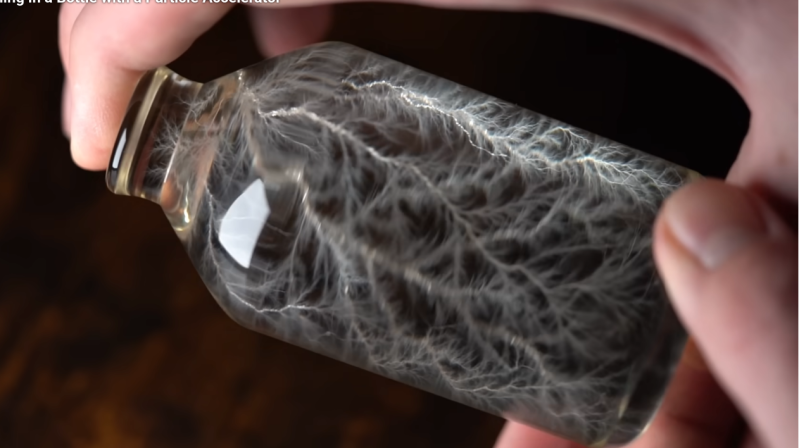
You’ve probably seen Lichtenberg figures before, those lightning-like traces left by high-voltage discharge. The safe way to create them is using an electron beam to embed charge inside an acrylic block, and then shake them loose with a short, sharp tap. The usual technique makes for a great, flat splay of “lightning” that looks great in a rectangular prism or cube on your desk. [Electron Impressions] was getting bored with that, though, and wanted to do something unique — they wanted to capture lightning in a bottle, with a cylindrical-shaped Lichtenberg figure.
They’re still using the kill-you-in-milliseconds linear accelerator that makes for such lovely flat figures, but they need to rotate the cylinder to uniformly deposit charge around its axis. That sounds easy, but remember this is a high-energy electron beam that’s not going to play nice with any electrical components that are put through to drive the spinning.
Ultimately, he goes old-school: a lead-acid battery and a brushed DC motor. Apparently, more power-dense batteries have trouble with the radiation. Though the 3D-printed roller assembly is perhaps not that old-school, it’s neat to know that PETG is resilient to beta ray exposure. Getting footage from inside the linear accelerator with a shielded GoPro is just a bonus. (Jump to five minutes in to see it go into the beam chamber.)
The whole process is very similar to one we featured long ago to put Lichtenberg figures into acrylic spheres (the linked post is dead, but the video survives). If you don’t have access to a powerful electron beam, you can still make Lichtenberg figures the old-fashioned way with a microwave sign transformer, but that’s very much an “at your own risk” project, considering it’s the deadliest hack on the internet.









Stoneridge Engineering sells excellent Lichtenberg figures if you want one of your own and haven’t got a particle accelerator:
https://capturedlightning.com/
Their website is also extremely interesting, with videos including one of a trip through the accelerator enclosure! Or so I remember from many years ago.
Why link to a youtube video that requires a login in order to view it?
That’s youtube’s fault, trying to prevent LLM scrapers
That and because data on watching habits is incredibly valuable.
“Incredibly” here being incredibly relative in this context. If one has access to 100s of millions of viewers and bilions in advertising from all the major corporations of the world, yea you can put the 2 together and make some bank. Each individuals data is worthless at the individual level, as in we couldn’t even spend its miniscule value even if we had it cashed out.
One wonders how much it would cost to get a larger-than-life sized Klein bottle full of this effect. Maybe around Halloween time. For reasons.
We could do that for you!
A microwave sign transformer, the kind that can be found inside a neon oven?
Yes, it heats your food to the perfect orange glow.
If you put glass noodles in it, they can be used to create signs that light up at night.
Interesting setup, but surely not the first Lichtenberg figure made in a cylindrical shape with a particle accelerator: https://www.youtube.com/watch?v=hrzbu_7fHY8
Video made with an ordinary mobile camera without any shields, but zoomed in and some meters away from the primary beam.
Seeing the self discharge: I always wondered what the limiting factor in electron deposition was.
Between the immense coulomb repulsion forces trying to expand the target from the inside, and the mechanical degradation of the acrylic polymer from the radiation exposure, I half-expected overcooked targets to self-destruct and splinter into a thousand pieces.
Too much radiation does not result in quicker or nicer lightning, nor does the acrylic explode. It simply becomes dark and nontransparent. I don’t know the limiting factors either.
Now, how can we program our shiny new UV laser engravers to create simulated 3D Lichtenberg figures inside chunks of K9 crystal? Much more interesting than the usual Santa Claus and teddy bear figures. It might be a fun coding experiment to generate these patterns as the required point clouds.