
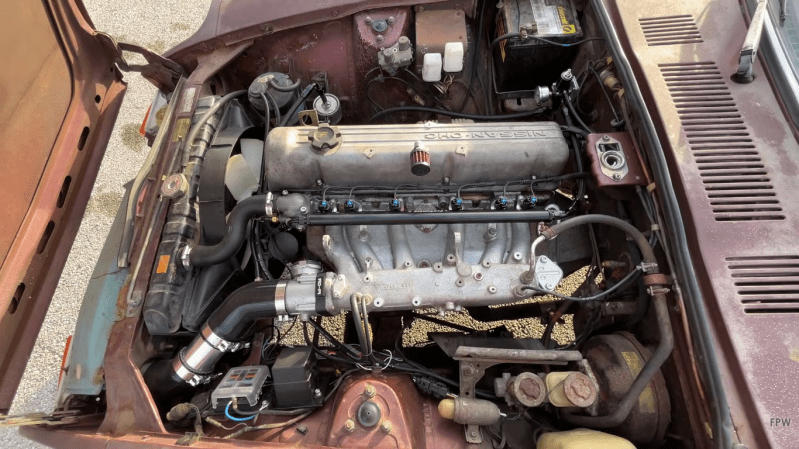
Although Nissan has been in the doldrums ever since getting purchased by Renault in the early 2000s, it once had a reputation as a car company that was always on the cutting edge of technology. Nissan was generally well ahead of its peers when bringing technologies like variable valve timing, turbocharging, fuel injection, and adjustable suspension to affordable, reliable vehicles meant for everyday use. Of course, a lot of this was done before computers were as powerful as they are today so [Ronald] set out to modernize some of these features on his 1978 Datsun 280Z.
Of course there are outright engine swaps that could bring a car like this up to semi-modern standards of power and efficiency, but he wanted to keep everything fully reversible in case he wants to revert to stock in the future, and didn’t want to do anything to the engine’s interior. The first thing was to remove the complicated mechanical system to control the throttle and replace it with an electronic throttle body with fly-by-wire system and a more powerful computer. The next step was removing the distributor-based ignition system in favor of individual coil packs and electronic ignition control, also managed by the new computer. This was perhaps the most complicated part of the build as it involved using a custom-made hall effect sensor on the original distributor shaft to tell the computer where the engine was in its rotation.
The final part of this engine modernization effort was upgrading the fuel delivery system. The original fuel injection system fired all of the injectors all the time, needlessly wasting fuel, but the new system only fires a specific cylinder when it needs fuel. This ended up improving gas mileage dramatically, and dyno tests also showed these modifications improved power significantly as well. Nissan hasn’t been completely whiffing since the Renault takeover, either. Their electric Leaf was the first mass-produced EV and is hugely popular in all kinds of projects like this build which uses a Leaf powertrain in a Nissan Frontier.











I loved those late 70s and early 80s Nissan inline 6 cylinders. I had a 2.4L in the transition year Maxima (had both Nissan and Datsun branding) and was the 510 the year before before becoming the Maxima. I can’t remember now if it was an 82 or an 83. It finally blew a head gasket in about 1997 and I got rid of it.
Actually it was the 810 that became the Maxima.
His videos are fun…
When he casually switched from referring to the fuel tank petcock (in his motorcycle revival series) to a ‘domesticated penis’ I chuckled a bit hard and woke my sleeping wife up. She wasn’t as amused as I was :p
My Summer Car players let down after clicking through.
How many development cycles does the Project Blinky team require to achieve equivalent performance?
It’s it possible to get such a heavily modified car insured? I would have thought no insurance company would touch a car that had undergone such major modifications (e.g. potentially malfunctioning throttle control).
Generally speaking, at least in the US where I live, my insurance company is completely hands off once you get the policy. They don’t come check to see what you’ve done to the vehicle. Now, that doesn’t mean they’ll cover you if something happens, but you’ll have insurance and thus be road legal (from that aspect).
the hardest part about insuring this car in the US is its age. Finding an insurer that will insure a car older than 85 if you dont have a garage is hell.
The only way the insurer is going to take issue is if the modification is found responsible for causing an accident.
Interesting. Neither Progressive nor State Farm even blinked at us insuring a 1975 Little British Sportscar. (And it was dirt cheap, too, like 1/10 the price of a modern car.) This may be dependent on where you live.
Liability or collision/comprehensive?
I’m guessing the person you’re replying to is referring to trying to get collision coverage for a classic.
As long as you have another car that is your “daily driver” getting an older car insured is a piece of cake. I use Hagerty. When I lived in NYC, I said I didn’t normally and that was fine.
If you total a car, it picks up a Salvage ‘brand’ on the title. If you repair it, it gets inspected by the state and then carries a Rebuilt brand on the title (states vary). In my experience, the insurance company cares about nothing other than these brands on the title.
Insurance is no problem. The insurer doesn’t care at all about what you’ve done to the car, they only care about the value of the car. Since this car is about “worthless” SWAG 5-$10k tops, it would actually be cheap to insure because all you’re really paying for is liability and uninsured motorist insurance and stuff. Anything more than the value of the car they declare it a total loss, pay you the scrap value and call it a day. Note- they determine the value of the car, and pay you that, not what you think it is worth or replacement cost both of which are likely substantially more.
In the US at least.
Source- live in US, insured a couple of old beater cars and one classic car.
.
Oh and modifications to the fuel system etc are illegal in some states (CA, looking at you) because it counts as tampering with emissions equipment, so it won’t pass Smog Check, unless the car is older than… I want to say 25 years or maybe it is “built before XXxx year” at this point. Either way this car would not be subject to that.
It’s “built before 1976” yeah, and that holds for a lot of states, although most others will let you modify the fuel system as long as it passes the emissions standards that were in place when the car was new. I believe California is the only place that actually inspects what you’ve done, so if you actually improve the emissions by putting in a modern crate engine with a catalytic converter, it’s still illegal. (I get why, because nobody wants to do that they all want to put in a modern SBC with open exhaust, but it seems frustrating.)
CA is easy to get away with ‘things’
But if the cops send you to the ‘state smog referee’ you have to put the stock stuff back, temporarily.
You can engine swap a newer motor and the ref will pass it, but now you’re on the hook for the new engine’s years’ worth of smog rules.
Sealed gas tank w carbon canister etc.
Basically the same process as registering a kit car.
Of course you never ever consider showing anything older than 75 to the smog assholes.
Even if engine swapping a LS-6 to a ’57 Fiat 500.
As to the 280Z, their main problem is the flap type mass air flow (MAF) sensor which are all broken and not rebuildable.
The long established solution is a MAF and an engine computer from a 300Z.
It’s was a kit.
I loved my ’75 280Z.
Was my college car.
Had great times in it.
Live in California can tell you it’s anything older than 1974 everything else has to smog and even at the the emissions level goes up slightly every year ( you only have to smog every other year but from one smog to the other the same car has to produce less emissions)
With tuning the car should be able to reach 26-28mpg as it’s a manual transmission.
You can only tune some much efficiency. Efficiency isn’t just correct fuel injection; it’s also about combustion chamber design, compression, valve controle, parasitic losses within the engine (a big lump of iron takes more energy to spin than a little 3 cylinder) and drivetrain losses as well.
I actually kinda wonder about that. I will die with a gearshift in my hand and old, old automatic transmissions had inefficiencies, but the huge majority of new cars shipped in the US are automatics now to the point it is hard to find a manual anymore at all. If they really had even a 1-2 mpg difference I’d think the emissions and efficiency benefit would be obvious. To the point that they would still be really common. Probably..?
Dunno about the 280, but its sister, Datsun B210, with a carburetor, got well over 40mpg back in the late 1970’s. My old car gets 35mpg and it’s not even all that well tuned. It’s amazing what you can do with 13 million joules when the car weighs 800 kilograms. It wasn’t until modern hybrids that cars finally got back to the fuel mileage levels that were common during the gas crisis.
In 97′ I finished the last 76 miles of a back-country road drive from my parents home to school with less than 2 gallons of gas. It was manual, so I did things like shut-down on the downhills (restarting by popping the clutch) as well as the obvious things like turning off AC and radio, driving windows up, etc.. Being a poor kid is a great motivator for finding efficiencies!
” fired all of the injectors all the time, needlessly wasting fuel” that’s not how that works …
Yeah, what might have happened is the computer failed and went into limp mode to get the customer to a mechanic. That’s probably why is did not run for 23 years…and differently would not pass smog.
No, that’s the way it’s supposed to work. Those old indirect injection systems were designed to squirt every time any one cylinder takes in fuel. The fuel gets mixed with air in the intake manifold, and gets drawn in by whichever cylinder needs it. This is not direct injection where the engine breathes just air and mixes the fuel inside the cylinder.
Having six injectors firing at the same time doesn’t mean it squirts six times the amount of fuel – the engine would get flooded and not even run. Each injector puts out 1/6th the fuel needed by the engine. You could have just one injector for the whole thing – the reason there are six is to get more fuel into the engine.
Yeah, migrating a carbed car to single-point/throttlebody injection shouldn’t be hard, but migrating to multipoint/port fuel injection is a whole other ballgame.
eh… Not really. Twenty years ago a couple chaps named Bowling and Grippo created a build-it-yourself electronic fuel injection controller called MegaSquirt that you could build for a couple hundred bucks. I’ve multi-point injected many an engine that existed decades before EFI was a pipedream, even road tuned multiple forced induction vehicles on MS. In fact, last spring I assisted a good friend getting his 1992 240sx ka24t running and tuned on a MS3.
Fast forward to today, there are dozens of off the shelf EFI systems, everything from single point throttle body, multi-point throttle body, multipoint indirect, sequential indirect, heck as of late even direct injection. Holley for example makes off the shelf direct bolt on kits with pre-made wiring harnesses you can literally just bolt on, plug in and go. They still need to be tuned, but the Holley system specifically has a pretty good program to create base maps and can even “self learn” as you drive using a wideband o2 sensor.
main reason for six is to inject close to the intake valves and get the same amount of fuel to each cylinder
This car is old enough it probably doesn’t have to get smog checks, depending on where he lives. It is super state and jurisdiction specific and even in CA there are some loopholes like if you build your own car, you don’t have to smog it.
In CA if you build your own car it will be smogged as the year of the drivetrain.
The smog ref (the guy you have to go through to get a kit car registered) will give you a hard stink eye for using a pre-75 engine.
If it’s built for power, he will look for a reason to deny you registration.
Best bet is to use the title, VIN plate and pan from a pre 75 bug and register it as such.
Hope you never meet the ref.
Many junkyards have file boxes full of titles and VIN plates from the good old days, when they didn’t have to give those up at the metal recycler.
They are not illegal to sell, but no new ones for decades now, from cars going to recycling.
But for newer cars being broken into parts, including body panels…VIN plates and titles are still valuable assets.
It’s called K-Jetronic. That’s exactly how it works. Look it up. You’re so confidently incorrect.
It was used on so many vehicles in the 70s.
Surely that’s in error. If you inject fuel directly in all cylinders every time one cylinder fires, you end up flooding the other cylinders with too much fuel at completely the wrong times, and injecting through the exhaust cycle which would blow out the muffler and throw mad flames out the back. The engine would probably not even run. You can’t waste fuel by injecting too much anyhow, because it would cause the engine to run way too rich and simply stall.
The only way it would actually work is by injecting into the manifold (port injection) instead of directly in the cylinders, but this should not result in any massive waste of fuel since each cylinder only takes in fuel when it needs it. The idea of port injection is to bring the fuel closer to the valve instead of injecting it at a single point up the manifold as in traditional indirect injection, so the amount of fuel that ends up in each cylinder is better controlled. It doesn’t “waste fuel” in any sense, and it doesn’t matter how many times per cycle it’s injecting, because the fuel-air mixture is simply waiting in the intake manifold to be sucked in.
And sure enough, the Datsun 280Z has a multi-point port injection system.
With all manifold injection systems, the actual timing of the fuel injection isn’t very critical as long as there’s fuel and air in the pipe all mixed and ready when the intake valves open. The major difference between different variations of throttle body injection, port injection, and direct injection is minimizing the lag between adding fuel and the engine reacting to the change. The less lag you have in the control loop, the better the ECU can manage the engine. E.g. it doesn’t have to “hunt” around for the correct AF ratio as much.
Yep i bet that’s the case. The reason why he got better fuel economy comes down to modern ECU doing a better job of doing a correct mixture for a given load. If you have sensors and fast processors, thats somewhat easy to do.
And secondly; likely newer injectors have better atomization, so further increasing efficiency.
The new ECU has an airflow map to define exactly how much fuel to give at any temperature and intake manifold pressure, which is much better than the old guess and hope system. You can actually tune it for more power or more economy if you want.
But, the difference between 17 MPG (13.8 L/100km) and and 19 MPG (12.4 L/100km) is not actually all that great. That’s just +11% distance, or roughly -11% fuel per distance, whichever way you want to count.
That much can be accounted for by placebo. That’s how all the fuel economy scams work: you put magnets on the fuel line or pour magic acetone in your fuel tank, and as soon as you start to monitor your fuel economy you also start to drive more consciously and more efficiently. There are also techniques to “hypermile” a car and significantly lower the fuel consumption without doing anything to the engine. In studies done on the subject, driver mood, and consequently their behavior, made the largest variation on fuel consumption, making a maximum difference around +-30%. It’s easy to see how even slight changes in behavior can end up with +-10%.
I think most of you ain’t familiar with the different types of fuel injection systems some of the early types pulsed all the injectors at the same time in the intake runner if your familiar with the term sequential fuel injection each injector is fired during the intake stroke to get a better air fuel mixture his statement is correct if you understand what the non sequential system acted like same amount or a little more fuel than the modern system just not as efficient
Naw, with my modern sports car I’m at like… +50% predicted fuel usage. Every freeway onramp is an opportunity to “make sure the injectors are clean” only when safe and not disturbing to other drivers, obv.
.
Which I guess only really makes sense if you heard me previously say with my muscle car (sadly gone now) that I had to make sure the secondaries weren’t gummed up.. which itself implies one knows what a 4-barrel carburetor is and how it works.
.
ok this joke/story is even making me bored.
280Zs have O2 sensors, so did the last year of 260Zs.
They always ran closed loop fine control on the FI, once hot.
That’s how my mk2 Volkswagen Golf with Digifant 2 fuel injection works. All of the injectors are wired in parallel and fire into the intake manifold at the same time. I just swapped in a 16 valve engine to replace the old engine and had to build a new injector harness, so that’s definitely how it works. I’m currently gathering parts to install a megasquirt ECU for sequential injection.
one thing to keep in mind is that with sequential injection you need a camshaft sensor to get the phase of the engine. With batch injection and wasted spark you don’t need that, the sensor on the crank is enough
I have a 1987 1000 cc Samurai 4×4 with a carburetor and distributor that I intend to install an injection system from Bosch that came from a Citroen AX. It’s a single point throttle body with coil packs and pickup ignition. I hope it will improve the handling a little.
These are fun little vehicles and sincere kudos for trying to keep working on it and keep it running.
I had a Samurai 4×4 (I think it was even the same year) for a couple months out of college and I am still, 20 years later, kicking myself for getting rid of it….
The right thing to do with a Suzuki 4×4.
Get a Toyota 4×4 and Dodge 1500 4×4 of similar vintage.
Throw away the zuk drivetrain.
Put Toyota drivetrain in Suzuki.
Put Dodge drivetrain in Toyota.
Throw away Dodge body.
And I definitely misspelled that word.
Why not replace it with 1.4 engine from Daewoo Lanos? When fitted with LPG (most used cars have it) it can be used very cheaply for daily commute.
“Of course there are outright engine swaps that could bring a car like this up to semi-modern standards of power and efficiency, but he wanted to keep everything fully reversible in case he wants to revert to stock in the future”
Did someone say daEVO lanos? Polish mechanic and YTber Profesor Chris did an extreme 1.6 Turbo build 5 years ago https://www.youtube.com/playlist?list=PL1gSs2RKCGG_p-bsplPsEm-JZeN7erqZv 270KM 340Nm at a cost of $9K in parts + hundreds of hours of labor. Basically uneconomical meme.
He also did Škoda Felicia NA build for LOLs https://www.youtube.com/watch?v=3Zi-i_83PeM&t=1027 Stock 1.3 68KM 100Nm in stages all the way to stroked 1.4 102KM 122Nm at huge cost.
TLDR: Dont bother with bad engines, you wont get much improvement while spending tons of money and time. Start with something that actually has a soul like Honda B16/18, K20/24, 2JZ, LS, or even good old Volvo red block.
Absolute tour de force of effort went into this, with minimal gains :( Goes to show that best 240Z/280Z is the engine swapped one.
There are likely some gains aside from power and fuel efficiency. The new system will probably run well under all weather and engine temperature conditions, since it’s a computer that can take such things into account, rather than a series of Rube Goldberg contraptions. It probably pollutes less as well.
Unless the algorithms in the computer are extremely poor, it’s not “probably” – it will.
That’s why singlepoint/throttlebody injection was used for close to a decade – it provided significant efficiency, power, and “nonoptimal environmental conditions” improvements but allowed recycling nearly everything from the legacy carb setup.