
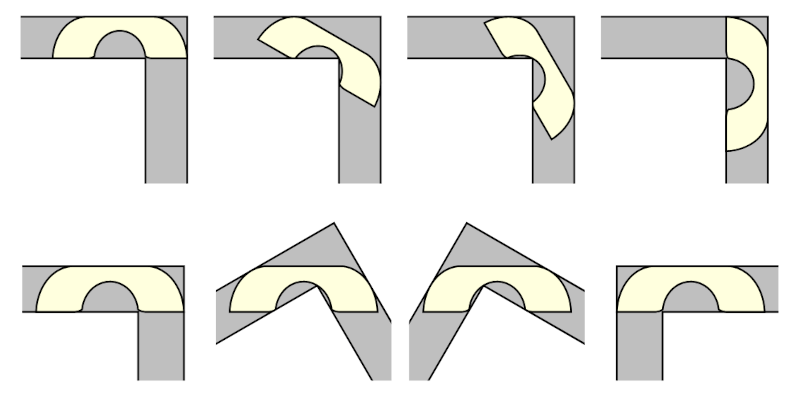
In 1966, a mathematician named [Leo Moser] proposed what sounds like a simple problem: What’s the largest shape you can move through a 1-meter corridor with a right-angle corner? Now, Korean mathematics whiz [Baek Jin-eon] claims to have solved the problem, nearly 60 years later.
The trick is, apparently, the shape of the sofa. By 1968, [John Hammerley] introduced a shape that did better than a rectangle, and by 1992, [Joseph Gerver] proposed something shaped like a phone handset, which remains the largest anyone had found, at 2.2195 square meters.
Of course, these are mathematicians, so it isn’t solved without a proof. That’s what [Baek Jin-eon] claims to have done: proof that the [Gerver] shape is the largest possible.
We won’t pretend to understand the math in the paper, but maybe you will. In all fairness, [Baek] worked on it for seven years. We assume deflating an air sofa and then reinflating it on the other side of the bend would be considered cheating.
We love applying math to seemingly everyday problems. Like, for instance, just how fast is the post office’s eagle? Or even math of a more practical nature.












I would simply materialize a door halfway through the hallway to move a much larger sofa.
Where was Professor Chronotis when I was moving house last year?
He was busy making a hardcore turbocharged Daewoo Lanos.
Pivot!
What did you mean when you said pivot?
https://www.youtube.com/watch?v=L_PWbnHABsM
PIVOT! PIVOT! PIVOT!
How high is the ceiling?
I wonder… if it’s a tall enough ceiling; just flip the item on the side, and that larger out of shape object will fit into the smallest square hole like all the other shapes.
We need a link to that old meme of the girl watching the ‘the shape goes into the square hole’
It is assumed to be the exact height of the object being moved so that you can’t turn it sideways, and the problem remains two-dimensional.
Ha, exactly my first thought. I moonlighted as a furniture mover a little bit in my youth. A 2-dimensional solution to this problem is a great example of an academic being so lost in theory that they are blind to the pragmatic solutions already employed in the field. But of course this math problem isn’t actually about moving couches, and it does have value somewhere.
There has been much published about “Moving Sofa Problem”.
But, congrats to Baek Jin-eon on his massive proof.
My last move was 30 years ago and the redneck movers simply used a crow bar to remove the door frame.
Modular furniture may make a comeback.
The most challenging task I’ve ever participated in as an active (albeit only partially useful) member was getting full-sized upright piano (the ones most widespread in the US are really 2/3 uprights, shorter and lighter) down and then up flight of stairs in the USSR five-story flats. Surprisingly, it makes through with mostly no problems save for scratches and bangs it receives, and even getting through the teeny-tiny entrances was fine.
Exceptions exist though, had these been their older variants built in the 1950s, tough luck, they are smaller than that – and their entrance doors were surprisingly out of whack, only the narrow sofa kinds can slip in and out without disassembly. As far as the traveling pianos go … I haven’t seen any pianos in those kinds, and I suspect the usual way of getting them there was by hoisting through the living room’s balcony door.
Which brings my other point – things should be made easily dis-assembled for this exact scenario. IKEA furniture, here’s prime example of flat pack fitting through pretty much any door/corridor, even the old 4/5 stories USSR flats (earlier flats had 4 stories, not 5, and they were proportionally lower, too – the reason why had nothing to do with the sofas, and a lot to do with the fire escape ladders that couldn’t reach higher than that).
That was the fourth paragraph in my ramblings.
IKEA had the right idea, and what’s weird that it simply did what the US used to do in the 1950s and 1960s, simple, elegant and inexpensive things that just work.
Theoretically the only important part of any piano is the deck with the strings. Hammers and all, too are dis-connectable from the keys, so with enough time one can probably remove the protruding keyboard with the keys, thus, making it much flatter. Putting it all back together, however, is usually done by the piano tuners. It is not a simple plug-and-play, because each key … I’ll leave this part as the exercise for the reader.
Spoiler alert – we’ve looked at such thing before and came to the sane and quite logical conclusion that some things should be left to experts to figure out. I don’t suppose there ever was invention making this part easier, maybe slightly simpler, but certainly not easier.
Exceptions exist, I am quite sure, though, in all likeness nothing within the average Sam’s budget. Given that the last used piano we’ve acquired was $300 plus around $200 in restoration fees and parts, the budget such task just would make no sense. It is simpler to just buy another piano and leave the last one where it was for the others to figure out.
Regardless, if one has deep pockets (I sure don’t) proper restoration/rebuild for a good piano deck (where it is essentially a new piano altogether) is around $5K, $10K if it needs to be flightly fancy. The best part? They are including the S&H in the price. I’ve checked multiple places in the vicinity (not many left, though), and that would take care of many items in one go, including figuring out the corridors and doorways navigation.
I really wish there were more furniture makes making thing like LoveSac because they seem way overpriced. However, I do really like how super modular they make everything and they seem super easy to modify a little to add neat extras (like wiring in custom electronics).
Again though the price they charge is outlandish.
I spot a golden business opportunity presently wasted giving LoveSac the monopoly.
Empirical proof seems much simpler? If the sofa would start out as a rectangle and was mode of something like Pur foam, the walls would shape the sofa form that remained after moving through the corner.
That particular approach would not control the proportion of material removed from each of the long sides.
What if the walls were made of Boron-Nitridium ceramic? Then it would be good enough to use even with aluminium sofa mockup.
A friend moving a piano into a new house materialized a chainsaw to assist in making the wall accommodate the piano shape. I thought it was an elegant solution.
That’s the opposite of the approach here. Instead of shaving off the parts of the piano that interfere with the walls, your friend carved out the parts of the walls that interfered with the piano.
Exactly. Thinking outside the box. Kobayashi Maru level stuff.
IOW: cheating! srsly, were the walls repaired? Even if the walls were left in chainsawed shape, I imagine there was at least some cosmetic repairs needed, which may indeed have been cheaper/easier than repairing a piano. Very clever, but “elegant”? -not so much. Although I congratulate you for a non-ethnic reference, because nearly every working class ethnic group likes to claim ownership of such solutions, from red neck to Chicano, Samoan, Polish… it’s often made into a matter of ethnic pride, which is fine I guess, until you’ve heard it the umpteenth time. Personally I find a Trekkie reference preferable.
Older house, new to them. They planned to enlarge that doorway anyway. I thought they picked a particularly stylish and expedient method to do it.
A doorway?
So he cut the supports for the header over the opening?
Smart or lucky?
Decades ago, was bragging about getting away with some dangerous shortcut.
‘You’ve got decades of dumbass shit like that to do, before you should call it a success!’
No doubt a rental.
Just cover the holes w toothpaste.
Works, until he finds a bearing wall.
The utter chutzpah of doing this to a rental made me laugh
You may laugh but this can also be used to design novel, more energy-efficient car engines with 90° V cylinders.
What are you going to cut away.
Cylinder head, headers, turbos or suspension?
In fact, already done, every time someone stuffs a V8 into a car perfect for it (e.g. 57 Fiat 500).
Combustion engines? Really? Real men stick with steam power! Why? Because it uses coal like the grand emperor envisions.
Got a full upright piano thru a narrow doorway by taking the action and keybed off leaving the side protrusions to be worked in, shaped like the “telephone” shape above. All screwed back together nothing to break off.