
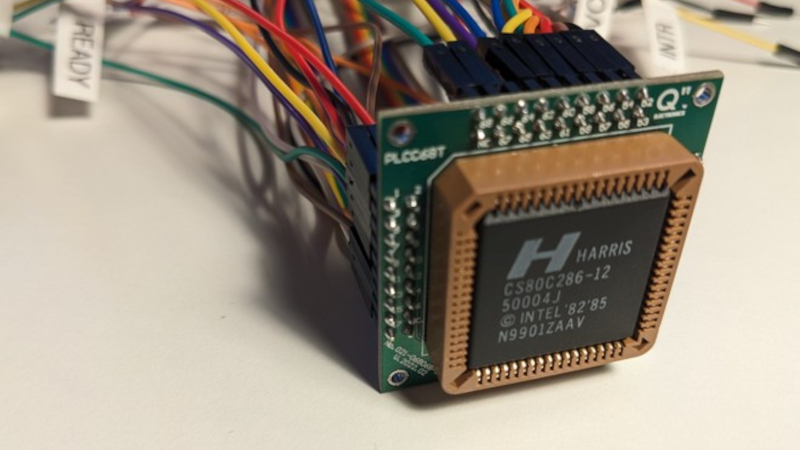
[Nagy Krisztián] had an Intel 286 CPU, only… There was no motherboard to install it in. Perhaps not wanting the processor to be lonely, [Nagy] built a simulated system to bring the chip back to life.
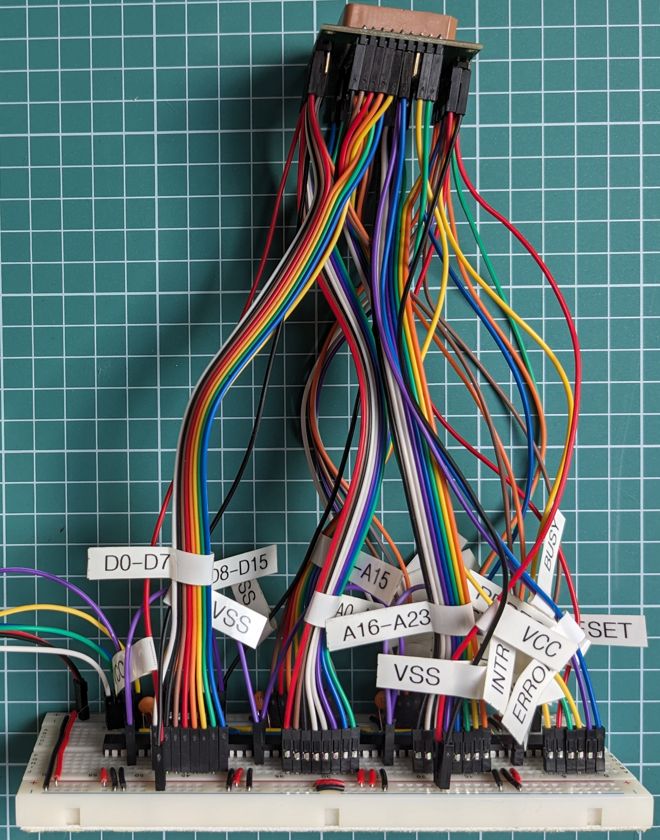
The concept is simple enough. [Nagy] merely intended to wire the 286 up to a Raspberry Pi Pico that could emulate other parts of a computer that it would normally expect to talk to. This isn’t so hard with an ancient CPU like the 286, which has just 68 pins compared to the 1000+ pins on modern CPUs. All it took was a PLCC-68 socket, an adapter PCB, a breadboard, and some MCP23s17 logic expanders to give the diminutive microcontroller enough I/O. With a bit of work, [Nagy] was able to get the Pi Pico running the 286, allowing it to execute a simple program that retrieves numbers from “memory” and writes them back in turn.
Notably, this setup won’t run the 286 at its full clock speed of 12 MHz, and it’s a long way off from doing anything complex like talking to peripherals or booting an OS. Still, it’s neat to see the old metal live again, even if it’s just rattling through a few simple machine instructions that don’t mean a whole lot. [Nagy] equates this project to The Matrix; you might also think of it as a brain in a jar. The 286 is not in a real computer; it’s just hooked up to a microcontroller stimulating its various pins in a way that is indistinguishable from its own perspective.
We’ve seen similar retro projects before, such as this FPGA rig that helped a NEC V20 get back on its feet. If you’re doing your own tinkering on the platforms of yesteryear, we probably want to know about it on the tips line.












This makes me happy. My first job out of college was in the integration lab for a prototype Doppler shift weather radar system. It had something like twenty-six 286s in something like early parallel processing. Good times.
Re: the matrix connection. Supposedly early versions of the script said the AI was putting people in the matrix to use their spare neurons as CPU power to run the AIs. (as opposed to the dumbed-down story that made the final script, where people were farmed for electricity. This project is more similar to the original idea.
At this point it feels more like the 286 is an extremely underpowered coprocessor for the RPi.
For a similar project using an Arduino Giga:
https://hackaday.com/2025/07/24/comprehensive-test-set-released-for-the-intel-80286/
The other plausible story I have seen is that, since The Matrix really is a kung fu movie in modern drag, the “energy” that was being tapped was chi, spirit energy/life force, which most humans cannot consciously exercise and which some kung fu practitioners, in that mythos, can access in entirely unreasonable amounts. Presumably the machines, not being alive, could not access this without human mediation.
That would make it a translation/familiarity problem rather than a plot problem.
I’m not sure I buy it, but it makes more sense then “batteries”.
Did a similar thing with a 6502, https://github.com/dmateos/420-6502
On the same theme, I have a ZX Spectrum Next – it’s an FPGA-based recreation-evolution of the classic 1980s home computer. A mighty 2-28MHz clock speed, 2MB of RAM… and a Raspberry Pi Zero as a co-processor/accelerator. First computer I’ve had in 40+ years where the accelerator board is orders of magnitude faster & more capable – and yet considerably cheaper! than the host computer.
The above was meant to be a reply to [Fluffy]’s comment. I don’t know what happened. Apologies for the seeming non-sequitur.