
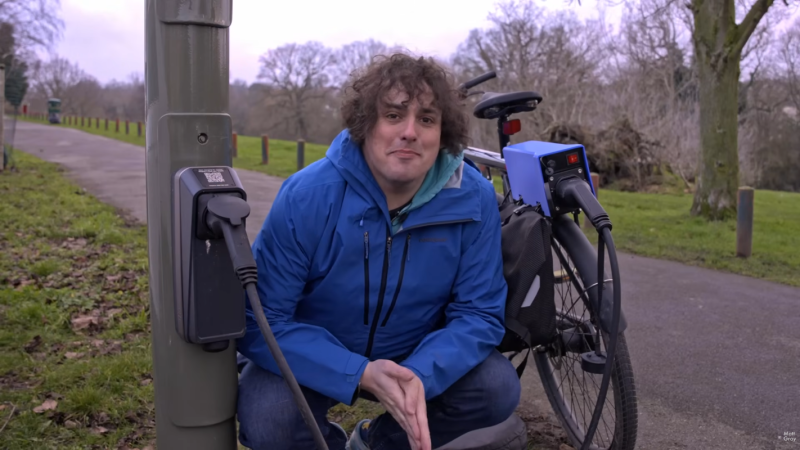
Electric vehicles are everywhere these days, and with them comes along a whole slew of charging infrastructure. The fastest of these are high-power machines that can deliver enough energy to charge a car in well under an hour, but there are plenty of slower chargers available that take much longer. These don’t tend to require any specialized equipment which makes them easier to install in homes and other places where there isn’t as much power available. In fact, these chargers generally amount to fancy extension cords, and [Matt Gray] realized he could use these to do other things like charge his electric bicycle.
To begin the build, [Matt] started with an electric car charging socket and designed a housing for it with CAD software. The housing also holds the actual battery charger for his VanMoof bicycle, connected internally directly to the car charging socket. These lower powered chargers don’t require any communication from the vehicle either, which simplifies the process considerably. They do still need to be turned on via a smartphone app so the energy can be metered and billed, but with all that out of the way [Matt] was able to take his test rig out to a lamppost charger and boil a kettle of water.
After the kettle experiment, he worked on miniaturizing his project so it fits more conveniently inside the 3D-printed enclosure on the rear rack of his bicycle. The only real inconvenience of this project, though, is that since these chargers are meant for passenger vehicles they’re a bit bulky for smaller vehicles like e-bikes. But this will greatly expand [Matt]’s ability to use his ebike for longer trips, and car charging infrastructure like this has started being used in all kinds of other novel ways as well.












I’m actually surprised this isn’t a commercial product
Type 2 male plug with the right resistors to signal single phase charging on the lowest current setting with a lead connected to it that terminates in a C13 or C5 connector
No need for the setup on the bike rack, just take the normal charger along but with the “on-the-go”-plug
https://amzn.eu/d/01OtZwae
It is
And much lighter to carry around than the thick charging cable.
How can you use this without a UL listing?
How can you breathe air without a permit?
I baited the baitest click with youtube clickbait.
I know we like DIY solutions here, but when you can just buy a simple adapter to plug your normal mains device (e.g. ebike charger) in to, this isn’t really a problem that needs fixing (especially not in a more complicated way).
https://www.aliexpress.com/item/1005007880180811.html
Right? I skim right past ‘I just solved the biggest problem with x’ videos. Usually accompanied by someone looking absolutely astounded and pointing at said thing in the thumbnail. Second only ‘some-org hates (or doesn’t want you to know) this’ videos.
Owners of vehicles that charge from a household socket often buy an adapter that takes a Type 2 charge point and adapts it to a household socket. That’s far simpler but gives up the water resistance during use of Type 2.
I would have loved to have one when I first rented an e-cargo bike for a week and the dealer gave me a near-flat battery. There was an EV charge point on my way home, maybe it has a 3 pin plug? Nope! Only the alien-looking Type 2.
Those adapters cost 25eur on Aliexpress.
I want to try eBikePacking with a map of charging stations, the only remaining problem is paiement systems.
Bosch also sells a faster charger.
Seems the biggest problem is no or not enough EV charge points with standard outlets.
Absolutely, and regulators should make this a requirement, because standard sockets and the corresponding energy consumption are not economically attractive for charging station operators, but bicycles and small electric vehicles are an important part of sustainable transportation.
I’ll just leave this here
https://youtu.be/BnzN3zDKFE
Unavailable
USB PD would work as well, it’s said that 240v charging doesn’t help that much for ebike sized batteries vs a wall plug.
Also have to consider overpriced charging.
https://dyza.co.uk/password
I think that URL dyza .co .uk / password has the worlds first usb-c ebike charger, made by another YouTuber.
I saw one of these in a video where a guy powered an EV (GeeWizz) with salvaged Vape batteries. He used this to charge the bank.
It never ceases to amaze me how personally some people in these comments will take any little project…