
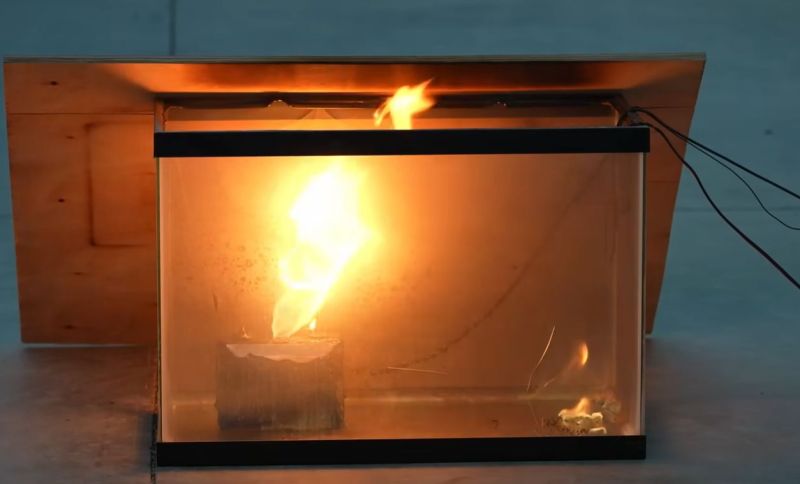
As great as batteries are, it’s essential to understand their risks and how to keep them from going spicy. Recently there has been a bit of a fuss about the dangers of LiFePO4 (LFP) batteries after someone’s dedicated LFP battery shed got shredded into matchsticks by a hydrogen explosion, following said LFP batteries having a thermal event. The thing about the LFP chemistry is that if it suffers such a thermal event, it generates hydrogen gas, which is one of the most explosion-happy gases known to man. This is demonstrated in a recent video by [Will Prowse].
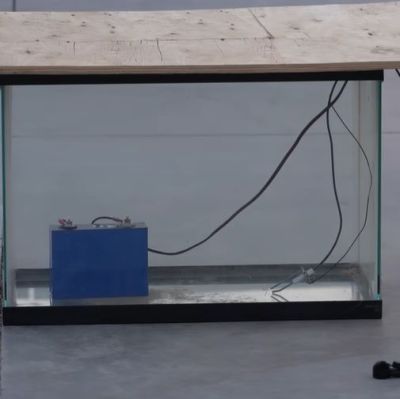
To kick things off, a single prismatic LFP cell is overcharged for half an hour after it was already at 100% state of charge. This ultimately pops the vent as the cell begins to release hydrogen gas into the aquarium that the cell was placed in. Using a spark generator it’s then attempted to ignite the gas, which initially takes a bit as enough hydrogen has to collect first.
Once there’s ignition, however, it happily keeps burning as more and more hydrogen pours out of the by now bulging cell’s vent. If any other LFP cells had been nearby these too would be at risk of suffering thermal runaway, showing how just one bad LFP cell is enough to potentially set an LFP battery bank ablaze.
In a commercial setting you will have precautions such as hydrogen sensors, ventilation and spark generators to deal with any generated hydrogen gas, as well as blow-out panels in case things end up going squirrely in a hurry.
While a benefit of LFP chemistry is that it does not generate its own oxygen as with other lithium-ion chemistries, hydrogen gas is a major problem due to how incredibly volatile it is. It’s not just a headache with battery storage, but also in the nuclear power sector, where zirconium fuel rod cladding can very efficiently turn steam into hydrogen and oxygen. This was the reason why some of Fukushima Daiichi’s buildings suffered detonations, with the nuclear plant operator opting to not install recommended hydrogen gas mitigation systems.












Sorry, but this does NOT look like a hydrogen explosion. Hydrogen would not burn yellow, and much more violent.
Instead i think, this is electrolyte vapor combusting.
There’s an important distinction here: this isn’t a pure hydrogen event. What you’re seeing is hydrogen‑laden fumes. The hydrocarbons used as electrolyte carriers boil, crack, and vaporize under abuse. Those vapors can ignite, and they burn dirty.
A true hydrogen explosion is far more energetic. It produces no soot, and it would have launched that board across the room and blown the aquarium glass outward. You can see the difference clearly in demonstrations using soap bubbles from electrolysis versus soap bubbles filled with acetylene.
In the video Will Prowse mentions, “StacheD”. Stached did a video recently that references a California fire call involving LiFePO₄ batteries and claims the batteries “blew up a sealed brick building.” But when you actually look at the photos, the outward blast pattern comes from a toolbox that exploded—not the batteries. The more likely sequence is: a fire started, the toolbox went, and the batteries later burned as secondary fuel.
In that same video, StacheD claims the property owner was hospitalized with inhalation injuries. But the fire department’s own report—submitted with the incident—states no injuries. Hazmat was called simply because any fire involving a battery triggers a hazmat response by default.
With all the built‑in protections and fail‑safe design, LiFePO₄ batteries are extremely difficult to force into a dangerous failure mode, and when they do fail, the result is mild compared to typical lithium‑ion chemistries used in cars and phones.
Will’s overcharge test on a bare cell required bypassing the BMS entirely—something that would never happen in a real system. Not really a likely scenario unless your purposely trying to get a dramatic pyrotechnic show as done.
I call BS, (bad science). I have personally cycle tested many BMS circuits in commercial products with LiFePO batteries, and about 70% of the time the BMS fails to treat the cells properly to within the specifications of the cells voltage limits. I have also investigated many fires involving these types of cells, and they do cause fires.
That’s largely because LFP batteries have lower energy density than the typical lithium-ion chemistries. They burn more like older generation Li-Ion cells at similar energy densities, rather than the modern ones with twice or thrice the energy that go up like road flares on steroids.
When you increase the energy density of a battery, the failure modes inevitably become more violent because the system becomes more reactive with itself.
Not so fast: a battery that is shorted to itself can easily cause some cells to dump their charge into others, leading to the same situation.
Oxygen plus two parts hydrogen well mixed is truly scary in the speed and power of the explosion (can easily kill if ignited inside a sealed container). But 78% Nitrogen, ~1% Argon, ~21% Oxygen and a tiny trickle of hydrogen not well mixed burns. As a very small kid I use to play with hydrogen a lot, and you learn a thing or two (as long as you do not screw up).
Why is the flame yellow and not blue?
Insufficient oxygen for complete combustion so a sooty yellow flame
So it reacts with what? Nitrogen? CO2?
Hydrocarbons have incomplete combustion. Hydrogen either oxidizes to make H₂O or doesn’t.
Hydrogen does not work that way. No carbon no soot.
…and where do the Hydrogen come from in the first place?
As far as I know there is no Hydrogen involved in the LiFePO4 reaction from either of the two electrodes, or the electrolyte…
The hydrogen is produced as the solvent in the battery is breaking down due to the heat. The solvents used to suspend the lithium are all hydrocarbons containing anywhere between 4 and 10 hydrogen atoms in each molecule.
Electrolysis of the water in the aqueous electrolyte
Same reason lead acid batteries start producing hydrogen on overcharge
There’s no water in LFP.
https://pmc.ncbi.nlm.nih.gov/articles/PMC7078597/
Ideally yes. They all leak, eventually, and the cathode is hygroscopic up to a couple hundred ppm and that much water will break down the cathode and eventually you end up with a fire.
Probably a good battery tech for arid dry areas, probably not the best tech in a rain forest.
Kind of like how ideally steel does not have water but in real life all steel eventually corrodes when it sucks water right out of the air.
Lead acid are far worse they produce hydrogen and oxygen.
I know someone who was knocked out when part of the plastic case shot at their head. The well mixed oxygen hydrogen when ignited instantly forms steam, so imagine what kind of pressure on any container is generated with a stoichiometric detonation velocity 2,800 to 3,000 meters per second.
Because it isn’t just hydrogen in the tank. By the appearance, it is mostly other stuff. That is to say, the hydrocarbons from the solvents in the battery. There might be some hydrogen, but from the look of it there’s a lot more of the other stuff.
So, abused with max overcharge for 30 minutes
No bms, sealed space, and intentional spark ignition
Real world potential in well designed setup? 0%
NMC real world thermal ignition risk on abusive ev use? 100%
Sorry guys, but all batteries have thermal events at max charge, the question is how violent do the get naturally
Lfp can’t self ignite, you have to force the clearly hydrocarbon electrolyte to ignite externally, with a HOT REPEATING spark and the PERFECT ratio
If that was h2 it would be nearly colorless, and would NOT collect in an open topped tank
Conclusion: OP is wrong about literally everything said
Not only that, but he applied 24V to a presumably “12V” battery pack – if it was “24V” it would hold around 27V at 100% SOC and no charging would happen.
All professional larger LFP installations (above 50-200kWh depending on country) have hydrogen/smoke detection and ventilation fans to detect cell failure and remove the gas, preventing explosion. Also they are segmented so fire in one 15kWh module will not spread to the other modules in the rack. Failures are extremely rare, but it does happen.
Would be ironic if a spark from the ventilation fans starting up ignited the gas they were designed to ventilate!
Better with no brushes.
Yes it can. It just does it at a higher temperature.
This. He seems mystified that flooding a closed chamber with combustible something and putting in a spark won’t immediately ignite it in the absence of an oxygen (oxidizer) source.
Worth noting also that it was a single cell overcharged at 24V, with nominal charge voltage being only 3.6V. It’s still a condition that can happen when a series string fails in weird ways.
Keep in mind that good old lead-acid is very notorious for outputting hydrogen during overcharge.
Flooded lead acid batteries release some hydrogen during normal operation too. You should never make or break a connection at the battery terminals. The spark can cause the battery to explode in your face.
I think it’s entertaining that the problem with getting it to burn wasn’t not enough hydrogen in the tank, it was not enough oxygen getting in. Makes me think about the attempts to shoot down Zeppelins during WW I… the bullets just went right through them with no explosion. It wasn’t until they were sufficiently holed and air could get into the envelopes that they’d finally catch fire and come down.
I am mostly surprised about the aquarium not falling apart, that’s some serious heat and yet the glass did not seem to break. Regarding the video, I’m not surprised either, anything can break and might end up in flames, yet I’m glad I now have seen it in a video, so I have an idea of what to expect and under what conditions. I feel I learned something today. Thanks for posting this.
This is like finding that a tank of petrol (gas) will catch fire if you drill holes in it while leaving a burning candle under it. Well duh..
How irresponsible to give coverage to a click-bait video.
They don’t care if they cause a “moral panic” over something as long as it lines their pockets.
There is no threat here, This is just sensationalized nonsense, and HaD should be ashamed for featuring it instead of directly speaking out against it.
We don’t need any more damage done to battery tech in the eyes of the public.
LiFePO4 batteries don’t need this kind of slander. They are so much safer than Lithium Polymer batteries and we SHOULD be using them when the job allows. (Sodium batteries too, but for environmental and economic reasons.)
OF COURSE something can be intentionally weaponized…
In other news, Iron can be used in such a way that it will cause brutal holes in your skin and cause your blood to leak out. Oh NO! Panic!
Shame on you HaD.
Please let me stress the fact, that zirconium does not produce hydrogen and oxygen when in contact with water vapor, but hydrogen and zirconium dioxide:
Zr + 2 H2O → ZrO2 + 2 H2
This fact might be of importance, when comparing (the footage of) the explosions at the Fukushima Daiichi plants: One building pops like a box of cardboard – while the explosion of (IIRC) plant #3 rather resembles the vertical shot of a cannon.
“Two and two are four. Sometimes, Winston. Sometimes they are five. Sometimes they are three. Sometimes they are all of them at once. You must try harder.”