
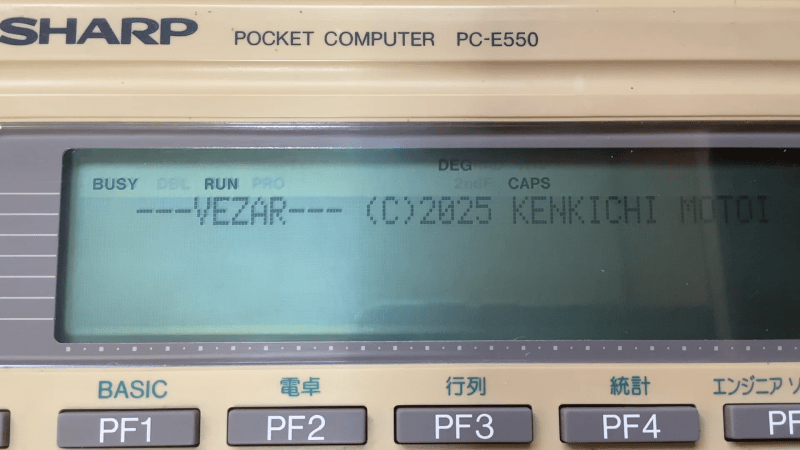
Pocket computers like Sharp’s 8-bit computing marvels were a big part of the 1980s, providing super-portable processing power to anyone who wanted a bit more than what something like a scientific calculator could provide at the time. These days they are mostly just a collector’s item for retrocomputing enthusiasts, which also means that a lot of the knowledge about how to program the CPUs in them is at risk of being lost.
This is why [gikonekos] decided to combine as much knowledge they can glean from official documentation into a reference project on GitHub for the SC62015 equipped Sharp pocket computers like the PC-E550.
Generally you’d program in Sharp’s dialect of BASIC on these computers, such as the ‘PLAY3’ program that [gikonekos] recently unearthed from a November 1993 copy of ‘Pocket Computer Journal’ using which you can create polyphonic tunes. This only unlocks a small part of what the hardware can do, of course, so having a full opcode reference like this is important.
While still a work in progress, it’ll eventually contain the full opcode and register tables, addressing modes, instruction summaries and of course a full accounting of how all of this was reconstructed. As the original Sharp documentation wasn’t released to the public, providing these scans is also not a goal, especially not under any kind of free license.
A cursory search reveals an instruction table for the PC-E500 from 1995 by [Andrew Woods], so documenting this is not a new thing, although at the time these Sharp pocket PCs didn’t count as ‘retro systems’ yet.











Timely post. I’ve been looking at my Sharp EL-5500II that I bought new in college and thinking about what I can do to hack it. There’s no peek/poke/call keywords in its BASIC, so I’m not sure how I’ll get in, but this might be useful.
Very interesting! I dug into the ESR-L CPU last year as it’s also used in Sharp’s organisers of the period and I wanted to see if I could enable the 40-column mode on larger-screen organisers from the 16-column BASIC card I owned. As part of this I wrote a very bad Ghidra specification for the ESR-L based on some and though the decompilation is a mess the disassembly was good enough to let me poke around in the organiser’s ROM a bit. The website link above should take you to the blog post I wrote on this with the links to ESR-L documentation I found (and my very bad Ghidra bodge job)!
Thanks, this is very interesting.
I also came across an old SHARP pocket computer disassembler page that might be relevant:
http://www.kt.rim.or.jp/~tmizuno/pocket/library/sharp01.html
It may not directly help with the ESR-L, but I thought it might still be of interest.