
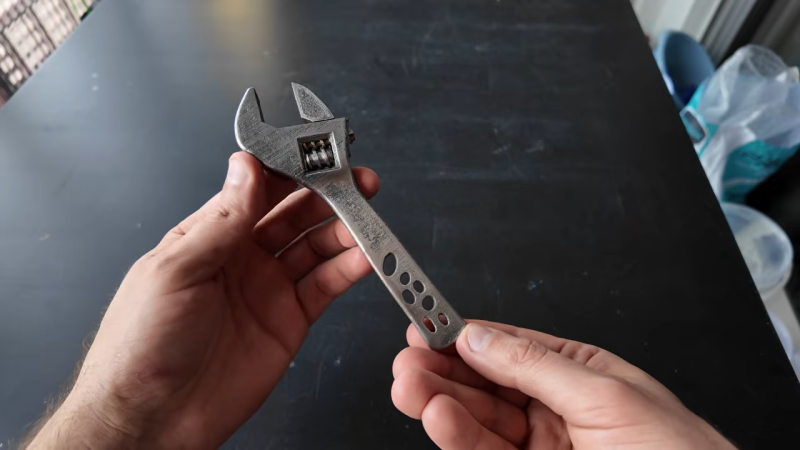
Consumer-grade 3D printing is good for prototyping and making relatively soft plastic stuff. If you wanna make tough things, though, it’s really hard to beat the strength of metal. [Shake the Future] has produced a guide on using 3D printing in a process to produce solid parts out of actual cast iron.
The concept is simple. [Shake the Future] uses silicon carbide crucibles, which can heat up by absorbing microwave energy. Put one in an insulated container, dump some metal in, and throw it in a microwave, and soon enough you have a pot of molten metal you can use to cast stuff.
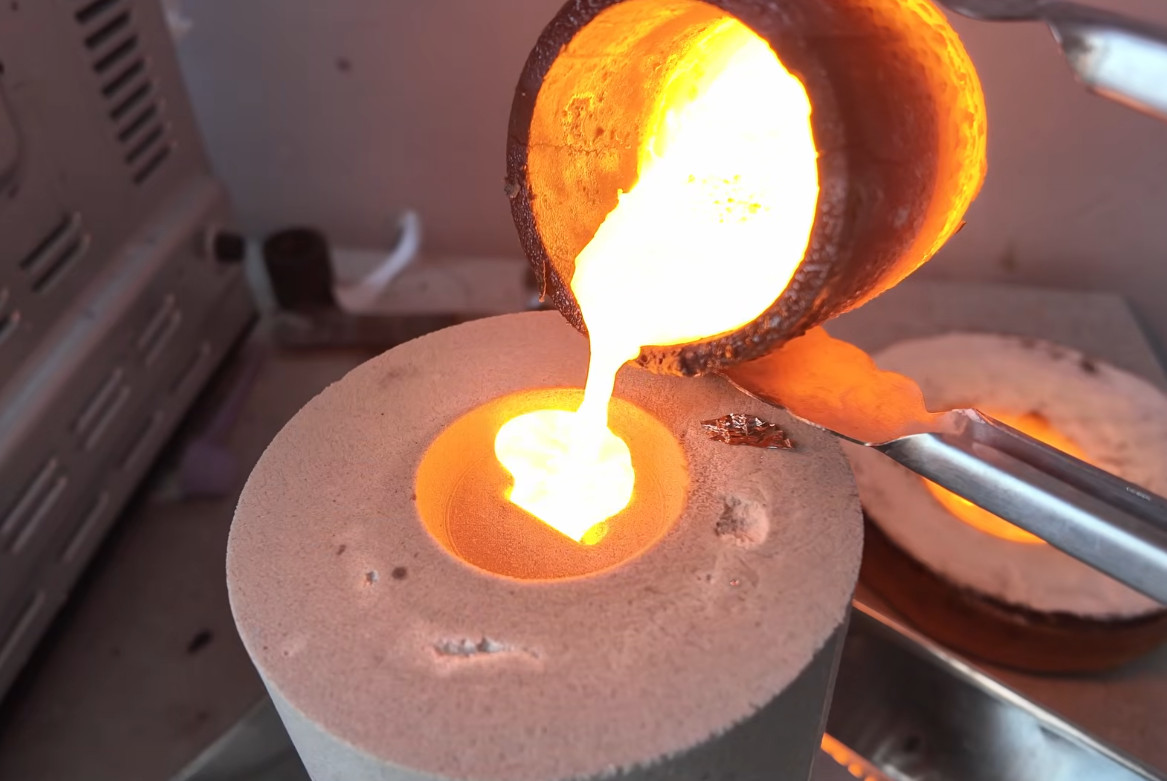 Let’s say you want to make an adjustable wrench, which is how [Shake the Future] demonstrates this technique. The first step is to print the wrench parts in plastic, such as PLA. These parts are then packed into fine sand to create casting molds. The PLA is burned out of the mold, leaving a negative imprint of the geometry. Molten cast iron can then be poured into the mold to create the part in solid metal.
It’s a messy technique that requires a lot of manual labor, but it does work quite well. There are some tricks to learn, though, particularly when it comes to successfully casting parts with holes or fine geometric features.
And before you think that you’re going to put the hardware store out of business, it should also be noted that it failed on first encounter with a real-world nut. The thinnest part by the screw just wasn’t strong enough.
Still, it’s a great demo, and if you’ve ever wanted to make a bespoke cast iron part of your own, this work may be very relevant to you. Alternatively, consider learning about DIY aluminium casting—just consider the pitfalls involved.












This is the type of maker youtuber we need. It feels like too many are doing it full time, high budget americans with a big workshop and tons of tools. And then there´s this guy, sitting on his balcony in Slovakia(?) doing big time metallurgy with his microwave.
‘Big time’??
A home foundry is half assed at best.
There are many tasks best outsourced, casting, heat treatment, plating, production of damn near anything in quantity, stripping at your friends bachelor party…
(Quality digression that!..I apologize for the mental image of naked nerd jumping out of cake.)
Anyhow:
Mastering each is a life’s work.
That’s true for many things, but the above tasks are dangerous, potentially toxic and dirty.
If you take them on, they will absorb all your time.
Leaving you no time to troll hackaday.
Industrial production is not the end-all-be-all of manufacturing. Cottage industries were viable for the majority of human history and are still viable today.
Go ahead and strip at the party, but don’t bitch at me when your tips are short.
I would like to know how he avoided the plasma from microwaving iron… (fan of Is It A Good Idea To Microwave This?). Maybe smooth down the edges of the chunks (so they don’t act as antennas), maybe ground the crucible somehow?
I had a bag of microwave popcorn that somehow made plasma in my microwave… must’ve been a little fleck of metal on the bag.
I understand the susceptor material (silicone carbide) absorbs the majority of the RF (microwave) energy and radiates the heat and the metal such as iron, steel, etc. absorbs that form of heat.
I think its a bit irresponsible, casting metal can and will cause big dangerous accidents.
I personally wouldn’t want that in an apartment block with potentially hundreds of victims over what would be a “dammit!” Moment if done on the ground
If 200ml of molten metal (at most) could create hundreds of victims, I would not like to live in that apartment block with or without someone melting metal anyway.
What you think he is melting? Plutonium?
Additionally, he is melting iron. While quite hot its much safer than aluminum as it doesnt flow nearly as well, and solidifies much quicker. His neighbor frying food in their kitchen next door is a much greater risk to everyones safety then he is.
This is an exercise in stupidity in my opinion..the grain strength is abysmal in the cast part…the saving grace is the unique method of melting the cast iron which is way different than the way it’s usually done..these parts are usually forged in the real world and for good reason..
One of my neighbors loved “Forged in Fire” well, when he tried out forging the first time using a burn barrel in his back yard he ended up burning down 4 hoses and doing a total of more than $5 million in damage to the neighborhood.
It’s no more dangerous than backing your car out of the driveway, if done right. And, I’m sure, there were a couple fire extinguishers and a bucket or two of water around, y’know, just in case.
Why would the microwave be standing on end? Wouldn’t you want the carousel for more even heating?
I concur. The hidden gem is not so much the kitchen-table iron casting, but his fabrication of the silicon carbide crucibles from the ceramic powders. Note that he alluded to other videos where he builds them from more advanced ceramics such as boron carbide, and alternatives such as alumina (aluminum oxide).
All those ceramics are essential components for building ballistic armor. Being able to sinter those ceramics and form them into complex shapes gives him the capability to craft his own body armor plates that could easily meet NIJ Level III and IV standards for stopping multi-hits from rifle and AP rifle cartridges.
Pulling that off in a tiny apartment is impressive.
Cast iron wrench, too brittle… :-(
Worked fine for decrypting files and unlocking Crypto wallets.
You must have been holding it wrong.
Careful Boeing has a way of dealing with anything in the path of it making money
He needs to figure out a microwave annealing oven next, I guess.
worth a try. i was thinking about combining multiple crucibles from separate runs for a larger pour. would he make a scaled up microwave case from steel sheet and fit the magnetron and psu inside. that way it could keep the metal at the right temp, without being powerful enough to melt iron on its own.
What’s the annealing temperature? Maybe dip the cast-iron tool into a second crucible filled with molten aluminum?
Off to finally cast my own jet engine!!
Lol thats funny 😁😂😀 50,000 parts later and tons of manual labor like the author states. 15 years later…. we will here from you when the prototype is ready lololllllll
Pulsejets are jets.
No casting required though.
Just learn to cut spring steel w a battery charger, salt water and some etching primer.
Make the reed valve, you’ll be disturbing the peace in no time.
Well there are micro jet engines running in RC planes with on 20 parts either commercially available or made in people’s garages. You can have a go and make your own KJ66. Though cast iron is not used, they use Inconnel for the turbine , a Garret aluminium turbo compressor wheel for the front-end and an old butane container for the outside case. The combustion chamber is rolled inconnel spot welded using the transformer from a junked microwave.
Now, what about injection molded kits…burn the plastic out of the old 1/650 AMT model of the USS Enterprise (The Original Series)–preferably the glow-in-the-dark kits…softer plastic.
Now you have a metal kit you can grind into shape, melt resin aftermarket fixes.
Then perhaps mold a corrected parts tree with sprue.
It takes a lot of pressure to fill thin wall structures like those found in model kits. Certainly not something you can sand cast and direct pour. It would require extensive gating, ventlines, investment casting, and centrifugal casting.
How thin? I cast a wedding ring in silver and the band was less than 1/16″. Also fine details and 3d print layer lines even showed up. Gating and vent lines took less time to make than it took to type this.
The plastic walls of a typical 1/24 or 1/25 scale plastic model car kit (styrene) generally measure between 0.020 and 0.040 inches (roughly 0.5mm to 1mm) in thickness. Quite a bit thinner than your wedding ring. Metal flowing into these thin channels solidifies faster than it can fill unless it is being introduced with significant pressure. Die casting Zinc alloy toy cars typically requires 15-30KPsi to fill the molds.
Could temper it at around 900°C for several hours, but that would be a LOT of microwaving!
I wonder if case hardening might not be a better method to harden the wrench? It’s a carbon-infusing technique that turns cast iron into a mild steel. It’d take a process I don’t know how to design for a microwave. A microwave kiln, some powdered graphite, and some clay might work. Mic the graphite with the clay, then encase the wrench in it, perhaps adding extra graphite at the jaws and thin spot where it broke, and cover it with the graphite-infused clay. Microwave it long enough to get the wrench really hot in the clay casing, then let it slowly cool. Then break away the clay. That might strengthen it.
Print out a PLASTIC piece to burn out of the mold?? Boy not only is that a toxic nasty thing to do to yourself, but how about eco wize here? Is that something to promote? This was formerly know as the lost wax casting as WAX was melted out not plastic. You can also make a 2 part mold and not be melting out plastic that releases more toxic crap to take a dump on mother earth for a hobby. It’s not something just anyone should be trying in there home with out the proper safety equipment and knowledge. Geezz go by a cheap wrench at harbor freight that’s gona be better anyway than something you cook in your microwave smh can’t believe this was a article
PLA degrades into CO2 and H2O
It does not produce toxic fumes, heavy metals, or dioxins, and it combusts with little to no remaining residue. No Toxic crap.
This wrench is proof of concept. I doubt he intended to never use this technique for anything but wrench production. Im sure he has many other ideas in mind moving forward.
PS Jewelry wax is rarely just melted out. A not insignificant portion is in fact BURNED out. Also, Many jewelers waxes contain plastic or synthetic resin additives to improve flexibility, reduce brittleness, prevent breakage, and allow for lower shrinkage compared to pure natural waxes. So their fumes can actually be WORSE than PLA.
this is why i only cast with canned biscut dough that has a healthy amount of human hair mixed in for stability
… there are wax based printing filaments designed for this very casting process.
No toxic fumes from burning plastics, far more efficient melt, fast turn around time, very easy patching, finishing, and customizing after the print.
https://machinablewax.com/wax-filament/
These products are not pure wax but rather are plasticized wax blends. Whats worse is the company you linked hides what plastics they use behind “proprietary blend” on their MSDS sheets so theres no telling what the composition of the offgassing during burnout.
In terms of 3D printing—check this out:
https://phys.org/news/2026-03-liquids-fracture-solids.html
This could be big for 3D printing.
New forms of carbon now:
https://phys.org/news/2026-03-ai-driven-framework-uncovers-carbon.html
https://phys.org/news/2026-03-nanodiamonds-carbon-materials-ai-exascale.html
https://phys.org/news/2026-03-laser-graphene-enables-molecule-thick.html